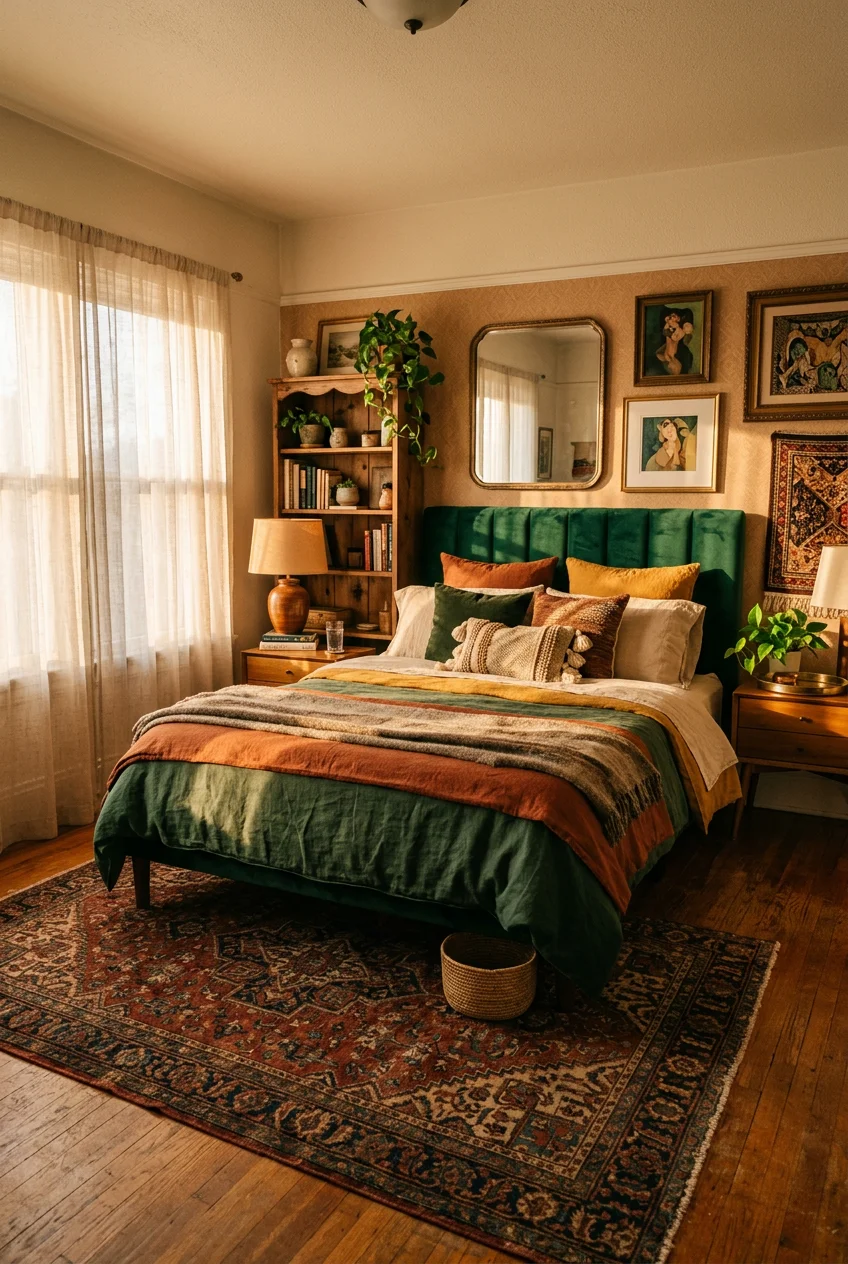
What’s Inside
- Mix Furniture Eras with Intention
- Curate a Dynamic Gallery Wall
- Layer Textiles for Richness and Comfort
- Embrace Global Accents Thoughtfully
- Hunt for Unique Vintage Treasures
- Anchor with a Statement Rug for Your Eclectic Bedroom Aesthetic
- Introduce Strategic Greenery
- Master the Art of Controlled Clutter
- Embrace Biophilic Eclecticism
- Define a Cohesive Color Thread
- Illuminate with Statement Lighting
- Avoid the Over-Matching Mistake
- Ground the Room with Darker Woods
- Use Unconventional Nightstands
- Blend Hardware Finishes on Furniture
- Soften the Lines with Curved Mirrors
- Build a Functional Reading Nook
- Layer Window Treatments for a True Eclectic Bedroom Aesthetic
- Keep the Bedding Base Neutral
My first attempt at an eclectic bedroom looked like a thrift store threw up on a mattress. I bought a heavy green velvet headboard, a rusted metal nightstand, and a neon pink sign, assuming the chaos would magically work. It didn’t. Instead of looking curated, my room felt like a holding cell for garage sale rejects. This style needs strict boundaries and editing, or you’ll just end up with a mess. I spent three years testing layouts, returning mismatched lamps, and figuring out how to balance modern pieces with vintage finds. Let’s break down how to mix eras, textures, and colors without losing your mind or your security deposit.
1. Mix Furniture Eras with Intention

You can’t just shove four decades of furniture into a room and hope for the best. The trick is balancing the visual weight. I pair a sleek, modern bed frame (I bought the Stella bed from Article for $999) with a much heavier vintage mid-century dresser. I found my walnut dresser on Etsy for $850, though you can find quality pieces ranging from $300 to $1500 on sites like 1stDibs. If you prefer taller storage, an antique armoire works beautifully. Brands like Sauder offer vintage-style pieces that give you that nostalgic look with modern drawer glides. I tried using an authentic 1920s dresser for months, but the wooden tracks stuck every time it rained—learned that the hard way. Mixing a new, functional bed with an older, character-rich storage piece ensures the room feels collected over time while still working for your daily routine. If the proportions are off, the room feels lopsided.
2. Curate a Dynamic Gallery Wall

A uniform grid of matching frames belongs in a corporate hallway, not here. You need an asymmetrical gallery wall featuring seven to nine distinct pieces to make the space feel personal. I mix cheap art prints from Society6 (usually around $20 for an 8×10) with personal photos and three-dimensional objects. Last Tuesday, I hung a small woven basket and a chipped vintage brass mirror right in the middle of my prints. The depth keeps the eye moving. You want to mix frame styles aggressively. Put a thick, ornate gold frame next to a thin, simple black modern one. The only rule is keeping a loose color palette. I stick to warm earth tones and faded blues across all my art to keep it from looking like a dorm room. Perfectly measured grids always feel too sterile for this style.
3. Layer Textiles for Richness and Comfort

Your bed needs to look like you could dive into it. Start with a neutral duvet cover. I use a washed linen option from Parachute Home that cost $250. Linen wrinkles naturally, adding a relaxed texture that stiff cotton lacks. Next, add a patterned throw. I drape a block-print throw from Saffron Marigold ($120) casually across the foot of the bed. Don’t fold it perfectly. Complete the look with two or three decorative pillows in textures like velvet or macrame. I grab $25 velvet Threshold pillows from Target because the covers are easy to wash. I used to buy cheap polyester throws to save money, but they trap heat and feel like scratchy plastic. Sticking to natural fibers like linen, cotton, and velvet makes the room feel expensive and comfortable.

50×70 Inch Rust Throw Blanket – Soft & Fluffy Fleece
50×70 Inch Rust Throw Blanket – Soft & Fluffy Fleece punches above its price — 11 buyers rated it 4.5 stars. I would buy it again.
4. Embrace Global Accents Thoughtfully

You want one or two statement pieces that reflect different cultures, but avoid turning your bedroom into a theme park. I keep a Moroccan leather pouf from The Citizenry ($250) tucked under my window. The smell of the tanned leather adds a rich sensory detail. You might also look for a hand-carved wooden side table from India or a Japanese-inspired rice paper lantern. Authentic Noguchi Akari lamps start around $200 and cast the softest, warmest amber light I’ve ever seen. The goal is selecting items that tell a specific story. When you have too many competing global patterns, the eye doesn’t know where to rest. Pick one region for your textiles and maybe one distinct architectural piece, then let the rest of the room support those focal points. I’d rather wait to find one authentic piece than buy five cheap knockoffs.
5. Hunt for Unique Vintage Treasures

New furniture lacks the minor imperfections that make a room interesting. I hunt for one-of-a-kind items on eBay, Etsy, and local antique malls. Last month, I found a heavy, glazed vintage ceramic lamp for $65. The glaze has tiny crackles you only notice up close. If you have the space, a mid-century modern armchair (usually $300 to $1000) in the corner adds instant credibility. The Eclectic Motif also sells great antique furniture online if you don’t want to dig through dusty thrift stores. I learned the hard way to always check the structural integrity of vintage seating. I bought a stunning 1960s chair with a cracked leg, and it collapsed the second my dog jumped on it. Always test the joints before you hand over your cash.
6. Anchor with a Statement Rug for Your Eclectic Bedroom Aesthetic

A bad rug placement ruins the room. If you have a queen-sized bed, you need an 8×10 foot rug. For a king, you need a 9×12. Position the rug so it extends at least 18 to 24 inches beyond the sides and foot of the bed. This gives you a soft landing for your bare feet on cold mornings. I made the mistake of buying a 5×7 rug for my queen bed, and it looked like a tiny bath mat floating in the center of the floor. To get that layered look popularized by designers like Brigette Romanek, I put a vibrant vintage Persian rug over a massive, cheap jute rug. I bought a heavy 9×12 jute rug at Costco for $120. The scratchy texture of the jute contrasts perfectly with the soft, worn wool of the Persian rug on top. You might also like: 20 Charming Bedroom Ceiling Lighting You Haven’t Thought Of

Govee RGBIC LED Strip Lights
Govee RGBIC LED Strip Lights punches above its price — 243 buyers rated it 4.5 stars. I would buy it again.
7. Introduce Strategic Greenery

Plants bring life into a stagnant corner. I keep two or three low-maintenance plants in my room to purify the air and add height. A large Snake Plant or a Rubber Plant in a floor planter works perfectly next to a dresser. I bought a simple white ceramic floor planter from West Elm for $85, and I grabbed a healthy, massive Monstera plant at Trader Joe’s for just $12.99. If you don’t have floor space, a Pothos trails beautifully off the top of a bookshelf. These vines thrive even when I forget to open the blinds for two days. I used to buy delicate ferns, but the dry air from my heating vent crisped the leaves within a week. Stick to thick-leafed plants that tolerate neglect and low light.
8. Master the Art of Controlled Clutter

Displaying your personal collections is crucial, but you have to group them correctly. I arrange similar items in odd numbers, usually groups of three or five, and vary the heights to create a visual triangle. I have a collection of four vintage cameras, but I only display three at a time because even numbers look too staged. If you leave small items out on open shelves, they will collect dust. I got tired of cleaning them with a cotton swab, so I bought a clear glass Detolf display cabinet from IKEA for $60. It protects my fragile glass bottles while keeping that museum look. Rotate your displayed items every few months when the seasons change. It keeps the room feeling fresh without forcing you to buy new decor. You might also like: 15 Brilliant Small Bedroom Inspiration That Changed Everything
9. Embrace Biophilic Eclecticism

Biophilic design focuses on connecting your indoor space with nature. This goes way beyond just putting a plant in the corner. You need to integrate raw, natural elements into the hard surfaces of the room. I swapped my metal headboard for a wooden one with organic, wavy curves. I also keep two heavy, rough stone-textured vases from CB2 ($49 each) on my windowsill. The gritty texture of the stone contrasts nicely with soft bedding. I use linen sheets in earthy tones like moss green and burnt terracotta. When the afternoon sun hits the terracotta linen, the whole room glows with a warm, grounding energy. This natural approach lowers my stress levels the second I walk through the door. You might also like: 20 Creative Bedroom Wall Design You’ll Want to Bookmark

KSIPZE 100ft Led Strip Lights RGB Music Sync Color Changing
If you want something that just works, KSIPZE 100ft Led Strip Lights RGB Music Sync Color Changing Led Lights is a safe bet (376 reviews, 4.5 stars).
10. Define a Cohesive Color Thread

Eclectic design celebrates variety, but without a unifying color palette, your bedroom will look chaotic. Choose two or three main colors and repeat them deliberately. I use a deep moody teal, a warm mustard yellow, and a grounding creamy white. I have a teal velvet pillow on the bed, a teal mat board in one of my frames, and a teal ceramic tray on my nightstand. This repetition tricks the brain into seeing harmony instead of random clutter. I used to just buy anything I liked, regardless of color. I ended up with neon pink, forest green, and baby blue all fighting for attention. It gave me a headache. Pick your three colors, write them down, and strictly refuse to buy major decor items that don’t fit that specific palette.
11. Illuminate with Statement Lighting

Builder-grade flush mount ceiling lights cast harsh, flat shadows that ruin the mood. You need a unique pendant light or chandelier to serve as the focal point. I installed a brass Sputnik chandelier for a mid-century touch, which cost me $150 on Wayfair. If you want a more bohemian feel, a woven rattan pendant works beautifully and usually runs between $100 and $500. You also need secondary lighting. I keep a heavy, vintage-style brass table lamp on my nightstand and a sleek black floor lamp near my reading chair. This creates pools of warm light at different heights across the room. I always use 2700K LED bulbs. Anything cooler than 3000K looks like a hospital waiting room and destroys the cozy, collected vibe.
12. Avoid the Over-Matching Mistake

Buying a complete bedroom set is the fastest way to kill your room’s personality. My first apartment had a matching cherry wood bed, nightstands, and dresser. It felt stiff, generic, and completely devoid of character. You see these matching bedroom-in-a-box sets at Walmart for $300, and while they are cheap, they make your space look like a budget motel. Instead, mix your wood tones and materials. If you have a dark walnut bed, use painted nightstands or a metal side table. The friction between different materials is what makes the design work. It takes more effort to source individual pieces that complement each other, but the result is a room that actually looks like a human lives there.

Leeleberd Led Lights for Bedroom 100 ft (2 Rolls of 50ft)
If you want something that just works, Leeleberd Led Lights for Bedroom 100 ft (2 Rolls of 50ft) Music Sync C is a safe bet (199 reviews, 4.5 stars).
13. Ground the Room with Darker Woods

When you use a lot of bright colors and varied textures, the room can start to feel floaty and unanchored. Dark woods like mahogany or walnut add necessary visual weight to the bottom half of the room. I found a heavy, dark mahogany trunk at a flea market for $40, and I use it at the foot of my bed to store winter blankets. The dark wood absorbs light and grounds the vibrant mustard and teal fabrics I use on the bed. I keep a fresh bundle of eucalyptus from Whole Foods ($9.99) in a glass vase on top of it. The bright green leaves pop against the dark, aged wood. You don’t need all your furniture to be dark, but having at least one heavy, dark piece keeps the room from feeling flimsy.
14. Use Unconventional Nightstands

You don’t have to use a traditional square table with two drawers next to your bed. I use an antique wooden stepping stool on one side of my bed and a stacked set of vintage hardback books on the other. It saves money and adds immediate interest. I also bought a sturdy wooden apple crate from Sprouts for $10, flipped it on its side, and used it as a bedside table in my guest room. It holds a lamp on top and stacks of magazines inside. Traditional nightstands often look bulky and take up too much floor space. Using unexpected items like a ceramic garden stool or a vintage drum gives you the surface area you need for a glass of water and your phone, without looking predictable.
15. Blend Hardware Finishes on Furniture

Matching all your metal finishes is an outdated rule that makes a room feel rigid. I mix unlacquered brass, matte black, and polished nickel throughout my bedroom. My closet doors have heavy matte black handles, but my dresser features shiny brass pulls. The brass adds warmth, while the matte black adds a sharp, modern edge. When I first tried this, I accidentally mixed brushed nickel with chrome, which just looked like a mistake—took me years to figure out. The trick is mixing metals that have high contrast. Brass and black work perfectly. Polished nickel and aged bronze look intentional. Don’t try to match the drawer pulls on your vintage dresser to the hinges on your door. Let the metals age and patina at their own rate.

HOMIDEC Closet Organizers and Storage
Honestly, HOMIDEC Closet Organizers and Storage surprised me — sturdier than it looks in the photos, and over 8 buyers gave it 4.5 stars.
16. Soften the Lines with Curved Mirrors

Most bedrooms are full of hard right angles: the bed, the dresser, the windows. You need curved shapes to soften the geometry. I lean a massive, arched floor mirror against the wall near my closet. I found a great brass-rimmed arch mirror in the Kroger home section for $40 during a seasonal sale. The curved top breaks up the rigid lines of the wall paneling. Mirrors also bounce natural light into the darker corners of the room. I used to have a standard rectangular mirror, but it felt purely utilitarian. A mirror with a scalloped edge or a sweeping arched top acts as functional art and instantly makes the room feel more relaxed and inviting.
17. Build a Functional Reading Nook

An empty bedroom corner is wasted real estate. You need a dedicated spot to sit that isn’t your mattress. I carved out a small reading nook using a thrifted velvet club chair and a slim brass reading lamp. I tucked a small woven belly basket I found at Sprouts for $14 next to the chair to hold my current books. The texture of the woven grass next to the smooth velvet creates that layered feel. I used to just throw my clothes on this chair, which defeated the purpose entirely. Now, I keep a heavy wool blanket draped over the back to discourage the laundry pile. Having a separate seating area makes the bedroom feel like a complete suite rather than just a place you sleep.
18. Layer Window Treatments for a True Eclectic Bedroom Aesthetic

Single-layer curtains look unfinished. To get that rich, collected look, you have to layer your window treatments. I start with natural woven bamboo blinds mounted inside the window frame. They cost about $35 each at Home Depot and add a fantastic, rough organic texture. Then, I hang heavy linen curtain panels high and wide outside the frame using simple matte black rods. The bamboo filters the afternoon sun into a warm, striped glow, while the heavy linen panels block the draft at night. I used to rely on cheap plastic horizontal blinds, and they rattled every time the AC kicked on. Layering natural materials over the windows frames the outside view beautifully and adds significant acoustic dampening.
19. Keep the Bedding Base Neutral

When your walls have art, your rugs have patterns, and your furniture features mixed woods, your bed sheets need to provide visual relief. I stick to crisp white or warm cream percale sheets. They cost around $100 for a quality set, and the smooth, cool cotton feels incredible. If you use heavily patterned sheets in an already busy room, the bed looks messy and chaotic, even when it’s freshly made. I bought a set of dark floral sheets a few years ago, and I hated them within a week. They fought with my textured throw pillows and made the room feel claustrophobic. A neutral bedding base acts as a blank canvas, allowing your vintage throws and colorful velvet pillows to stand out without overwhelming your eyes.
Building a space that actually reflects your personality takes time, patience, and a lot of trial and error. You won’t finish this in a weekend, and you shouldn’t try to. Let the room evolve as you find weird lamps at flea markets or finally splurge on that linen duvet cover. I’ve rearranged my current setup at least four times this year, and that’s just part of the process. If you found these tips helpful, pin this article to your bedroom inspiration board so you can reference these specific measurements and brands the next time you’re standing in an antique store wondering if that vintage rug is too small.
Frequently Asked Questions
How do I mix patterns in an eclectic bedroom?
Start with a large-scale pattern on your rug, add a medium pattern on your throw blanket, and use small, intricate patterns on your accent pillows. Keep a unifying color across all three to prevent the space from looking chaotic.
Can I do an eclectic bedroom on a tight budget?
Absolutely. Focus on sourcing secondhand furniture from thrift stores or Facebook Marketplace. You can find unique vintage lamps for under $20 and mix them with affordable modern basics from IKEA. The key is patience while hunting for pieces.
What is the difference between boho and eclectic design?
Boho design relies heavily on natural textures, macrame, and earthy colors with a relaxed vibe. Eclectic design is broader, intentionally mixing distinct historical eras, like pairing a sleek 1980s modern bed with an ornate 18th-century antique dresser.
How many colors should I use in an eclectic bedroom?
Stick to three main colors to keep the room grounded. Choose one dominant color for the walls or large furniture, a secondary color for textiles, and a third accent color for small decor items and art frames.
