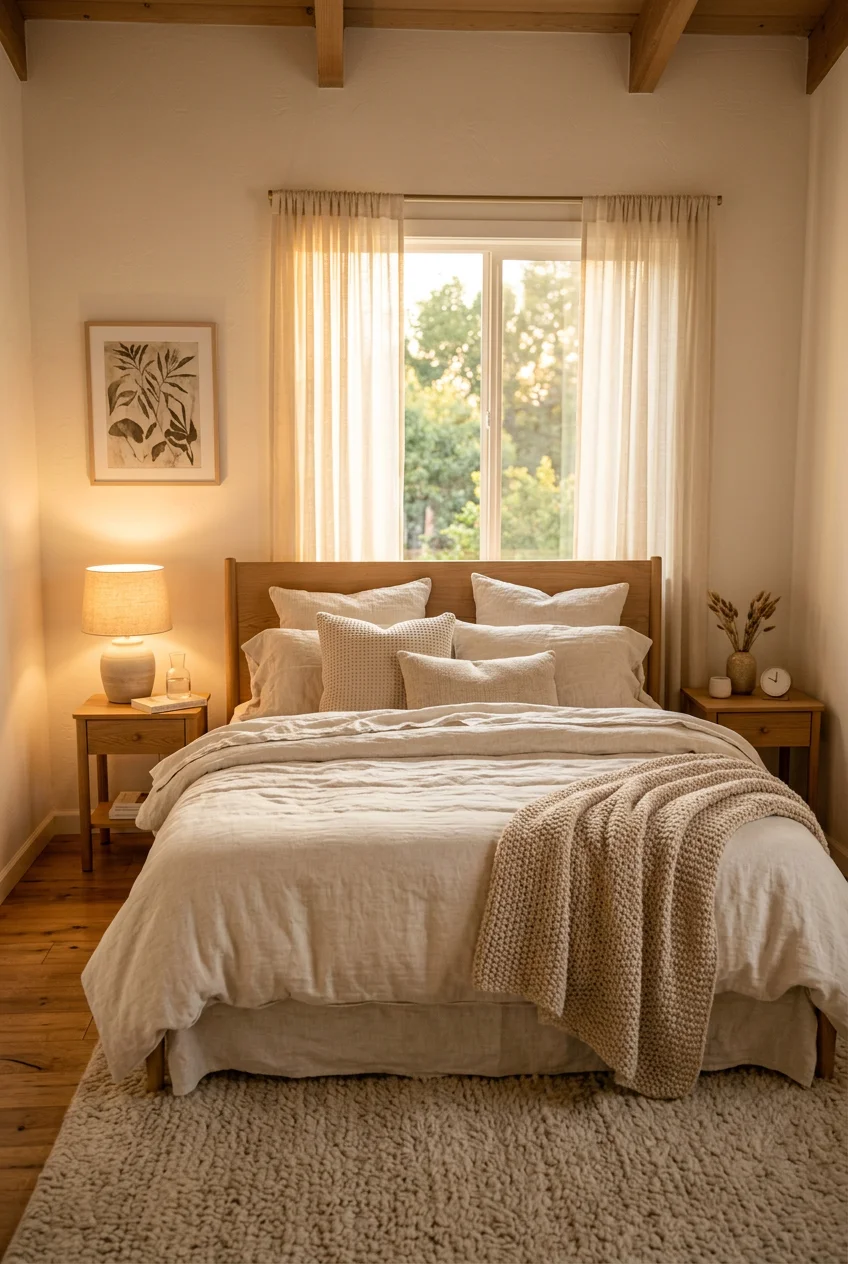
What’s Inside
- Master Layered, Warm Lighting for a Cozy Aesthetic Bedroom
- Choose the Right Rug Size and Placement to Anchor Your Space
- Embrace Natural Materials and Textures
- Curate a Calming Color Palette with 2026 Trending Hues
- Invest in a Quality Weighted Blanket for Enhanced Relaxation
- Integrate Aromatherapy with a Smart Diffuser
- Soundproof for Serenity with Acoustic Panels
- Layer Bedding Thoughtfully – Avoid Bed-in-a-Bag Sets
- Prioritize Intentional Decluttering and Smart Storage
- Choose a Headboard to Define Your Bed
- Optimize Window Treatments for Light Control and Texture
- Practice Sense-scaping for a Multi-Sensory Retreat
- Embrace Warm Minimalism for a Balanced Cozy Aesthetic Bedroom
- Personalize with Art, Unconventionally Placed
- Create a Cozy Seating Nook, If Space Allows
I spent my first year in Chicago sleeping in a room that felt like a sterile doctor’s office. I had one harsh overhead light, stark white walls, and a cheap polyester comforter that made me sweat through my pajamas. I couldn’t figure out why I was waking up anxious every morning. Building a cozy bedroom isn’t about throwing a fluffy pillow on a mattress and calling it a day. It requires methodical choices about texture, lighting, and spatial planning. I tried the cheap quick fixes for months before figuring it out. You need specific layers and functional pieces to change how a room feels. Here’s the exact blueprint I use to fix cold, uninviting spaces. Trust me on this.
1. Master Layered, Warm Lighting for a Cozy Aesthetic Bedroom

Harsh overhead lighting is the enemy. I lived with a single ceiling fixture for a year, and it made my room feel like a cafeteria. You need multiple light sources with warm, diffused light. I strictly use bulbs with a color temperature between 2000K and 2700K. The Philips Hue White Ambiance A19 bulbs cost $49.99 for a two-pack, and they let you dial down the temperature from your phone. I put one in a brass Target Threshold floor lamp ($35) in the corner and another in a small ceramic table lamp on my nightstand. Niki Wright, co-founder of lights&lamps, notes that simply switching on a lamp can change the feeling of an entire room and add calmness. Skip the bright white daylight bulbs. They trick your brain into thinking it’s noon. I’ve used this exact Philips Hue setup for three years now. The app occasionally disconnects from my Wi-Fi, which is annoying, but the light quality makes the minor technical glitch entirely acceptable.
2. Choose the Right Rug Size and Placement to Anchor Your Space

Most people get this wrong. I bought a 5×8 foot rug for my queen bed back in 2019, and it looked like a sad bath mat floating in the middle of the floor. For a queen-sized bed, you need an 8×10 foot rug. For a king, get a 9×12 foot rug. This ensures the material extends 18 to 24 inches beyond the sides of the bed, giving your feet a soft landing spot in the morning. I use the Ruggable Kamran Hazel rug ($399 for the 8×10 size). Here’s a styling trick I use constantly: pull the rug down slightly from under the nightstands. Leave the bare floor underneath the nightstands exposed. This makes the placement look intentional rather than accidental. You also need to maintain a 6 to 8 inch gap from the baseboards to the edge of the rug so it doesn’t look like wall-to-wall carpeting. The standard Ruggable pad is fairly thin (0.125 inches), so I usually upgrade to their cushioned pad for an extra $40 if I’m placing it over hard wood.
3. Embrace Natural Materials and Textures

The 2026 design standard leans heavily into organic modernism. This means blending clean architectural lines with raw, natural materials. Synthetic fabrics trap heat and feel stiff. I replaced my microfiber sheets with the Lost Loom European Flax Linen Sheet Set ($245 for a Queen). Linen, wool, organic cotton, hemp, and bamboo breathe better and drape heavily over the bed frame. I tried a cheap poly-blend first, and it literally pilled after two washes. The Lost Loom linen takes about three wash cycles to truly soften up, which requires some patience, but the temperature regulation is excellent. I pair this with a solid oak bed frame rather than an upholstered one to introduce a hard, natural element against the soft bedding. When you mix a plush 100% New Zealand wool rug (like the ones from West Elm, usually around $599 for an 8×10) with crisp linen curtains, the contrasting textures do the decorating for you.

50×70 Inch Rust Throw Blanket – Soft & Fluffy Fleece
A dependable everyday pick — 50×70 Inch Rust Throw Blanket – Soft & Fluffy Fleece pulls in 11 ratings at 4.5 stars. Not flashy, just solid.
4. Curate a Calming Color Palette with 2026 Trending Hues

Stark whites and cool grays look dated and clinical. I painted my walls a flat builder-grade white last year, and the room felt instantly colder. Now, I stick to warm neutrals like soft beiges, creams, and earthy tones like sage green or terracotta. A 2023 University of Sussex study showed that soft greens and lavenders actually reduce cortisol and lower your heart rate. I use Sherwin-Williams Sea Salt (SW 6204). A gallon of their Emerald interior matte paint costs about $85. It has a slight gray-green undertone that acts as a neutral but feels significantly warmer than plain white. If you want something slightly warmer, Benjamin Moore Quiet Moments (1563) is an excellent alternative. I apply two coats with a 3/8-inch nap roller. The matte finish hides drywall imperfections much better than an eggshell or satin finish. Matte paint does scuff easier if you bump it with a laundry basket, so keep a small touch-up jar in your closet.
5. Invest in a Quality Weighted Blanket for Enhanced Relaxation

Weighted blankets provide deep pressure touch stimulation, which increases serotonin production. I used to toss and turn for hours before I bought the Bearaby Cotton Napper ($249 for the 15-pound version). It uses 100% organic cotton woven into a thick, chunky knit instead of relying on glass beads for weight. Blankets with glass beads tend to shift, leaving all the weight pooled around your ankles by 3 AM. The general rule is to choose a blanket that is roughly 10% of your body weight. The Bearaby loop design is incredibly breathable, so I don’t overheat during the summer months. It’s heavy to wash. You need a heavy-duty washing machine, or you’ll have to lug it to a laundromat with commercial machines. I learned that the hard way when my apartment washer started shaking violently. If you run hot, Hush Blankets makes an Iced version for around $259 that uses a cooling cover, but I prefer the texture of raw cotton. You might also like: 15 Inspiring Master Bedroom Wall Decor to Transform Your Space
6. Integrate Aromatherapy with a Smart Diffuser

Scent is a physical layer in a room. I bought a cheap plastic diffuser from a discount store once, and it leaked water all over my vintage nightstand, ruining the wood veneer. Now, I use the Asakuki 500ml Premium Essential Oil Diffuser. You can get it on Amazon for $25.99. It has a large water tank that actually lasts through the night, unlike the smaller 100ml ones that shut off by midnight. I fill it with 400ml of distilled water and add exactly 8 drops of lavender essential oil. I buy the Aura Cacia Lavender essential oil from Whole Foods ($9.99 for a 0.5 oz bottle). Skip the synthetic fragrance oils. They smell like cheap perfume and give me a headache after twenty minutes. The Asakuki has a small green LED light indicator that stays on while it runs. I had to cover it with a tiny piece of black electrical tape because I need absolute darkness to sleep, but the mist output is incredibly consistent. You might also like: 17 Minimalist Bedroom Ideas Worth Trying

Ultra Soft Cozy Faux Fur Throw Blanket
Honestly, Ultra Soft Cozy Faux Fur Throw Blanket surprised me — sturdier than it looks in the photos, and over 970 buyers gave it 4.5 stars.
7. Soundproof for Serenity with Acoustic Panels

You can’t relax if you hear your neighbor’s television through the drywall. Acoustic panels reduce echoes and block out ambient street noise. I installed Aku Woodpanel slat wood wall panels behind my bed to function as both a headboard and a sound buffer. They cost $119 per 94-inch panel. They are made from MDF and real wood veneer attached to a recycled felt backing. I ordered four panels in the Natural Oak finish. You have to screw them directly into the wall studs using black drywall screws (about $8 for a box at Home Depot). The installation took me a full Saturday, and cutting the panels to fit around my electrical outlets required a jigsaw and some patience. However, they reduced the hallway noise in my apartment by at least 40%. It completely deadens the echo in a room with hard floors. If you don’t want to drill into your walls, Acousart makes hand-painted acoustic wall art starting around $178.99 that hangs like a standard picture frame. You might also like: 20 Fresh Bedroom Ideas to Transform Your Space
8. Layer Bedding Thoughtfully – Avoid Bed-in-a-Bag Sets

Buying a matching bed-in-a-bag set is the fastest way to make your bedroom look like a college dorm. They lack texture, and the polyester filling makes you sweat. I piece my bedding together from different sources. I start with a West Elm brushed cotton duvet cover ($190 for a Full/Queen). Then, I add two boucle lumbar pillows from CB2 ($49 each) and finish with a chunky knit throw blanket at the foot of the bed. I use the Target Threshold chunky knit throw ($35, 50×60 inches). Designer Laura Tribbett points out that bedding is a massive opportunity for interest and pattern. I fold the duvet halfway down the bed to expose the flat sheet, which adds a distinct horizontal line across the mattress. The Target throw does shed small fibers for the first few weeks, which is annoying if you wear black leggings, but the visual texture it adds to the room is exactly what you need to break up a massive block of flat color.
9. Prioritize Intentional Decluttering and Smart Storage

Let’s be real, visual clutter creates mental clutter. I used to trip over a pile of shoes every time I walked to the bathroom at night. A cozy room requires warm minimalism, which means keeping decor intentional and hiding the daily mess. I bought two IKEA Malm under-bed storage boxes ($50 for a 2-pack). They roll out smoothly on casters and hold all my off-season sweaters and extra shoes. I also swapped my open-shelf nightstands for closed-drawer units. Open shelves just become a dumping ground for half-empty water glasses, charging cables, and unread books. I keep only three items on my nightstand surface: a lamp, a coaster, and my current book. The IKEA boxes are made of particleboard, so they aren’t heirloom quality, and assembling them took me forty-five minutes of frustration with an Allen wrench. But getting the clutter off the floor completely changed the airflow and visual weight of the room.

Ultra Soft Cozy Faux Fur Throw Blanket
If you want something that just works, Ultra Soft Cozy Faux Fur Throw Blanket is a safe bet (970 reviews, 4.5 stars).
10. Choose a Headboard to Define Your Bed

Skipping a headboard leaves a bed looking like a temporary setup. A mattress pushed against a bare wall feels unfinished and damages the drywall over time. I used a bare wall for two years, and the oils from my pillows left a permanent gray smudge on the paint. I bought the Article Sven upholstered headboard in Cascadia Blue velvet ($499 for a Queen). It grounds the entire room and gives me a soft surface to lean against when I read at night. Upholstered headboards in linen or velvet add a massive block of texture right at eye level. Dust does accumulate on the top edge of velvet headboards, so I have to run a lint roller over it every Sunday morning. It’s a minor maintenance task, but it keeps the fabric looking sharp. If you have cats, skip the velvet. They will treat it like a $500 scratching post. Opt for a tightly woven linen or a solid wood headboard instead.
11. Optimize Window Treatments for Light Control and Texture

Bare windows make a room feel like a fishbowl. I used cheap plastic blinds for years, and they let in a harsh, sliced light that completely ruined the room’s atmosphere. You need proper window treatments to control the light and add vertical texture. I use the Pottery Barn Emery Linen Blackout Curtains. They cost $179 per 50×84-inch panel. I layer them over a sheer white netted curtain. The blackout lining adds serious weight to the fabric, so they drape beautifully and block out the streetlights completely. You have to hang the curtain rod high and wide. I mount my matte black metal rod (from Amazon, $29.99) exactly 4 inches below the ceiling and extend it 10 inches past the window frame on each side. This makes the window look massive. The linen panels arrive incredibly wrinkled, and you have to spend an hour with a hand steamer to get them to lay flat. Don’t skip the steaming step.
12. Practice Sense-scaping for a Multi-Sensory Retreat

Sense-scaping is a 2026 design standard that focuses on layering texture, scent, light, and sound. It treats the room as a holistic environment rather than just a visual display. I incorporate this by turning on my Saje Aroma Om ceramic diffuser ($92, 90ml capacity) an hour before bed. At the same time, I dim the Philips Hue bulbs to 20% brightness and pull down the blackout shades. I keep a 100% pure wool throw blanket from Costco ($29.99) draped over my reading chair. The rough texture of the wool contrasts with the smooth linen sheets. The Saje diffuser has a very small water tank, so it only runs for about three hours before shutting off automatically. This is actually perfect for sense-scaping, as it fills the room with scent while I read, but won’t run dry in the middle of the night. You’re intentionally engaging your sense of smell, touch, and sight to signal to your brain that the day is over.

COOVA Faux Fur Throw Blanket for Couch
COOVA Faux Fur Throw Blanket for Couch punches above its price — 12 buyers rated it 4.5 stars. I would buy it again.
13. Embrace Warm Minimalism for a Balanced Cozy Aesthetic Bedroom

Minimalism used to mean empty white rooms and uncomfortable metal furniture. In 2026, warm minimalism is about stripping away the excess while keeping the textures rich and inviting. I got rid of my bulky, dark cherry wood dresser that dominated my floor plan. I replaced it with a lighter, low-profile oak dresser from West Elm ($899). I keep the top surface almost completely bare, except for a single ceramic tray for my jewelry. I bought a light wash wood nightstand from Anthropologie ($398) that has clean lines but a visible, organic wood grain. This approach keeps the room clutter-free without making it feel like a museum exhibit. The Anthropologie nightstand doesn’t have soft-close drawers, which is a bit annoying for the price point, but the visual balance it brings to the room is exactly what warm minimalism requires. You want pieces that serve a distinct function but have enough natural texture to feel grounded.
14. Personalize with Art, Unconventionally Placed

Hanging a perfectly symmetrical gallery wall above the bed can feel too formal for a relaxed space. I stopped measuring and hammering a dozen holes into my drywall. Instead, I place framed art on the floor, leaning directly against the wall, or propped up on a low bench. I use Framebridge to custom frame black-and-white candid photos from my travels. Their 10×12 inch Irvine slim white gallery frames cost $85 each. I lean a large 24×36 inch abstract canvas against the wall next to my floor mirror, overlapping them slightly. It adds a casual, studio-like character to the room. The only downside to floor art is that you have to move it every time you vacuum, which adds an extra step to my Saturday chore routine. But the relaxed, unstudied look is worth it. It breaks up the rigid lines of the furniture and makes the room feel lived-in rather than staged.
15. Create a Cozy Seating Nook, If Space Allows

Your bed shouldn’t be the only place to sit in your bedroom. If you have an empty corner, add a dedicated seating area. I bought the Drew Barrymore Beautiful Boucle Chair from Walmart for $248. I placed it by the window with a small brass side table from Target ($45). It gives me a specific spot to drink my morning coffee or read a book without getting back under the covers. The boucle fabric adds a nubby, looped texture that contrasts with the smooth walls. Here’s the strict rule I follow: you can’t use the chair as a laundry basket. The moment you throw a worn pair of jeans on it, the cozy aesthetic is dead. No exaggeration. The Walmart chair is surprisingly firm. It isn’t a sink-in lounge chair, so I’d never sit in it for a three-hour movie, but it provides exactly the right amount of support for thirty minutes of morning reading.
Building a space that actually helps you decompress takes methodical planning. I’ve rearranged my own room a dozen times to get the lighting and textures right. Start by fixing your overhead lighting and swapping out your synthetic sheets for natural linen or cotton. Those two changes alone will drastically shift the temperature of the room. It took me years to figure out. If you found this breakdown helpful, pin this article to your bedroom inspiration board so you have the exact measurements and paint colors handy when you go shopping.

Bedsure GentleSoft White Throw Blanket for Couch
Bedsure GentleSoft White Throw Blanket for Couch – Mothers Gifts Day B punches above its price — 224 buyers rated it 4.5 stars. I would buy it again.
Frequently Asked Questions
What colors make a bedroom look cozy?
Warm neutrals like soft beiges, creams, and earthy tones such as sage green and terracotta create a cozy atmosphere. Avoid stark whites and cool grays, which can make a room feel cold and clinical.
How do I add texture to a cozy aesthetic bedroom?
Mix natural materials like linen sheets, a chunky wool throw, and a boucle accent chair. Layering different fabrics breaks up flat colors and adds visual warmth to the space.
What is the best lighting for a relaxing bedroom?
Skip harsh overhead lights and use layered, warm lighting. Opt for bulbs with a color temperature between 2000K and 2700K in floor lamps and bedside table lamps to create a soft, diffused glow.
What size rug do I need for a queen bed?
For a queen bed, you need an 8×10 foot rug. This allows the rug to extend 18 to 24 inches beyond the sides and foot of the bed, anchoring the space properly.
