What’s Inside
- Master the Art of Layered Crochet Bedroom Decor Throws
- Style Your Bed with a Custom Crochet Bed Runner
- Incorporate Modern Minimalist Crochet Wall Art
- Craft Sturdy Crochet Storage Baskets for Functional Style
- Design Unique Crochet Lampshades for Ambient Lighting
- Personalize with Crochet Pillow Covers in Trending Hues
- The Gauge Swatch Rule for Fitted Crochet Bedroom Decor
- Use a Larger Pillow Insert for a Fuller Look
- Embrace Sustainable Yarn Choices for Green Decor
- Prevent Uneven Edges by Counting Stitches Religiously
- Create 3D Botanical Accents for Your Space
- Choose the Right Yarn Fiber for Heavy Durability
- Avoid the Wrong Hook Size for Your Yarn Weight
- Integrate Crochet Plant Hangers for a Biophilic Touch
- Layer Textures for Complex Sensory Design
- Crochet Heavy Curtains to Soften Window Light
- Crochet Rugs for a Soft Morning Landing
- Small Touches: Crochet Coasters for the Nightstand
The first time I tried making my own crochet bedroom decor, I spent three weeks wrestling with cheap acrylic yarn. I ended up with a stiff, scratchy blanket that barely covered my shins and smelled faintly of plastic. It was a complete disaster. I threw it in the back of my closet and ignored it for a year. Since then, I’ve learned that getting the right look requires specific materials and actual planning, not just a random hook and whatever clearance yarn you find. Adding handmade textures softens a room, but you’ve got to do it right. Here are 18 ways I incorporate these pieces without making my space look like a dusty antique shop.
1. Master the Art of Layered Crochet Bedroom Decor Throws

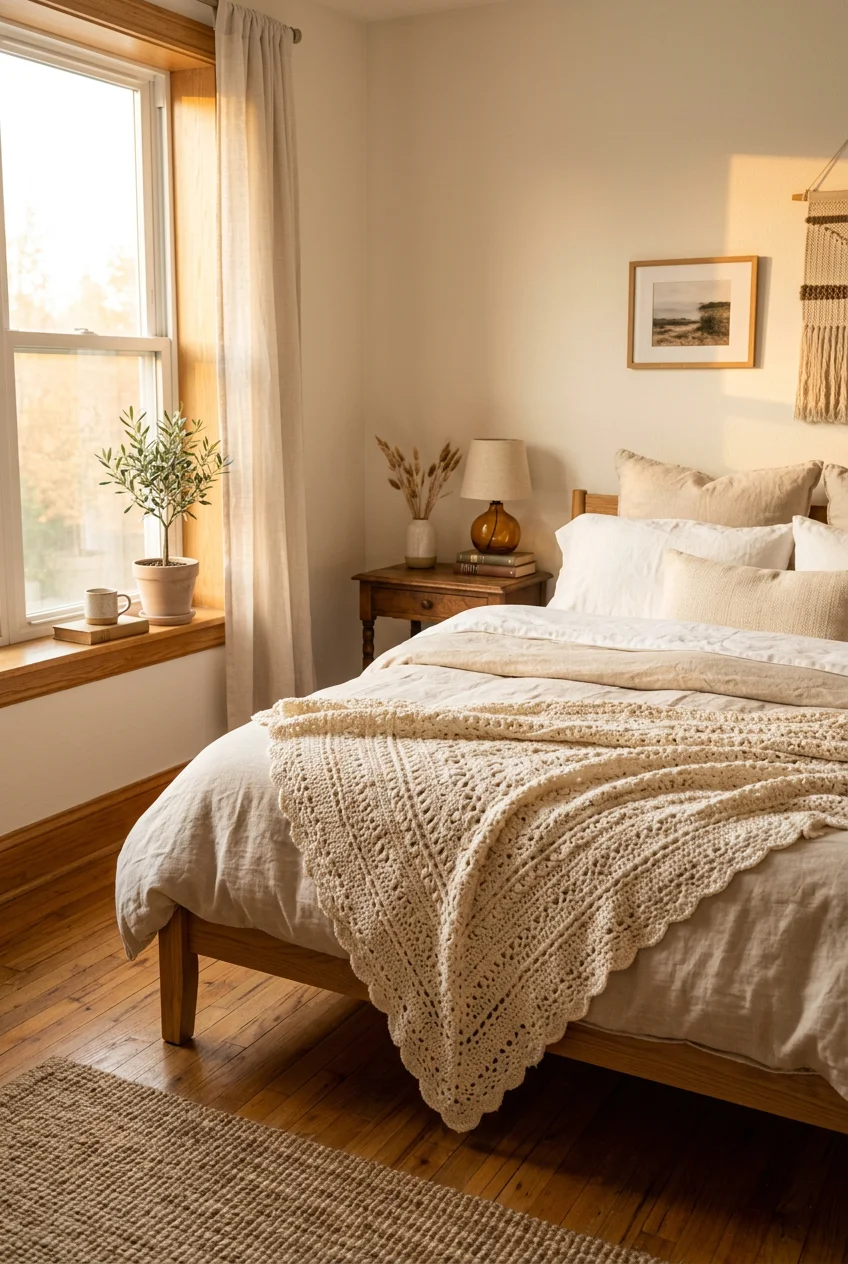
I tried the single, thin blanket look for months before figuring it out. It just looked flat and sad on my mattress. The trick to a cozy aesthetic is layering heavy, textured throws on your bed over a smooth duvet. You need a large, neutral base throw. I use a queen-sized blanket measuring exactly 90 x 100 inches. I made mine with Lion Brand Wool-Ease yarn, which costs $9.99 a skein at Target. It took 15 skeins, but the heavy weight keeps it from sliding off the bed at night. I layer a smaller 50 x 60-inch throw featuring a chunky puff stitch right at the bottom third of the bed. The contrast between the smooth duvet and the thick, raised yarn creates actual shadows and visual depth. Skip the cheap, squeaky synthetic yarns for this. They pill after one wash and feel terrible against your skin. Stick to a soft, durable wool blend. Trust me on this.
2. Style Your Bed with a Custom Crochet Bed Runner

If a massive, heavy blanket feels like too much work, a bed runner is the exact right compromise. Home decor specialist Maria José Ventrameli recommends these for bedrooms because they add texture without trapping heat while you sleep. I made one last spring that measures 28 inches wide and drapes perfectly over the foot of my queen mattress. I used Lion Brand 24/7 Cotton, which runs $5.99 for a 3.5 oz skein. It took about 600 yards total. I specifically chose a tight shell stitch because looser loops get caught on my laundry basket when I throw it on the bed. The mercerized cotton has a slight sheen and handles machine washing without stretching out of shape. I learned the hard way that acrylic runners just slide right off slippery duvet covers. Cotton has the physical weight and grip to stay exactly where you put it, even if you toss and turn.
3. Incorporate Modern Minimalist Crochet Wall Art

Most people hear about yarn on walls and immediately picture those dusty, fringed owls from the 1970s. You can actually create modern minimalist pieces that fit right into a contemporary aesthetic. I own a massive 30 x 40-inch geometric wall hanging above my dresser. I made it using Ganxxet chunky cotton cord, which costs $22.50 for a large cone. The thick 4mm cord gives the stitches severe, architectural lines instead of floppy, soft edges. I mounted it on a thick wooden dowel I grabbed from the hardware store for $3.49. The key here is sticking to a single, solid neutral color like bone white or charcoal grey. When you mix too many colors in a large wall piece, it completely overwhelms a small sleeping space. This piece absorbs sound nicely, too. Since I put it up, the echo in my high-ceilinged room is noticeably muffled, making the space feel much quieter at night.

upsimples 6 Pack Wooden Floating Shelves
A dependable everyday pick — upsimples 6 Pack Wooden Floating Shelves pulls in 45 ratings at 4.5 stars. Not flashy, just solid.
4. Craft Sturdy Crochet Storage Baskets for Functional Style

Keeping a bedroom tidy requires actual storage solutions, not just shoving things under the bed. Sturdy crochet baskets are highly functional if you construct them correctly. I used to make these with regular worsted weight yarn, and they’d collapse into sad, wrinkly puddles the second I put a bottle of lotion inside. Now, I strictly use super bulky yarn like Lion Brand Wool-Ease Thick & Quick or hold two strands of stiff cotton together. I followed an “Easy Modern Storage Basket” pattern by Sigoni Macaroni last month. It called for a 4.5 mm hook to keep the stitches brutally tight. The total yarn cost was $24.50 for a medium-sized basket. It sits on my nightstand and holds heavy hand creams and a massive bottle of Costco ibuprofen without buckling. The tight tension makes your hands ache while making it, but the resulting basket stands up entirely on its own.
5. Design Unique Crochet Lampshades for Ambient Lighting

Harsh overhead lighting ruins the mood of any sleeping space. A crocheted lampshade diffuses light beautifully, casting intricate shadows across your ceiling. I made a boho-inspired pendant light cover using fine size 10 cotton thread. I crocheted a lace-like pattern, soaked the entire thing in a mixture of standard white school glue and water, and stretched it tightly over a fully inflated balloon to dry. Once it hardened into a stiff globe, I popped the balloon and pulled it out. You absolutely must use LED light bulbs with these. Traditional incandescent bulbs get far too hot and create a massive fire hazard when placed near dried cotton and glue. I use a smart LED bulb I bought at Target for $14.99, which lets me dim the light to a warm, amber glow from my phone. It softens the entire room without looking like a dorm room craft project.
6. Personalize with Crochet Pillow Covers in Trending Hues

Throw pillows are the fastest way to change the entire color palette of a room. Right now, the trend heavily favors nature-inspired hues like sage green, warm clay, and soft cream. I update my bedding seasonally with removable covers. For a standard 18 x 18-inch pillow insert, I crochet two 17-inch corner-to-corner squares. I typically use a worsted weight acrylic like Red Heart Super Saver, which is heavily accessible and costs just $4.49 a skein at Walmart. I add a row of large wooden buttons down the back so I can easily strip them off and throw them in the washing machine. I used to sew the pillows completely shut, which was a terrible mistake. After one coffee spill in bed, I had to throw the entire lumpy pillow into the washer, and it took three days to dry completely. Removable covers save so much time and frustration. You might also like: 19 Purple Bedroom Decor You Need to See

Bedsure GentleSoft Sage Green Throw Blanket for Couch
Bedsure GentleSoft Sage Green Throw Blanket for Couch – Checkered Cute has been one of the most consistently praised picks in this category. 97 reviewers averaged 4.5/5.
7. The Gauge Swatch Rule for Fitted Crochet Bedroom Decor

Skipping a gauge swatch is the most common mistake people make, and I did it for years when creating fitted crochet bedroom decor. A gauge swatch is just a small 4×4 inch test square you make before starting the actual project. When I tried making a fitted cover for a specific lumbar pillow, I ignored the gauge instructions completely. I spent ten hours stitching, only to end up with a cover that was three inches too narrow. I had to rip the entire thing out and start over. Taking twenty minutes to crochet a small square ensures your personal tension matches the designer’s math. If your square is too big, you drop down a hook size. If it’s too small, you go up a size. It prevents you from running out of yarn halfway through a blanket or creating a misshapen, stretched-out mess. I keep a small ruler in my hook case now specifically to measure these swatches. You might also like: 17 Minimalist Bedroom Ideas Worth Trying
8. Use a Larger Pillow Insert for a Fuller Look

If your handmade pillows look sad, flat, and wrinkly, the problem isn’t your stitching. It’s the insert you’re using. A lesser-known designer secret is to always use a pillow insert one full size larger than your crocheted cover. If I make an 18-inch square cover, I stuff it with a 20-inch insert. I buy the basic down-alternative inserts from Target for $12.00 each. Shoving that oversized insert into the smaller cover forces the yarn to stretch slightly, filling out the corners perfectly and creating a firm, plush surface. Before I learned this, my pillows always had empty, floppy corners that looked incredibly cheap. Just be careful when zipping or buttoning the back closed. You have to physically compress the insert with your forearm while pulling the edges together so you won’t snap your yarn or pop a button off. The firm, custom look is entirely worth the slight wrestling match. No exaggeration. You might also like: 20 Fresh Bedroom Ideas to Transform Your Space
9. Embrace Sustainable Yarn Choices for Green Decor

Bringing sustainable materials into your home is more than just a passing trend. When you make your own decor, you control exactly what materials sit on your mattress. I used to buy massive plastic bags of cheap synthetic yarn, but I hated the chemical smell they brought into my room. Now, I actively seek out eco-friendly options. Brands like Ganxxet offer incredible recycled cotton cords made from fashion industry waste. Their single-twist macrame cord costs about $18.99 for a large spool and works beautifully for thick, structured crochet projects. Lion Brand also has a fantastic Re-Spun line made entirely from recycled plastic bottles, priced at $7.99 a skein. It feels surprisingly soft and has a matte finish that looks highly expensive. Using recycled materials gives the finished piece an ethical dimension, and the natural fibers breathe significantly better than cheap acrylics when you use them as blankets.

AMADA HOMEFURNISHING Floating Shelves
Honestly, AMADA HOMEFURNISHING Floating Shelves surprised me — sturdier than it looks in the photos, and over 116 buyers gave it 4.5 stars.
10. Prevent Uneven Edges by Counting Stitches Religiously

Nothing ruins a beautifully textured blanket faster than edges that wave in and out like a snake. I own a blanket shoved in my linen closet that started at 50 inches wide and somehow ended up 42 inches wide by the final row. Miscounting stitches is a brutal reality, even for experienced crafters. You get distracted watching TV, miss the last stitch of the row, and suddenly your perfect rectangle is a trapezoid. To fix this, I now use bright plastic stitch markers. I bought a pack of 100 on Amazon for $4.99. I clip one into the very first stitch and the very last stitch of every single row. It visually forces me to stop and ensure I hit the exact edge before turning my work. It feels tedious at first, but ripping out six hours of work because you dropped a stitch on row four is infinitely worse.
11. Create 3D Botanical Accents for Your Space

Adding 3D botanical accents brings a highly curated, artistic feel to plain items. I like to crochet small, structured floral motifs and attach them to plain canvas pillow covers or use them as curtain tie-backs. The trick is using a mercerized cotton that holds a crisp, stiff shape. I strictly use DMC Natura Just Cotton, which costs $6.50 for a 50-gram ball, or Scheepjes Catona. Both of these yarns have a tight twist that prevents the petals from looking fuzzy or limp. Last Tuesday, I spent an hour making a vine of small green leaves to drape over the corner of a large floor mirror. It adds a subtle, organic texture without the maintenance of real plants. Don’t use standard acrylic yarn for these small details. The static electricity attracts dust instantly, and the flowers will look like blurry, matted blobs after just a few weeks of sitting out.
12. Choose the Right Yarn Fiber for Heavy Durability

The fiber you choose dictates how long your item will actually survive in a heavily used space. I once made a gorgeous, fluffy merino wool throw for the end of my bed. Within a month of sitting on it to put my shoes on, the friction caused it to felt into a solid, matted board. For decor that sees daily friction, you’ve got to prioritize durability over extreme softness. Maria José Ventrameli advises using durable cotton or cotton blends for this exact reason. I picked up a heavy cotton blend yarn during a random grocery run at Whole Foods last year when they had a local artisan pop-up. I used it to make a heavy floor cushion. Cotton is highly absorbent, withstands heavy friction, and doesn’t pill into little annoying balls. You can throw it in a heavy-duty wash cycle without destroying the stitch definition. Save the delicate, expensive wools for cowls and hats.

Govee RGBIC LED Strip Lights, Smart LED Lights for Bedroom
If you want something that just works, Govee RGBIC LED Strip Lights is a safe bet (248 reviews, 4.5 stars).
13. Avoid the Wrong Hook Size for Your Yarn Weight

Using the wrong hook size completely alters the physical fabric of your project. I used to just grab whatever hook was closest to me, completely ignoring the yarn label. I tried to make a soft, drapey blanket using a thick worsted yarn and a tiny 4.0 mm hook. The resulting fabric was so stiff and rigid it could practically stand up on its own. It felt like a heavy rug. Not a blanket. Always check the yarn label for the recommended hook size. If you want a blanket to drape softly over your legs, you often need to go up half a size from what the label suggests. If you’re making a basket or a structured pillow, you need to go down a full size to force the stitches tightly together. The hook size dictates the tension, and the tension dictates whether your project feels like a cloud or a piece of cardboard.
14. Integrate Crochet Plant Hangers for a Biophilic Touch

Hanging plants draw the eye upward and make a room feel significantly taller. Crocheted plant hangers are a highly popular way to bring this urban garden ambiance into your sleeping space. I stopped at Sprouts last week and bought a trailing Pothos for $12.99, specifically to hang in the empty corner by my window. You’ve got to use sturdy cotton rope or a thick macramé cord for these. I use a 3mm braided cotton cord that costs $14.00 a spool. If you try to use standard knitting yarn, the sheer weight of a freshly watered ceramic pot will stretch the yarn out by six inches, leaving your plant dangling dangerously low. I use a simple half-double crochet mesh pattern that hugs the pot securely. I also hang them from heavy-duty ceiling hooks rated for at least 20 pounds. I learned that lesson after a cheap adhesive hook failed and dropped a fern onto my nightstand at 2 AM.
15. Layer Textures for Complex Sensory Design

A room full of completely smooth surfaces feels sterile and cold. Interior design trends focus heavily on layering different textures to create visual depth and physical contrast. When I plan my bed setup, I intentionally pair opposing textures. I place a smooth, tightly crocheted cotton blanket at the base. Then, I toss a pillow featuring a dense, raised bobble stitch right in front of it. The bobbles create actual shadows that change as the sun moves across the room. I use a specific pattern that places a bobble every three stitches, creating a highly tactile, bumpy surface. It feels incredibly satisfying to run your hands over it. If you make everything in your room using the exact same basic single crochet stitch, the pieces blur together into a boring, flat surface. Mixing a flat, smooth stitch with an aggressive, raised puff stitch makes the entire room feel curated, expensive, and intentional.

50×70 Inch Rust Throw Blanket – Soft & Fluffy Fleece
50×70 Inch Rust Throw Blanket – Soft & Fluffy Fleece has been one of the most consistently praised picks in this category. 12 reviewers averaged 4.5/5.
16. Crochet Heavy Curtains to Soften Window Light

Standard blinds look harsh and block out too much natural light. I started crocheting my own window valances and curtain panels to filter the light without plunging the room into total darkness. I use Aunt Lydia’s Classic Crochet Thread in size 10, which runs $3.49 a ball at Joann Fabrics. It takes an agonizing amount of time to make a full curtain panel using thread and a tiny 2.0 mm steel hook, but the result is stunning. The intricate lace patterns break up the harsh morning sunlight into soft, geometric shadows on my floor. I highly recommend washing and heavily blocking these panels before hanging them. I pin them down to foam mats while wet and spray them with a heavy liquid starch. This forces the lace pattern to open up entirely and prevents the edges from curling inward once they’re hung on the rod.
17. Crochet Rugs for a Soft Morning Landing

Stepping onto a cold hardwood floor in the middle of winter is a terrible way to wake up. I fixed this by placing a thick, crocheted rug right next to my side of the bed. You absolutely can’t use standard yarn for a rug. It’ll slip, stretch, and look filthy within three days. I exclusively use chunky T-shirt yarn for this. I buy Hoooked Zpagetti yarn for $15.99 a cone. It’s thick, slightly elastic, and creates a dense, squishy fabric that feels incredible under bare feet. I use a massive 12 mm hook and work in a simple circle or oval pattern. The most critical step is applying a non-slip backing. I bought a jar of liquid rubber for $14.00 at a local craft store and painted three heavy coats onto the back of the rug. Before I did that, I stepped on the rug and slid three feet across the floor, nearly twisting my ankle. Took me years to figure out that step.
18. Small Touches: Crochet Coasters for the Nightstand

You don’t have to commit to a massive blanket to bring handmade texture into your room. Small, functional pieces make a huge difference in how a space feels and operates. I keep a stack of thick crocheted coasters on my nightstand to protect the wood finish. I use Lily Sugar’n Cream worsted weight cotton, which is intensely cheap at $2.49 a skein. I made a set of four using a tight thermal stitch that creates a double-thick fabric. Last month, I set a boiling hot mug of chamomile tea I bought from Kroger directly onto my wooden nightstand. The thick cotton coaster absorbed the heat entirely, preventing a nasty white heat ring from ruining the finish. They also absorb the condensation from ice water glasses perfectly. I just throw them in with my regular towel laundry when they get dirty. They’re a brilliant, zero-stress way to add color to a small surface.
Designing your space with handmade textiles doesn’t mean it has to look cluttered or outdated. By choosing the right fibers, paying attention to tension, and mixing textures intentionally, you can create a highly functional, beautiful room. I highly recommend starting small with a structured basket or a set of heavy cotton coasters before committing to a massive king-sized bed throw. It saves you from the frustration of ripping out hours of work. If you found these ideas helpful for planning your next room refresh, make sure to save this post or pin it to your decor boards so you can reference the exact yarn weights and measurements later.
Frequently Asked Questions
What is the best yarn for crochet bedroom decor?
For durable, functional decor like runners and baskets, mercerized cotton or thick cotton blends are best. They hold their shape and withstand washing. For cozy bed throws, choose soft, heavy wool blends or premium acrylics that won’t pill easily.
How do I keep my crochet baskets from collapsing?
Use a super bulky yarn or hold two strands of worsted weight cotton together. Drop your hook size down by at least one full millimeter to force the stitches into a tight, stiff fabric that stands up on its own.
Can I wash crochet pillow covers?
Yes, if you use machine-washable cotton or acrylic yarn. Always add buttons or a zipper to the back of your pillow covers so you can remove the insert before washing. Wash on a gentle cycle and lay flat to dry.
Why do my crochet blankets come out stiff?
You are likely using a hook size that is too small for your yarn weight, creating a dense tension. To achieve a soft, drapey blanket, go up half a size or a full size larger than what the yarn label recommends.
