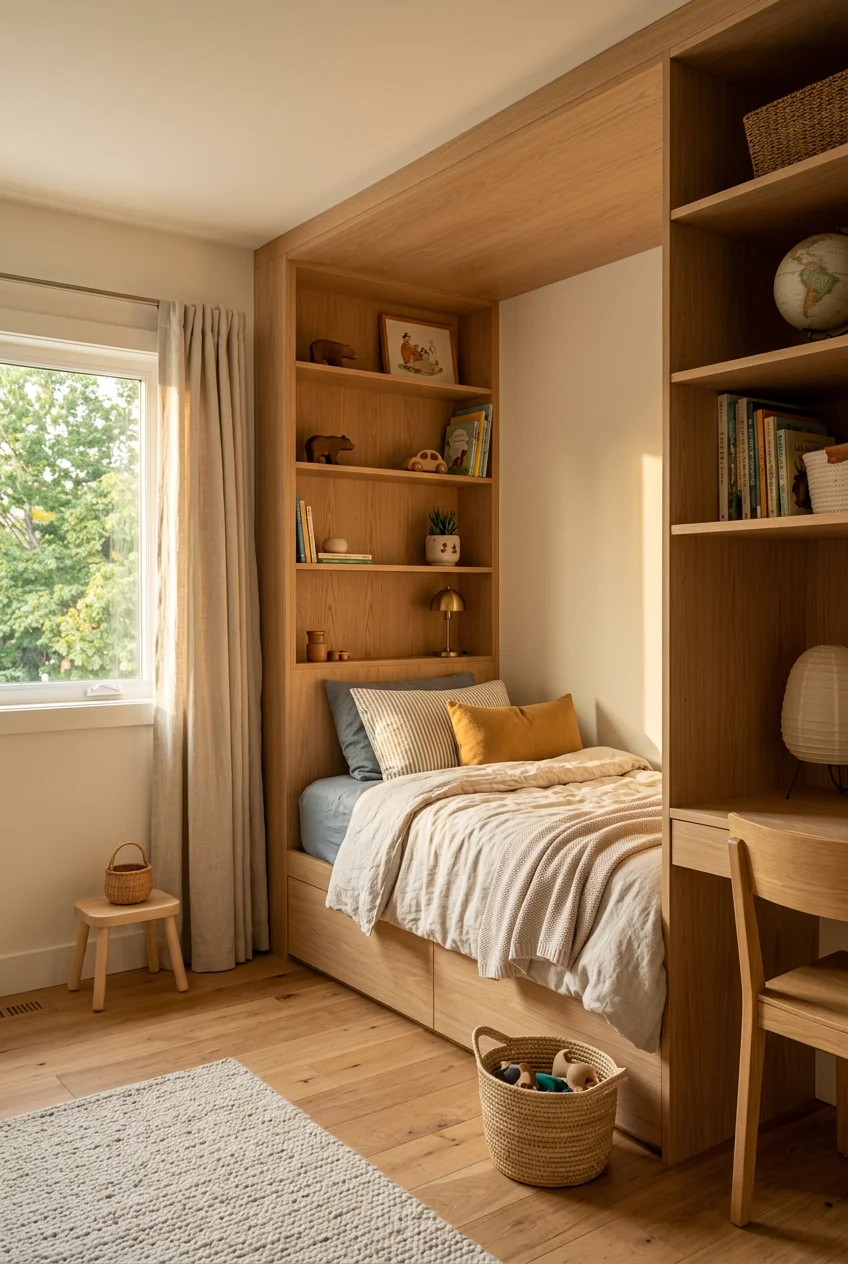
What’s Inside
- Embrace Multi-Functional Beds to Maximize Floor Space
- Prioritize Vertical Storage with Modular Systems
- Implement Smart Under-Bed Storage Solutions
- Choose a Future-Proof Color Palette
- Install Wall-Mounted or Foldable Desks
- Create Defined Zones within the Room
- Opt for Smart Lighting for Function and Ambiance
- Incorporate Eco-Friendly and Non-Toxic Materials
- Utilize the Fifth Wall with Ceiling Details
- Choose Durable, Longevity-Focused Furniture
- Make Toys Decorative and Accessible
- Install Tension Rods for Hidden Hanging Storage
- Incorporate Sensory-Friendly Design Elements
- Use Large-Scale Patterns Strategically
- Secure Furniture and Choose Rounded Edges
- Swap Bulky Curtains for Sleek Roman Shades
Last Tuesday, I stood in my nephew’s 9×10 foot room, ankle-deep in sharp plastic building blocks, realizing his current layout was a structural disaster. If you need small bedroom ideas for kids, you already know the frustration of trying to fit a bed, desk, and wardrobe into a space the size of a walk-in closet. I spent three hours mapping out floor plans on grid paper while eating a $3.99 bag of plantain chips from Trader Joe’s. Most parents buy miniature furniture hoping it solves the spatial deficit. It doesn’t. You just end up with a cramped room filled with tiny, useless items your child outgrows in fourteen months. Finding effective small bedroom ideas for kids requires treating the space like a micro-apartment. Every cubic inch matters. I’m going to walk you through the exact measurements, specific hardware, and layout math I use when styling compact children’s rooms. We aren’t relying on magic here. We’re using structural logic to reclaim your floor space.
1. Embrace Multi-Functional Beds to Maximize Floor Space

Floor space is your most expensive commodity. A standard twin bed consumes roughly 14 square feet. You can’t afford to lose that much footprint to a piece of furniture used only for sleeping. I strictly specify beds that integrate secondary functions. The IKEA KURA Reversible Bed costs exactly $229 and solves this math problem immediately. You can set it up as a low bed for a toddler, then flip the pine frame upside down to create a loft when they hit six years old. This reclaims the 38 by 75-inch space underneath for a reading nook or toy storage. I bought one last October and paired it with a 6-inch thick memory foam mattress I grabbed for $119 at Costco. If you use a loft setup, you must ensure the guardrails are at least 14 inches high for safety. A thick mattress compromises that barrier. Keep the mattress profile between 4 and 6 inches. I learned that the hard way when a standard 10-inch mattress sat completely flush with the safety rail, rendering it useless and forcing me to buy a second mattress the next day.
2. Prioritize Vertical Storage with Modular Systems

When analyzing small bedroom ideas for kids, I look at the walls before I look at the floor. Storage needs to act as architecture, not an accessory. Pushing a bulky, freestanding dresser against a wall eats up 20 inches of depth and visually weighs down the room. Instead, you need modular systems that draw the eye upward and utilize the room’s height. The IKEA TROFAST series is my standard baseline for this. The solid pine frames cost $69, and the lightweight plastic bins range from $3 to $10 depending on depth. I install these units side-by-side to create a continuous, built-in look. You can also find similar modular cube systems at Target for around $45 per 6-cube unit. The structural advantage here is that kids can easily slide the 16.5-inch bins completely out, take them to the floor to play, and slide them back. It forces organization. I tried using heavy wooden toy chests for years before realizing children won’t dig through a dark 24-inch deep box to find a single missing puzzle piece. They just dump the whole thing out. No exaggeration.
3. Implement Smart Under-Bed Storage Solutions

The void under a standard bed frame is a dust trap that usually collects discarded socks and broken crayons. You have to seal and utilize this zone. Don’t just throw loose items under there. I use Fixwal Under Bed Storage Containers. They cost $29.99 for a 2-pack and feature a clear plastic top with a rigid metal frame. More importantly, they have small caster wheels. When you’re dealing with a 7-inch clearance under a bed frame, dragging fabric bins across carpet creates friction and tears the material. I ripped three fabric bins last year doing exactly that. The Fixwal containers measure 31.5 by 17.3 inches, holding bulky winter coats or extra sheets while keeping them visible. I keep a strict inventory of what goes in these bins. If you store daily-use items under the bed, your child won’t put them away. Reserve this 15-cubic-foot area strictly for seasonal clothing or heavy blankets that only rotate out every six months. The smooth rolling action means you aren’t wrestling with heavy boxes.

SUOXING Bedside Wall Organizer for Bedroom,Rv,Small Rooms
If you want something that just works, SUOXING Bedside Wall Organizer for Bedroom is a safe bet (207 reviews, 4.5 stars).
4. Choose a Future-Proof Color Palette

Painting a room neon blue or fire-engine red shrinks the visual space instantly. Highly saturated colors absorb light. In a 100-square-foot room, you need light reflection. I follow a strict 80/20 rule for color distribution. Keep 80 percent of the room (the walls, ceiling, and heavy furniture) in timeless, light-reflecting neutrals. I use Sherwin-Williams Alabaster, which costs $45 a gallon. It has a slight warm undertone that prevents the room from looking like a sterile hospital ward. The remaining 20 percent is where you inject personality. Use a $35 velvet throw pillow, a $60 washable rug, or removable wall decals. I spent four days stripping custom superhero wallpaper out of a client’s house last spring because her son decided he hated comic books overnight. It’s an expensive, messy mistake. By keeping the structural elements neutral, you can swap out the high-personality textiles for under $100 when your child’s tastes inevitably shift. Earthy browns, muted clay tones, and soft sage greens are currently dominating the styling forecasts because they age incredibly well.
5. Install Wall-Mounted or Foldable Desks

A standard freestanding desk requires a 48 by 24-inch footprint, plus another 36 inches of clearance for the chair to pull out. You don’t have that space. Wall-mounted desks eliminate the leg structure entirely, visually opening the floor. I specify the SoBuy Wall-Mounted Desk FWT20-W for tight corners. It costs $69.99 and mounts directly to the studs. It projects only 20 inches from the wall when open. If the room is exceptionally narrow, I use the Haotian Wall-Mounted Drop-Leaf Table for $49.99. It folds completely flat against the drywall when not in use, protruding a mere 3 inches. You must anchor these into wooden wall studs. I once tried using heavy-duty drywall anchors for a floating desk, and the entire unit ripped out of the wall when a 40-pound child leaned on it to color. Learn from my structural failure. Buy a $15 stud finder at Walmart and use 3-inch wood screws to secure the hinges to actual wood. It’s the only way it won’t collapse.
6. Create Defined Zones within the Room

A small room turns into a chaotic mess when activities bleed together. You can’t have Lego bricks mixed into the bedsheets. You have to establish strict geographical zones for sleeping, studying, and playing, even if those zones are only 3 feet wide. I use a 5×7 foot area rug, usually a low-pile polypropylene one for $55, to anchor the play zone. The edges of the rug act as a hard boundary for toys. For the study zone, I use a specific desk lamp to create a pool of light that signals focus time. I bought a sleek, matte black metal task lamp at Kroger last month in their seasonal home aisle for $18.99, and it works perfectly to visually isolate the desk from the rest of the room. When you compartmentalize the floor plan, the brain registers the space as organized and functional rather than cramped. Just ensure you leave a clear 24-inch walking path between the door and the bed. If you have to turn sideways to walk to the closet, your zones are too large. You might also like: 20 Simple Bedroom Wall Design Ideas That Actually Work

HOMIDEC Closet Organizers and Storage
If you want something that just works, HOMIDEC Closet Organizers and Storage is a safe bet (8 reviews, 4.5 stars).
7. Opt for Smart Lighting for Function and Ambiance

Relying on a single, 60-watt overhead ceiling fixture casts harsh shadows into the corners of a small room, making it feel like a cave. You need layered lighting to push the visual boundaries outward. I strictly use smart bulbs to control color temperature and intensity. I install Philips Hue White and Color Ambiance bulbs, which cost $49.99 each. Yes, they aren’t cheap, but they eliminate the need for separate nightlights, reading lamps, and wake-up lights. I also use the Amazon Echo Glow for $29.99 on the bedside table. It’s a 4-inch spherical smart lamp that shifts colors based on routines. I set it to fade to a dim amber at 8:00 PM to signal winding down. Blue light suppresses melatonin, so having the ability to shift the room’s lighting to warm, low-kelvin tones before bed is a functional necessity. I tried cheap LED strip lights two years ago, but the adhesive ruined the drywall and the diodes burned out in six weeks. Stick to reliable bulb systems. You might also like: 18 DIY Bedroom Decor Worth Trying
8. Incorporate Eco-Friendly and Non-Toxic Materials

Indoor air quality is measurably worse in small, enclosed spaces. When you pack synthetic furniture, vinyl plastics, and chemical-laden paints into a 10×10 room, the volatile organic compounds (VOCs) concentrate rapidly. I refuse to use particleboard furniture that off-gasses formaldehyde. Instead, I source solid pine, bamboo, or metal frames. For textiles, I use 100 percent organic cotton sheets. I picked up a twin set of organic percale sheets at Whole Foods of all places, during a random home goods promotion, for $45. They are crisp, breathable, and lack the chemical sizing agents found in cheap polyester blends. If you’re painting, you must use a zero-VOC paint. Standard latex paints can off-gas for up to three years. I painted a nursery once with standard acrylic enamel, and the chemical smell lingered for a month despite leaving the window open daily. The minor price increase for non-toxic materials is a non-negotiable structural requirement when the room volume is this restricted. You don’t want your kids breathing that in while they sleep. You might also like: 15 Lovely Cool Bedroom Ideas Worth Trying This Year
9. Utilize the Fifth Wall with Ceiling Details

People completely ignore the ceiling, which is a massive waste of 100 square feet of blank canvas. In a small room, drawing the eye upward creates the illusion of height. I never paint a small room’s ceiling stark white if the walls are dark; the high contrast creates a visual lid that compresses the space. Instead, I paint the ceiling a 50 percent lighter tint of the wall color. If you want to add architectural interest without consuming floor space, install a sky ceiling. I use a combination of soft cove lighting around the perimeter and high-quality, glow-in-the-dark constellation decals. A pack of 200 realistic domed star decals costs about $14.99 on Amazon. I apply them using an accurate star map. It gives the child something expansive to look at while falling asleep. I tried painting a mural on a ceiling once. My neck locked up for three days, and the paint dripped onto the hardwood floor. Stick to decals and strategic lighting to manipulate the ceiling height without ruining your posture.

HOMZ 2-Pack Snaplock, Small Clear Plastic Storage Organizer
HOMZ 2-Pack Snaplock has been one of the most consistently praised picks in this category. 56 reviewers averaged 4.5/5.
10. Choose Durable, Longevity-Focused Furniture

Buying toddler-specific furniture is a financial trap. A racecar bed looks fun when they’re three, but it becomes an embarrassing, bulky piece of plastic by the time they hit eight. You don’t have the space or budget to replace heavy furniture every five years. I only specify pieces with clean, architectural lines that can transition into the teenage years. Instead of a twin bed, if the room’s width allows, I use a small double bed measuring 48 by 75 inches (often called a 3/4 bed or a large twin). This accommodates growth spurts and provides enough space for you to comfortably lay next to them during night terrors. I bought a solid steel platform frame for $115 that holds up to 500 pounds. It won’t squeak, it won’t warp, and the matte black finish works for a six-year-old just as well as it works for a sixteen-year-old. Stop buying temporary furniture. Analyze the 10-year lifespan of every piece you drag into that room.
11. Make Toys Decorative and Accessible

You can’t hide every single toy in a small room. You don’t have the cabinet space. Instead, you have to curate the toys and use them as part of the visual aesthetic. I use transparent or semi-transparent storage so the items themselves add color to the room, while remaining strictly contained. The IKEA GLIS box with a lid is my standard tool for this. They cost $4.99 for a pack of three. They measure 6.75 by 4 inches, which is the exact mathematical volume needed to hold a standard set of markers, small building blocks, or action figure accessories. I line these boxes up on a floating wall shelf. The child can see exactly what is inside without dumping four different bins onto the floor. I used to use opaque woven baskets for toy storage. It was a disaster. The kids couldn’t see what was inside, so they just dumped every basket out to find one specific toy, destroying the room in three minutes flat. Clear acrylic or frosted plastic prevents this.
12. Install Tension Rods for Hidden Hanging Storage

Closet space in small bedrooms is usually abysmal. You have to manufacture hanging space out of thin air. My favorite structural hack involves the dead space between the bottom of the mattress and the floor. If you have a bed frame with wooden or metal legs, you can wedge a heavy-duty tension rod horizontally between the legs. I use a 28 to 48-inch adjustable steel tension rod that I buy in the hardware section at Walmart for $6.48. I install it 4 inches back from the front edge of the bed frame. You can use standard plastic S-hooks to hang dress-up costumes, light backpacks, or tomorrow’s outfit. It keeps these awkwardly shaped items wrinkle-free and completely off the floor, but they remain hidden by the bed’s natural shadow. I originally tried using command hooks on the side of the dresser for backpacks, but the bags protruded into the walking path and I kept bruising my hip on them. The tension rod solves the clearance issue perfectly.

YUFLINX 16’’White Floating Shelves for Wall Set of 4
YUFLINX 16’’White Floating Shelves for Wall Set of 4 punches above its price — 638 buyers rated it 4.5 stars. I would buy it again.
13. Incorporate Sensory-Friendly Design Elements

A cramped room inherently causes sensory overload. The walls are physically closer, sounds bounce off the drywall faster, and visual clutter is magnified. Effective small bedroom ideas for kids must prioritize acoustic and visual dampening. I install heavy, velvet blackout curtains over the windows. A 52 by 84-inch panel costs roughly $25. Not only do they block streetlights, but the dense 330 GSM fabric absorbs high-frequency sound waves, quieting the room. I also create a dedicated calm corner. I use a 3-foot wide corduroy beanbag chair ($45) tucked into a corner, shielded by a simple cotton canopy ($30) suspended from the ceiling. It gives the child a physical boundary to retreat into when they’re overwhelmed. I even spray a magnesium and lavender room mist I buy at Sprouts for $9.99 to anchor the space with a calming scent. I used to ignore room acoustics until I realized a room with only hard surfaces echoes like a gymnasium, making it impossible for a child to wind down.
14. Use Large-Scale Patterns Strategically

There’s a stubborn myth that small rooms require small patterns. This is mathematically false. Tiny, repetitive prints on wallpaper or bedding force the eye to rapidly jump around the room, creating visual anxiety and making the walls feel like they’re closing in. You need large-scale patterns to trick the brain into perceiving a larger surface area. I use oversized, peel-and-stick botanical wall murals. A high-quality vinyl roll measuring 100 by 144 inches costs about $150. I apply it to a single accent wall, usually behind the bed. The massive 24-inch leaves or sweeping geometric arches create a focal point that visually pushes the wall backward. I tried applying a tiny, 2-inch gingham pattern wallpaper to a 9×9 room in 2022. It looked like the inside of a picnic basket and gave me a headache within ten minutes. We had to tear it all down the next morning. Go big with your graphics, and keep the adjacent walls a solid, flat neutral.
15. Secure Furniture and Choose Rounded Edges

In a tight space, the physical distance between the bed, the dresser, and the door is minimal. Your child will inevitably bump into the furniture. You must prioritize rounded edges and structural stability. I refuse to install dressers or nightstands with sharp, 90-degree corners. I specifically source pieces with bullnose edges or chamfered corners. If you already own sharp furniture, buy clear silicone corner protectors. A pack of 12 costs $8.99 and takes three minutes to apply. More importantly, you must anchor every single piece of furniture that is taller than 24 inches. I use steel zip-tie anti-tip kits that cost $14 for a 4-pack. I anchor dressers directly into the wooden wall studs, never just the drywall. I learned that when my own bookshelf tipped forward while I was organizing it, spilling fifty pounds of books onto my foot. In a small bedroom, a falling dresser doesn’t just hit the floor; it hits the bed, the desk, or the child. Anchor everything.

SILFU Neon Rope Lights, 50FT RGB LED Strip Lights
Honestly, SILFU Neon Rope Lights surprised me — sturdier than it looks in the photos, and over 112 buyers gave it 4.5 stars.
16. Swap Bulky Curtains for Sleek Roman Shades

Floor-length curtains consume a shocking amount of spatial volume. The fabric stacks on either side of the window, protruding up to 6 inches into the room and eating up valuable wall space where a desk or bookshelf could go. In a micro-bedroom, I strip out the curtain rods and install inside-mount Roman shades. A custom-cut, cordless blackout Roman shade from Home Depot costs around $85, depending on the window width. Because it mounts entirely inside the window frame, it sits flush with the drywall. This reclaims the 12 inches of wall space on either side of the window casing. I installed standard curtains in a tight room last year, and the fabric kept getting caught in the drawers of a dresser I had to place near the window. It was infuriating. The Roman shade eliminates this interference entirely. It provides the necessary light-blocking functionality while maintaining a rigid, architectural profile that doesn’t encroach on the room’s limited square footage.
Designing a compact space isn’t about compromising; it’s about engineering. I’ve spent years measuring clearances and testing hardware to figure out what actually functions in a 100-square-foot box. If you stick to modular storage, utilize your vertical space, and keep your color palette grounded, you won’t just survive the small footprint. You’ll make it look intentional. I’m constantly refining these layouts, so save this page and pin it to your kids’ room boards for when you’re ready to tackle that weekend measuring project. You’ve got the math now. Get to work.
Frequently Asked Questions
What is the best bed for a small kids bedroom?
A multi-functional bed like a loft or cabin bed is best. It reclaims the floor space underneath for a desk or play area. Always ensure loft beds have at least 14-inch safety guardrails and use a thinner 4 to 6-inch mattress.
How do I maximize storage in a small bedroom?
Prioritize vertical space using modular wall-mounted systems and utilize the space under the bed with clear, wheeled storage bins. Avoid deep, dark toy chests and bulky freestanding dressers that consume valuable floor square footage.
What colors make a small kids room look bigger?
Keep 80% of the room in light-reflecting, timeless neutrals like warm whites or soft sage greens. Use large-scale patterns instead of tiny prints to visually expand the space, and inject color through easily swappable textiles.
How can I fit a desk in a tiny bedroom?
Install a wall-mounted or drop-leaf desk directly into the wall studs. This eliminates the bulky leg structure of a traditional desk, freeing up floor space. Ensure you use a stud finder and heavy-duty wood screws for safety.
