What’s Inside
- Embrace Color Drenching with Moody Hues
- Layer Textiles Extravagantly on the Bed
- Curate a Maximalist Gallery Wall (with a Twist)
- Invest in an Oversized Statement Headboard
- Master Pattern Mixing with Varying Scales
- Layer Rugs for Depth and Texture
- Incorporate Free-Standing, Characterful Furniture
- Display Sentimental Items Creatively
- Utilize Vertical Space with Intentional Shelving
- Bring in Lush Greenery with High-Impact Plants
- Use Lighting as a Textural Element
- Don’t Forget the Fifth Wall (The Ceiling)
- Incorporate Multifunctional Storage that Doubles as Decor
- Mix Vintage and Modern Elements
- Surprising Tip: Overlap Items on Your Gallery Wall and Shelves
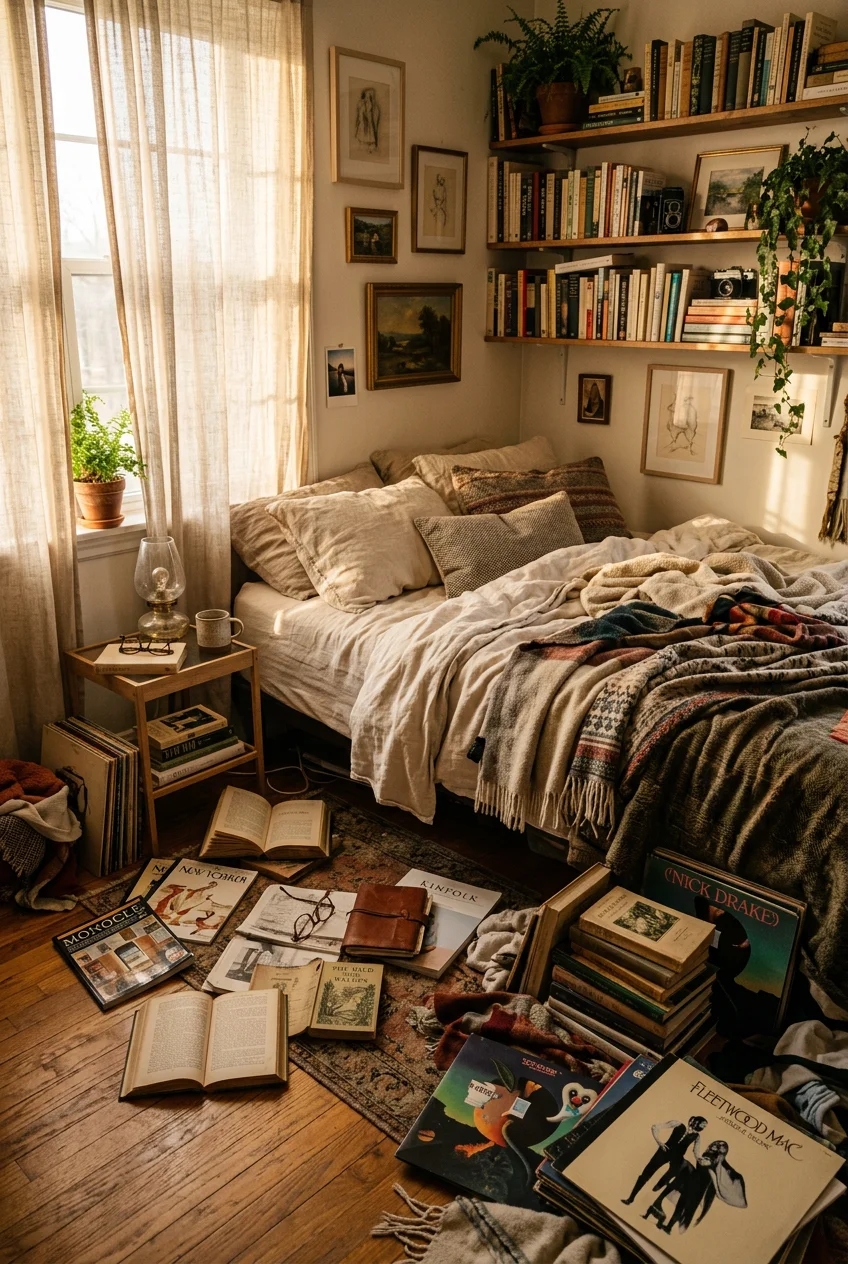
Last Tuesday at 10 PM, I sat on my bedroom floor staring at a pile of vintage brass candlesticks and a stack of unread paperbacks. My attempt at a minimalist sanctuary looked exactly like a sterile doctor’s office waiting room. I spent three years trying to force myself into the clean-girl trend before finally accepting that a cluttered bedroom aesthetic is actually what my brain needs to relax. It’s not about leaving dirty laundry on the floor or hoarding trash. It’s about intentional maximalism and curating a space that actually reflects your personality. When I finally stopped fighting my instinct to collect things and started organizing them instead, the entire energy of my house shifted. I’m going to walk you through exactly how I transformed my boring white box into a rich, layered sanctuary. I’ve made plenty of expensive mistakes along the way, so I’ll share the exact measurements, paint colors, and rules you need to follow to get this right.
1. Embrace Color Drenching with Moody Hues

Instead of painting one sad accent wall, you need to paint the walls, trim, baseboards, and ceiling the exact same color. I tried leaving my ceiling white for months before I realized it made the room feel disjointed. Last month, I bought three gallons of Behr’s “Hidden Gem” (a smoky blue-green that costs $54.98 per gallon at Home Depot) and painted every square inch of my 12×14 foot bedroom. The difference is stark. When you paint the trim and ceiling to match the walls, it blurs the hard edges. This creates a cocoon effect that grounds the space and makes the perfect backdrop for a cluttered bedroom aesthetic. If you’re using a flat finish on the walls, buy a satin finish in the exact same color for the baseboards so they hold up to the vacuum cleaner. Skip the builder-grade beige; it looks like wet cardboard under artificial light. If blue isn’t your vibe, Valspar’s “Warm Eucalyptus” is a solid green alternative that costs $49.98 a gallon at Lowe’s. The dark color acts as an anchor for all the objects you’re going to layer into the space.
2. Layer Textiles Extravagantly on the Bed

A flat, tightly made bed looks out of place when you’re going for a collected look. You need to combine different weights and textures to build physical depth. I start with a set of 100% linen sheets from Target’s Casaluna line. A queen set costs $139. They feel slightly scratchy straight out of the packaging, but they soften up beautifully after three washes in hot water with 1/2 cup of baking soda. Over the crisp linen, I use a heavy, plain white cotton duvet. Then comes the crucial part: a velvet quilt folded at the bottom third of the bed. I bought a 90×90 inch dark rust velvet quilt from West Elm for $229. It adds a heavy, light-catching texture that anchors the mattress. Finally, I throw a 60×70 inch faux fur blanket right at the foot. I found a great one at Costco last winter for just $19.99. The stark contrast between the matte, wrinkly linen and the shiny, smooth velvet makes the bed look intentionally messy and inviting. Don’t iron your sheets. The wrinkles are part of the texture.
3. Curate a Maximalist Gallery Wall (with a Twist)

The wall behind your headboard needs to hold a dense, salon-style arrangement of art. A common mistake is buying a matching 10-piece set of black frames. I did this in my first apartment, and it looked like a generic hotel lobby. Instead, you need a chaotic mix of ornate gilded frames, raw wood, and lacquered pieces. I source most of my 8×10 and 11×14 inch frames from Goodwill for $3 to $5 each. The trick to keeping a cluttered bedroom aesthetic from looking like an actual junk shop is a unifying element. For my wall, every single piece of art contains some shade of mustard yellow, even if the frames and art styles are entirely different. Alternatively, you can use wildly different art prints but paint all your mismatched frames the same antique gold. I use Rust-Oleum Metallic Gold spray paint, which costs $6.98 a can at Walmart. Hang the frames extremely close together. Leave no more than 1.5 inches of space between them. You want your eye to bounce rapidly from piece to piece without getting stuck on blank wall space.

50×70 Inch Rust Throw Blanket – Soft & Fluffy Fleece
50×70 Inch Rust Throw Blanket – Soft & Fluffy Fleece punches above its price — 12 buyers rated it 4.5 stars. I would buy it again.
4. Invest in an Oversized Statement Headboard

When you have a massive amount of items in a room, the bed needs a strong visual anchor so it doesn’t get lost in the shuffle. A flimsy metal bed frame won’t cut it. I bought a cheap wire frame off Amazon five years ago. It squeaked, and my pillows constantly fell through the back gap during the night. I finally replaced it with the IKEA Tufjord upholstered headboard, which costs $299 for a queen size. It’s 43 inches tall and features a curved, wingback design in a deep green velvet. The massive scale of the headboard provides a solid resting place for the eye. If you can’t afford a brand new bed, you can fake the scale yourself. I helped my sister staple 2 yards of heavy upholstery fabric (about $45 total at Joann Fabrics) over a piece of 1/2-inch thick plywood cut to 60×40 inches. We padded it with a 2-inch thick foam roll ($35) and mounted it directly to the wall behind her mattress using heavy-duty metal French cleats.
5. Master Pattern Mixing with Varying Scales

Mixing patterns is mandatory for this look, but there is a strict mathematical formula to it so you don’t induce a migraine. You must combine large-scale, medium-scale, and tiny-scale prints. If you put two medium-scale prints directly next to each other, they fight for visual dominance. I learned this the hard way when I paired a medium floral duvet with medium geometric curtains. The room felt visually vibrating in a highly unpleasant way. Start with a large-scale pattern on the walls. Lick’s “Electric Poppies 02” wallpaper costs $120 a roll and features massive, sprawling flowers. Since the wall pattern is huge, your bedding needs a small, tight pattern. I use a tiny 1/4-inch black and white gingham print for my pillowcases. Then, for the medium scale, I add a throw pillow with a 3-inch wide geometric stripe. The secret is pulling one specific color through all three patterns. If the wallpaper has a distinct olive green leaf, make sure that exact olive green shows up in the stripe of your throw pillow. You might also like: 20 Charming Bedroom Ceiling Lighting You Haven’t Thought Of
6. Layer Rugs for Depth and Texture

Bare wood floors make a room echo, and a single rug often looks too flat. You need to layer them to build up the floor. Start with a massive, neutral base rug that covers at least two-thirds of the floor space. I use a 9×12 foot chunky jute rug from NuLoom that I bought at Walmart for $189. Jute is thick and slightly rough underfoot, which provides a fantastic textural baseline. On top of that, I place a 5×7 foot vintage Persian-style rug right at the base of the bed. I found a synthetic, low-pile patterned rug at Target for $99. The synthetic material is actually a bonus here because it’s thin enough that you won’t trip over the transition between the two rugs. The contrast between the rough, natural fiber of the massive jute rug and the intricate, colorful pattern of the smaller top rug adds immediate warmth. Pro tip: always use a 1/4-inch thick felt rug pad ($45 on Amazon) under the base rug. It stops the coarse jute from scratching your hardwood floors to pieces. You might also like: 18 Aesthetic Posters For Bedroom That Actually Work

200 FT Led Lights for Bedroom (2 Rolls 100 FT)
200 FT Led Lights for Bedroom (2 Rolls 100 FT) has been one of the most consistently praised picks in this category. 827 reviewers averaged 4.5/5.
7. Incorporate Free-Standing, Characterful Furniture

Built-in closets are efficient, but they’re incredibly boring to look at. To get that collected-over-time atmosphere, you need large, free-standing furniture pieces. Three years ago, I ripped out a basic wire-shelving closet system and replaced it with a massive antique mahogany armoire I found on Facebook Marketplace for $250. It weighs about 300 pounds and required three exhausted friends to move it up my narrow stairs. It was a complete nightmare to transport, but it changed the entire geometry of the room. The carved wood and heavy brass keyhole hardware add a level of history that white MDF simply can’t provide. If an armoire is too big for your space, look for an antique dresser or a long mid-century modern sideboard to use as your main clothing storage. Don’t worry if the wood tones don’t match your nightstands. They shouldn’t match at all. Matching bedroom sets are the enemy of this aesthetic. If a piece of vintage furniture smells musty, leave a plastic bowl with 1 cup of dry coffee grounds inside it for a week to absorb the odor before you put your clean clothes in. You might also like: 17 Boho Bedroom Decor You Need to See
8. Display Sentimental Items Creatively

Stop keeping your concert tickets and your grandmother’s brooches in a dusty shoebox under the bed. The whole point of this style is to have your personal history entirely visible. I use shadow boxes for anything three-dimensional. I buy the 11×14 inch Studio Décor shadow boxes from Michaels when they go on sale for $24.99. I pin my old 5K running medals, vintage enamel pins, and a pair of tarnished silver spoons my aunt gave me directly to the linen backing. For flat items like postcards, matchbooks, or Polaroid photos, I skip the frames entirely. I bought a set of 8-inch tall wooden letters spelling my initials for $4 each at local craft stores. I used a 4-ounce jar of matte Mod Podge ($5.99) to decoupage the paper items directly onto the raw wood. It creates a dense, chaotic collage that looks deliberate and artistic. I place these heavy wooden letters on my dresser next to a stack of hardback books. It turns literal paper clutter into a distinct architectural feature in the room.
9. Utilize Vertical Space with Intentional Shelving

When your floor space is full of heavy furniture and layered rugs, you have to move your storage upward. Floating shelves are the best way to display collections without taking up precious square footage. I bought four 36-inch wide pine floating shelves from Home Depot for $29.98 each. Here is the trick to making them look expensive and custom: I painted them the exact same dark blue-green color as my walls. This makes the wooden shelves visually recede, so the objects sitting on them seem to float in mid-air. I load these shelves with thick hardback books, small brass animal figurines, and trailing potted plants. Most people just line their books up straight like a library. Don’t do that. Stack three books horizontally to act as a pedestal, then lean four books vertically against them. Place a small, heavy object on top of the horizontal stack. I use a 3-inch purple geode I bought at a museum gift shop for $12. Breaking up the vertical lines makes the shelf look highly curated.

Govee RGBIC LED Strip Lights, Smart LED Lights for Bedroom
Govee RGBIC LED Strip Lights punches above its price — 248 buyers rated it 4.5 stars. I would buy it again.
10. Bring in Lush Greenery with High-Impact Plants

You need biological life in the room to balance out all the heavy textiles and dark wood. Small, sad succulents sitting on a windowsill won’t make a dent. You need high-impact, dramatic plants. Last Tuesday at Trader Joe’s, I grabbed a 6-inch potted Monstera Deliciosa for just $14.99. It sits on a wooden stool in the corner of my room, and its massive, split leaves cast incredible shadows on the wall at night. I also have a 4-foot tall Fiddle Leaf Fig that I bought at Sprouts for $39.99. I put it in a heavy ceramic pot ($45 at Target) right next to my mahogany armoire. For the higher shelves, I rely heavily on trailing plants like Golden Pothos. I hang one in a thick cotton macramé hanger ($15 on Etsy) from a metal hook screwed directly into the ceiling joist. A quick warning: I killed my first Fiddle Leaf Fig because I put it in a dark corner. These big plants need actual sunlight to survive. If your bedroom is dark, skip the live trees and buy a high-quality fake olive tree. A decent 5-foot artificial tree from Target costs about $80, and it won’t drop dead leaves all over your vintage rug.
11. Use Lighting as a Textural Element

Overhead flush-mount lighting is aggressive and flattens out all the beautiful details in your room. You need at least three separate light sources at different heights. I never turn on my ceiling light anymore. Instead, I rely on a vintage Murano glass mushroom lamp I found on Etsy for $250. It sits on my nightstand and casts a warm, mottled glow through the swirled white glass. On the other side of the bed, I use a cheap brass lamp base from Walmart ($19.98) but I swapped out the basic white shade for a 10-inch pleated fabric shade from Target’s Threshold line ($20). The pleats add a harsh, geometric shadow that looks fantastic against the dark painted walls. For ambient light, I installed a small, plug-in spotlight ($15 at Home Depot) on the floor hidden behind my plant stool, pointing upward. It highlights the wide leaves of the Monstera and creates massive, dramatic shadows on the ceiling. Mixing smooth glass, pleated fabric, and raw metal adds three distinct textures to the room without taking up much physical space.
12. Don’t Forget the Fifth Wall (The Ceiling)

The ceiling is the largest expanse of uninterrupted space in your bedroom, and leaving it stark white is a massive missed opportunity. If you aren’t color-drenching the room with paint, you should wallpaper the ceiling. I helped a friend install a peel-and-stick tin-tile replica wallpaper on her bedroom ceiling last month. We used a brand called NuWallpaper, which costs $34.99 for a 20.5-inch by 18-foot roll on Amazon. It took us four hours of intense labor, and our necks hurt for two days afterward. It was physically miserable to install. But the final result is incredible. The metallic sheen reflects the ambient light from her bedside lamps and makes the standard 8-foot ceiling feel much taller. If wallpaper on the ceiling sounds too intense for you, paint the ceiling a color that sharply contrasts with your walls. If your walls are a soft cream, paint the ceiling a deep terracotta. It draws the eye upward immediately and makes the room feel like a customized jewel box rather than a standard drywall cube.

SILFU Neon Rope Lights, 50FT RGB LED Strip Lights
Honestly, SILFU Neon Rope Lights surprised me — sturdier than it looks in the photos, and over 112 buyers gave it 4.5 stars.
13. Incorporate Multifunctional Storage that Doubles as Decor

A room full of objects easily crosses the line into a garbage dump if you don’t have hidden storage solutions. You need designated places to shove the ugly things like laptop chargers, heating pads, and extra pillowcases. I use an 18-inch round velvet ottoman with a removable lid from West Elm. It cost $349, which really hurt my budget at the time, but it serves as a sturdy seat when I’m putting on my shoes and holds four bulky winter sweaters inside. At the foot of my bed, instead of a traditional wooden bench, I use a vintage canvas and wood steamer trunk I bought at a local flea market for $60. It’s 36 inches long and holds all my extra heavy blankets. The battered canvas exterior fits perfectly with the highly textured aesthetic, while the cavernous inside hides the chaos. When you’re buying furniture for this style, always check if it opens up. If a piece of furniture takes up valuable floor space but doesn’t offer interior storage, it’s simply not working hard enough for you.
14. Mix Vintage and Modern Elements

If you only buy vintage items, your room will look like a dusty museum exhibit. If you only buy modern items, it looks like a sterile catalog page. You have to force the two eras to crash into each other. I have an ornate, heavily carved antique oak dresser from the 1920s. Right on top of it sits a sleek, stark white Google Nest Hub ($99 at Best Buy) and a minimalist, matte black metal desk lamp ($35 from IKEA). The harsh, clean lines of the modern electronics make the intricate wood carving of the antique dresser stand out even more. I also put Philips Hue smart bulbs ($49.99 for a two-pack at Target) into my vintage brass lamps. I can control the color temperature of the room from my phone, turning the lights a deep amber right before bed. The bulbs are modern technology hidden completely inside 60-year-old brass. This tension between old and new is exactly what makes a space feel dynamic and intentionally collected rather than just old and forgotten.
15. Surprising Tip: Overlap Items on Your Gallery Wall and Shelves

This is the most important rule for the cluttered bedroom aesthetic, and it’s the one that drives strict minimalists completely nuts. You have to physically overlap your belongings. When I first set up my dresser, I lined up my perfume bottles, a wooden jewelry box, and a framed photo in a neat, straight row. It looked rigid and awful. Then, I slid the framed photo behind the jewelry box so that the bottom right corner of the frame was entirely obscured. I leaned a small hand mirror against the side of a stack of books. On my gallery wall, I intentionally hung a small 4×6 inch frame so it physically overlaps the edge of a larger 16×20 inch canvas. You can use 3M Command Strips ($4.98 for a pack at Kroger) to secure the overlapping frame to the larger one so it doesn’t wobble. Layering objects over each other mimics the way items naturally accumulate over a lifetime. It forces the eye to stop and investigate the space, creating a dense, rich visual experience. Don’t arrange your room like a retail store display. Arrange it like a crowded, beloved antique shop.
Finding the right balance takes time and patience. You won’t get it right on the first try, and that’s perfectly fine. I rearranged my floating shelves four times this week alone before I was happy with the visual weight. Stop worrying about making the space look perfectly clean and start focusing on making it look intensely personal. If you’re tired of living in a beige box, go buy that weird vintage lamp or that dark gallon of paint. I’d highly recommend starting with the lighting first. Pin this guide for your next weekend project, and let me know which corner of your bedroom you decide to tackle first.

Amazon Basics Bedroom Closet Organizer with 5-Fabric
Amazon Basics Bedroom Closet Organizer with 5-Fabric Storage Drawers f punches above its price — 41 buyers rated it 4.5 stars. I would buy it again.
Frequently Asked Questions
What is the cluttered bedroom aesthetic?
The cluttered bedroom aesthetic is a design trend focused on intentional maximalism. It involves layering textures, mixing vintage and modern decor, and displaying personal collections to create a cozy, highly personalized space rather than a sterile, minimalist room.
How do you make a cluttered room look aesthetic instead of messy?
The secret is using unifying elements like a consistent color palette and intentional grouping. Overlap items deliberately, use hidden storage for ugly electronics, and anchor the room with a dark wall color to make the clutter look curated.
What colors work best for a maximalist bedroom?
Deep, moody hues work best because they ground the space. Color drenching—painting the walls, trim, and ceiling in a single saturated color like dark green, navy, or terracotta—creates a perfect backdrop for layered decor.
How do I mix patterns without it looking chaotic?
You must vary the scale of the patterns. Combine one large-scale print (like floral wallpaper) with a medium-scale print (like striped pillows) and a tiny-scale print (like gingham sheets), ensuring one specific color ties them all together.
