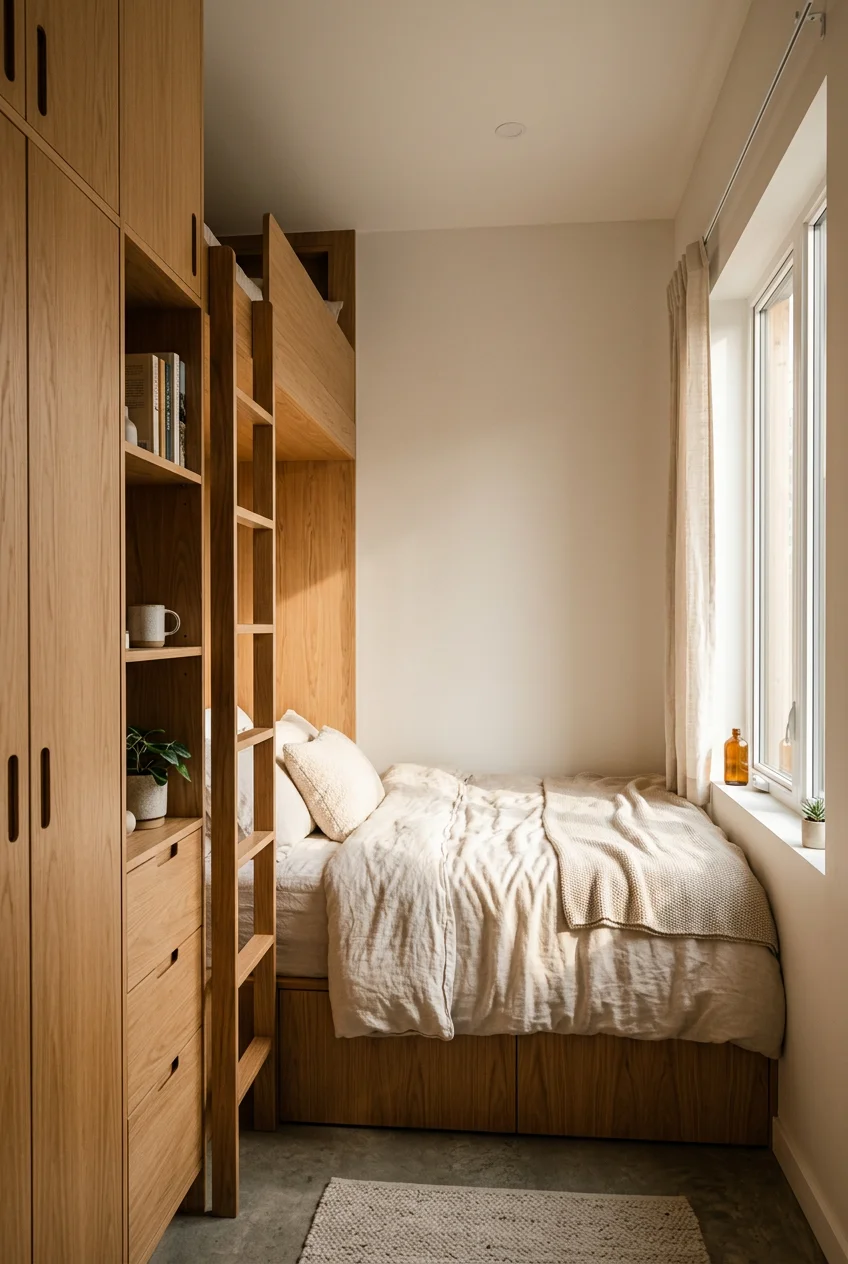
What’s Inside
- Embrace Vertical Storage with Wall-Mounted Solutions
- Invest in a Multifunctional Bed, like a Murphy or Loft Bed
- Opt for Wall-Mounted Nightstands or Slim Alternatives
- Maximize Storage with Under-Bed Solutions
- Strategically Place Large Mirrors to Amplify Space and Light
- Implement Layered Lighting with Wall-Mounted Fixtures
- Choose a Cohesive, Light Color Palette with Warm Neutrals
- Ditch Traditional Closet Doors for Curtains or Sliding Doors
- Select Proportionate, Leggy Furniture
- Utilize the Back of Doors for Hidden Storage
- Go Big with Your Area Rug (Don’t Go Small)
- Embrace Multifunctional Furniture Beyond the Bed
- Avoid Feature Walls in Super Small Bedroom Ideas
- Incorporate Vertical Elements in Decor and Textiles
- Declutter Ruthlessly and Curate Thoughtfully
- Install a Drop-Leaf Desk for Super Small Bedroom Ideas
Last October, I tried shoving a standard queen frame and two bulky dressers into my 9×10 guest room. I ended up with a bruised shin, a cracked baseboard, and a layout so tight I had to shimmy sideways just to open the closet door. If you’re hunting for small bedroom ideas that actually work, I’ve been exactly where you are. Decorating a tiny space isn’t just about buying miniature furniture. It’s about tricking the eye and using every square inch of vertical room. I tried the generic advice for months before figuring out what works day-to-day. Skip the tiny, useless scatter rugs. They chop up the floor and look like bath mats floating in a void. Instead, focus on smart dimensions, specific hardware, and ruthless curation. Here’s how I fixed my cramped layout, including the products, measurements, and hard lessons I learned. Trust me.
1. Embrace Vertical Storage with Wall-Mounted Solutions

When floor space is limited to a narrow perimeter around your mattress, you have to look up. I spent three years tripping over a pile of books and a dying pothos plant before I finally used my blank walls. Installing floating shelves pulls weight off the floor. I recommend the IKEA EKET system. The single cubes cost $25 each, and you can stack them asymmetrically to hold your water glass or heavy novels. I also mounted an IKEA SKÅDIS pegboard ($24.99) above my tiny desk. It holds scissors, charging cables, and a metal cup of pens. The matte white pegboard against a flat wall adds a nice architectural element, too. Just don’t make the mistake I did last Tuesday. I tried to mount a heavy oak shelf using basic plastic drywall anchors from Walmart. The entire thing ripped out of the wall at 2 AM, shattering my favorite mug. I learned that the hard way. Buy heavy-duty toggle bolts from Home Depot for $6.98 a pack if you store anything heavier than a paperback.
2. Invest in a Multifunctional Bed, like a Murphy or Loft Bed

A standard queen bed eats up a massive footprint. If you’re working with less than 100 square feet, a traditional frame acts like a giant sponge. A Murphy bed reclaims significant space. I looked into Lori Beds recently. A queen-sized Murphy bed occupies about 9 square feet closed, compared to 33 square feet when open. That gain of 24 square feet means you actually have room to roll out a yoga mat or open a suitcase without contorting your spine. They cost around $1,499. It’s an investment, but the solid wood construction smells like real pine and won’t wobble. Alternatively, if you’re decorating for a teenager or a casual guest room, a loft bed clears the floor completely. The IKEA VITVAL loft bed frame costs $249 and opens up the area underneath. I set one up for a client, and we slid a 47-inch desk under it to create a shadowed nook for working. The metal ladder is cold on bare feet, but the trade-off is worth it.
3. Opt for Wall-Mounted Nightstands or Slim Alternatives

Nothing suffocates a tight layout faster than two chunky nightstands flanking the mattress. I used to have heavy mahogany tables from a thrift store that blocked my dresser drawers. Choose wall-mounted options or slim, leggy designs to keep things airy and free up the floor. Floating nightstands should sit 24 to 28 inches high, level with your mattress. I installed a walnut-veneered floating drawer from West Elm for $149. It has a narrow depth of just 10 inches, keeping the area tight without sacrificing utility. I fit my lip balm, earplugs, and a 6 oz bottle of hand cream inside, leaving the top clear. If you won’t drill into the studs, look for a pedestal table with a single metal base. Target sells a Project 62 round marble-top side table for $60. The slim brass stem allows light to pass right through, preventing the mistake of visually overcrowding the bed.

Bedsure GentleSoft White Throw Blanket for Couch
If you want something that just works, Bedsure GentleSoft White Throw Blanket for Couch – Cozy Soft Fleece Su is a safe bet (236 reviews, 4.5 stars).
4. Maximize Storage with Under-Bed Solutions

You’re wasting premium real estate if you let dust bunnies claim the dark cavern beneath your mattress. I used to stuff random cardboard boxes under my bed, which looked messy every time the duvet shifted. Using this space is essential. I eventually bought the IKEA MALM bed frame with four integrated rolling drawers for $399. The drawers slide out on metal casters, deep enough to hold my bulky winter sweaters and three extra sets of sheets. The white stained oak veneer feels high-end. If you have a standard metal frame and can’t afford a new bed, buy dedicated under-bed storage bins. Skip the cheap fabric bags that tear. I bought a set of four Iris USA plastic latching boxes from Costco for $34.99. They’re exactly 6.5 inches tall, slipping perfectly beneath a standard 7-inch bed clearance. The hard plastic protects off-season clothes from moisture. Measure your clearance height first. I once bought 8-inch bins from Target that got wedged so tightly I had to lift the mattress to pry them out.
5. Strategically Place Large Mirrors to Amplify Space and Light

A large, frameless mirror placed opposite a window acts like a fake second window. It bounces natural sunlight across the room, making tight quarters feel larger and brighter. I learned this after living in a gloomy north-facing apartment where I had to turn on the lights at noon. I bought a 65-inch by 22-inch aluminum-framed floor mirror from Target for $70 and leaned it against the wall facing my window. The room instantly stopped feeling like a cave. Designers always suggest placing mirrors near windows to maximize light. Avoid hanging a cluster of small mirrors. A gallery wall of tiny mirrors chops up the reflection and adds visual clutter. If you lack wall space, consider mirrored closet doors. IKEA’s PLATSA wardrobe system lets you add full-length mirrored doors (the LÄRDAL doors cost about $60 each). It’s a brilliant two-in-one solution that hides your clothing while doubling visual depth. Keep Windex handy, because those doors show every fingerprint.
6. Implement Layered Lighting with Wall-Mounted Fixtures

Relying on a single overhead dome light is a terrible idea. That flat, downward beam creates harsh shadows and makes a small room feel like a waiting room. I lived with a cheap flush-mount ceiling light for a year, and it gave me a headache every time I read in bed. Instead, layer your ambient, task, and accent lighting. Wall-mounted sconces are excellent for reading, freeing up your nightstand. I installed two IKEA RANARP wall lamps ($34.99 each) directly into the studs behind my headboard. The matte black metal looks industrial, and the fabric-wrapped cords add detail. I angled the shades down for reading so the light doesn’t blind me. For accent lighting, I stuck a 16-foot strip of Govee LED lights ($19.99 on Amazon) along the back edge of my headboard. It creates a soft, diffused glow against the paint, adding an illusion of depth without taking up floor space. You might also like: 19 Home Decor Bedroom for Every Budget

SUOXING Bedside Wall Organizer for Bedroom,Rv,Small Rooms
If you want something that just works, SUOXING Bedside Wall Organizer for Bedroom is a safe bet (214 reviews, 4.5 stars).
7. Choose a Cohesive, Light Color Palette with Warm Neutrals

A common mistake is assuming you have to paint a tiny room hospital white. I tried that in my first studio using cheap flat white paint from Walmart, and the walls looked dingy. A minimalist neutral palette with soft whites, warm beiges, or even pale pinks is a much better approach. These colors create a soothing, expansive feel without feeling sterile. I repainted my current bedroom using Behr Premium Plus paint from Home Depot in ‘Swiss Coffee’ ($34.98 a gallon). It has a creamy, warm undertone that catches the afternoon light beautifully. Painting the walls, baseboards, and ceiling the same color blurs the sharp boundaries of the room. When your eye doesn’t catch a harsh line where the wall meets the ceiling, it creates the illusion of more height. Skip the high-gloss finishes. They just highlight every dent in your drywall. You might also like: 17 Cozy Teen Bedroom You Need to See
8. Ditch Traditional Closet Doors for Curtains or Sliding Doors

Traditional hinged closet doors consume at least three feet of floor space every time you swing them open. In a tight layout, that swing radius might hit the foot of your bed. I used to have heavy wooden bi-fold doors that constantly jammed. I finally ripped them out and replaced them with a lightweight linen curtain. This small change made the room feel more spacious and improved the visual flow. I bought a heavy-duty tension rod from Target for $15 and hung two panels of IKEA DITTE cotton curtains ($14.99 a pair). The soft drape adds a nice textural element, and I can push them out of the way when I’m doing laundry. If you hate the curtain look, invest in a sliding track system. Hammonds Furniture offers mirrored sliding wardrobes that glide silently, combining hidden storage with the mirror trick. Just make sure your closet is organized, because a curtain won’t block the sound of a falling shoe rack. You might also like: 20 Clever Bedroom Ideas for Men That Make a Real Difference
9. Select Proportionate, Leggy Furniture

Oversized, bulky furniture that sits flat on the floor eats up visual space. I once bought a massive, solid oak dresser from a garage sale. It sat directly on the carpet with no legs, making my room feel like a cramped storage unit. You have to choose sleek styles with visible legs. When a piece of furniture is lifted off the ground, it allows light and sight lines to pass underneath, making the floor feel continuous. I eventually sold that heavy oak monster and bought a mid-century modern dresser from West Elm for $899. It features 6-inch tapered wooden legs. Seeing the baseboard and floor running underneath the dresser tricks your brain into thinking the room is wider. Apply this logic to your bed frame, too. A platform bed with a solid base is visually heavy. A frame with thin legs lets the room breathe. Remember that leggy furniture means you have to vacuum under it regularly.

HOMZ 2-Pack Snaplock, Small Clear Plastic Storage Organizer
HOMZ 2-Pack Snaplock punches above its price — 56 buyers rated it 4.5 stars. I would buy it again.
10. Utilize the Back of Doors for Hidden Storage

Don’t overlook the back of your entry or closet doors. A standard interior door offers over 17 square feet of vertical surface. I ignored this for years, leaving my belts and scarves in a tangled knot. Installing an over-the-door organizer gets that clutter off your floor. I bought The Container Store’s Elfa utility door rack system for $140. It hooks securely, so it doesn’t bang against the wood. The white epoxy-coated steel baskets hold my hair tools, winter scarves, and a small bin for loose receipts. You can also use a simple hook rack for an overnight landing pad. I have a $12 steel hook rail from Walmart on my closet door where I hang the next day’s outfit. Just ensure your door hinges are tight. Adding 15 pounds of denim and shoes to a hollow-core door can cause it to sag.
11. Go Big with Your Area Rug (Don’t Go Small)

It sounds backward, but a massive area rug makes a small room feel bigger. A tiny 3×5 scatter rug at the foot of the bed acts like a visual island, emphasizing the room’s small size and chopping up the floor. I made this mistake in my twenties, buying a cheap 4×6 faux fur rug from Ross for $25. It looked like a bath mat floating in the room. An oversized rug that extends under your bed draws the eye outward, creating an illusion of space. Designer Kati Curtis emphasizes this rule: choose a rug that covers almost the entire room. I upgraded to an 8×10 flatweave wool rug from Boutique Rugs for $189. It slides completely under my queen bed and nightstands. The continuous pattern grounds the furniture and makes the floor feel deliberate. The wool is slightly scratchy, but a low-pile rug is much easier to vacuum in tight quarters.
12. Embrace Multifunctional Furniture Beyond the Bed

When you only have room for three pieces of furniture, every single one needs to pull double duty. Single-use items are a luxury you can’t afford. I used to have a velvet chair in the corner that solely held clean laundry. It was a waste of 4 square feet. I replaced it with a hollow storage ottoman from Target ($45) that holds throw blankets inside and serves as a seat. Look for a small desk that doubles as a nightstand. A 30-inch wide console table can hold your laptop during the day and a lamp at night. IKEA’s HEMNES daybed is a prime example of brilliant engineering. It costs $399, functions as a sofa during the day, pulls out into a king-sized bed, and features three massive storage drawers underneath. Just measure your drawer clearance before buying a thick rug. A high-pile shag will block those drawers from opening.

QEEIG Floating Shelves for Wall Bathroom Shelf Bedroom
Honestly, QEEIG Floating Shelves for Wall Bathroom Shelf Bedroom Kitchen Living surprised me — sturdier than it looks in the photos, and over 46 buyers gave it 4.5 stars.
13. Avoid Feature Walls in Super Small Bedroom Ideas

A common mistake is creating a bold, dark feature wall behind the bed. I painted a navy blue accent wall in my old 10×10 bedroom, thinking it would add interest. Instead, the dark wall felt like it was closing in on me, highlighting the boxy edges. If you want effective small bedroom ideas, ditch the high-contrast accent wall. Stick to one color for all four walls. Wrapping the room in the same shade blurs the corners and creates the illusion of continuous space. If you want a dark color, like moody forest green or charcoal, paint the entire room, including the ceiling. I recently painted a tiny guest room entirely in Sherwin-Williams ‘Urbane Bronze’ ($75 a gallon). Because the ceiling matched the walls, the sharp boundaries disappeared. The room feels like a shadowed jewelry box rather than a closet. The paint fumes were intense, so keep a box fan running for 48 hours.
14. Incorporate Vertical Elements in Decor and Textiles

To draw the eye upward and fake the illusion of tall ceilings, you have to use strong vertical lines. Horizontal stripes or squat furniture will make a room feel squashed. I used to have short curtains that cut the wall in half horizontally. It made my standard 8-foot ceilings feel like a basement. I swapped them for floor-to-ceiling curtains, and the visual lift was staggering. I bought two panels of heavy cotton velvet curtains from CB2 for $119 each. I mounted the matte black curtain rod two inches below the ceiling and let the fabric pool slightly. That long vertical line forces your eyes to look up. You can also achieve this with vertical paneling. Even your plant choices matter. I bought a 3-foot artificial olive tree from Target for $80. It draws the eye straight up, distracting from the narrow floor.
15. Declutter Ruthlessly and Curate Thoughtfully

Excessive visual clutter makes a small room feel chaotic. A mish-mash of tiny items scattered across every surface creates visual static. I used to line my dresser with ten different perfume bottles, jewelry, and mail. It made the whole room feel messy, even right after I vacuumed. A major 2026 trend emphasizes personalized pieces over generic catalogs, but this requires ruthless curation. Group your small daily accessories on a single, structured tray. I bought a brass and glass vanity tray from Target’s Hearth & Hand line for $24.99. Containing my daily moisturizer, a candle, and my rings within that tray made the dresser look intentional. Ensure every single item has a designated home inside a drawer or a box. If a book or a sweater doesn’t have a specific home, donate it. Living in a tight space means you can’t hoard empty shoeboxes or clothes that don’t fit. No exaggeration.

YUFLINX 16’’White Floating Shelves for Wall Set of 4
Honestly, YUFLINX 16’’White Floating Shelves for Wall Set of 4 surprised me — sturdier than it looks in the photos, and over 645 buyers gave it 4.5 stars.
16. Install a Drop-Leaf Desk for Super Small Bedroom Ideas

When you need a workspace but lack the square footage for a proper desk, a wall-mounted drop-leaf table is the ultimate solution. I tried cramming a 48-inch wooden desk into my bedroom, and the corner constantly bruised my hip. If you’re hunting for practical ideas, this one is functional. I replaced the bulky desk with an IKEA BJURSTA wall-mounted drop-leaf table for $49. When folded down, it sits flat against the wall, projecting barely two inches into the room. When I need to answer emails, I flip it up, and the heavy steel hinges lock into place, providing a sturdy 35-inch surface. The laminate top is easy to wipe down. The only negative is the installation. You absolutely must mount the brackets into wooden wall studs. I tried using heavy-duty drywall anchors the first time, and the table sagged under the weight of my laptop.
Living in a tight space doesn’t mean you have to sacrifice style or sleep in a room that feels like a storage unit. It just requires a bit more math and less hoarding. I’d recommend starting with the wall-mounted nightstands and the oversized rug. Those two changes shifted the proportions of my room within a single weekend. If you’re still feeling stuck, take a tape measure and map out your floor plan with painter’s tape before you buy anything. It saves you the headache of returning a 100-pound dresser to West Elm. Pin this list of small bedroom ideas to your home decor board so you can reference the measurements and products when you’re ready to start drilling holes in your drywall.
Frequently Asked Questions
How do I maximize space in a super small bedroom?
Utilize vertical wall space with floating shelves and wall-mounted sconces. Swap bulky furniture for leggy pieces that show the floor underneath, and use an oversized rug to visually expand the room’s footprint.
What colors make a tiny bedroom look bigger?
Warm neutrals like soft beige, taupe, and pale pink work best. Painting the walls, baseboards, and ceiling the exact same color blurs the sharp boundaries of the room, faking the illusion of higher ceilings.
Should I use a small rug in a small bedroom?
No, a small scatter rug chops up the floor plan and makes the room feel cramped. Choose a large area rug that extends under your bed and reaches within a foot of the walls to draw the eye outward.
How can I add storage without taking up floor space?
Use the 17 square feet of vertical space on the back of your doors for hanging organizers. You can also invest in a bed frame with integrated under-bed drawers or use wall-mounted pegboards for small accessories.
