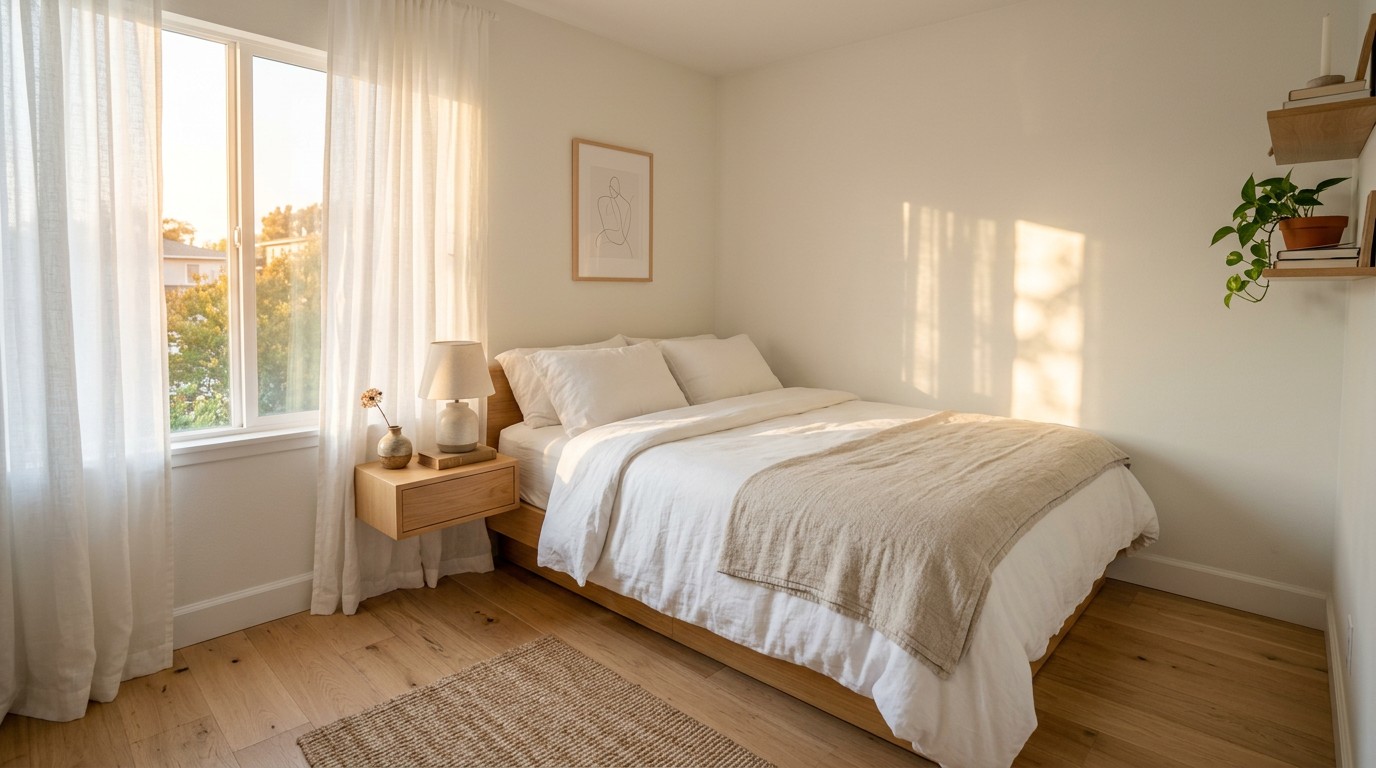
Three years ago, I tripped over a cheap plastic laundry basket in my cramped 9×10 bedroom and spilled a half-eaten bag of Trader Joe’s dark chocolate peanut butter cups all over my crisp white duvet. That sticky, frustrating, $3.99 chocolate mess was my absolute breaking point. I desperately needed real small bedroom inspiration that didn’t involve knocking down walls or spending my entire life savings. I’m talking about actual, usable space where I wouldn’t stub my toe every single morning. I spent months buying the wrong bulky furniture and painting walls the wrong shades of white before I finally figured out how to make a tiny room feel like a massive luxury suite. You don’t need a mansion to have a gorgeous sleep space. Here are the exact layouts, specific products, and sneaky design tricks I’ve used to fix my own cramped quarters.
1. Embrace Floating Furniture for an Airy Layout

If you’re dealing with a tiny floor plan, bulky nightstands are your worst enemy. I learned this the hard way when I tried to squeeze two massive oak tables next to my bed. I couldn’t even open my bottom dresser drawers without smashing my knuckles against the sharp wooden corners. Learned that the hard way. Opt for wall-mounted nightstands, slim floating shelves, and compact floating desks to free up floor space and reduce visual clutter. This approach is a big trend for 2026. It makes the room feel lighter and significantly more spacious, especially in minimalist designs. For a budget option, I highly recommend the Lack Wall Shelf from IKEA. It runs around $15 to $20 and holds exactly what you need. A heavy glass of ice water, a tangled phone charger, and a battered paperback book. If you’ve got a bigger budget, West Elm’s Floating Nightstand typically costs $150 to $300 and features a gorgeous, smooth walnut finish. Sweeping the floor underneath a floating nightstand takes two seconds. It’s incredibly satisfying.
2. Strategically Place Large Mirrors to Amplify Space

A common mistake I see constantly is mismanaging mirrors. People buy tiny, decorative mirrors and hang them in dark corners where they do absolutely nothing. Instead, you need to use oversized mirrors to reflect light and create the illusion of depth. Place a large frameless mirror opposite a window to literally double your natural sunlight. I bought IKEA’s Hovet mirror for around $150. It’s heavy, cold glass and massive, but leaning it against my wall completely changed the room’s proportions. Expert designer Marcia Bryan suggests mounting a tall mirror directly above a nightstand to pull the eye upward and shift the room’s scale. I tried this wrong for months before figuring it out. I owned a small round mirror that just looked like a weird little porthole on my wall. Upgrading to a floor-length rectangular shape made my ceiling feel two feet higher. Just make sure it reflects something pretty, not your messy open closet.
3. Implement Multifunctional Furniture

Maximizing utility is mandatory in small spaces. Look for pieces that serve multiple purposes. This is a huge trend for 2026 as homes get smaller and we all accumulate more stuff. You need furniture that works overtime. Examples include storage ottomans at the foot of the bed or beds with built-in drawers. I personally swear by IKEA’s Malm storage bed. It starts around $300 to $500 depending on the size you choose. The heavy drawers glide open so smoothly on their metal tracks, and they hold an incredible amount of stuff. I keep my thick winter sweaters, extra linen sheets, and even bulk snacks I buy from Costco hidden down there. If you’re designing a guest room, a high-quality sofa bed is essential. Skip the cheap metal futons. They feel like sleeping on a bag of sharp rocks. Invest in something with a real memory foam mattress. It’s worth the extra cash so your guests don’t wake up with terrible back pain.

QEEIG Floating Shelves for Wall Bathroom Shelf Bedroom
A dependable everyday pick — QEEIG Floating Shelves for Wall Bathroom Shelf Bedroom Kitchen Living pulls in 45 ratings at 4.5 stars. Not flashy, just solid.
4. Go Vertical with Smart Storage Solutions

When floor space is limited, you must utilize vertical space. Stop buying wide, low dressers that eat up half your room and leave you with nowhere to walk. Install wall-mounted shelving units, like IKEA’s Kallax series. They come in various sizes starting around $35, and you can fill them with textured woven baskets to hide your ugly charging cables and random junk. For clothing, consider a narrow, tall dresser instead of a wide horizontal one. The PAX Wardrobe system from IKEA is brilliant because it allows for completely customized vertical storage. Prices vary based on configuration, but a standard 175x58x201 cm setup runs around £328 or $400. I built one last Tuesday, and my fingers were blistered and raw from tightening the tiny metal screws, but the result was incredible. Taking your storage all the way up to the ceiling draws the eye up and stops the room from feeling like a cramped little box.
5. Color Drenching for Small Bedroom Inspiration

Here is a surprising tip that terrifies most people. Paint your ceiling. Color drenching means painting the ceiling the exact same color as the walls, or a slightly softer neutral, to blur the visual boundaries. This makes the room feel much larger. This trending approach for small bedroom inspiration avoids the stark contrast of a bright white ceiling that actually emphasizes the room’s small dimensions. I tried painting my tiny guest room a moody forest green last year, but I left the ceiling bright white. It looked like a swampy little cube. Once I finally painted the ceiling to match, the sharp corners seemed to completely disappear. The room felt like a cozy, endless luxury tent. Use a high-quality matte paint for this. I prefer Behr Marquee from Home Depot, which costs about $55 a gallon. It covers beautifully in one coat and doesn’t leave those awful roller streaks that ruin the whole vibe. You might also like: 20 Creative Bedroom Wall Design You’ll Want to Bookmark
6. Choose a Large Rug, Not a Postage Stamp
A massive, incredibly common mistake is using a rug that is way too small. A tiny 5×7 rug under a queen bed visually chops up the floor and makes the room feel even smaller than it already is. Instead, opt for a large rug that covers most of the floor space. It needs to extend at least 18 to 24 inches beyond the bed’s edge on the sides and the foot. For a queen bed, an 8’x10′ rug is usually your best bet. If space is very tight, a 6’x9′ can work if placed under the lower two-thirds of the bed. I absolutely love Ruggable for this. They offer washable rugs in various sizes, with an 8’x10′ typically ranging from $300 to $500. Last month, I spilled a massive mug of hot black coffee on my cream-colored Ruggable. I threw it in the washing machine, and it came out smelling fresh and looking brand new. Don’t skimp on rug size to save a few bucks. You might also like: 15 Brilliant Small Bedroom Inspiration That Changed Everything

Yieach Bedside Shelf for Dorm Bed,Rv
Honestly, Yieach Bedside Shelf for Dorm Bed surprised me — sturdier than it looks in the photos, and over 94 buyers gave it 4.5 stars.
7. Layer Lighting for Ambiance and Functionality

Relying on a single overhead light source is a rookie mistake. That harsh, glaring boob light on your ceiling makes a small room feel stark, flat, and tiny. Instead, you need to layer ambient, task, and accent lighting. Use wall sconces to save precious surface space on your nightstands. Brands like West Elm or Pottery Barn sell gorgeous brass plug-in sconces for $50 to $200 each. You don’t even need an electrician to hardwire them. Just drill two holes, mount the metal bracket, and plug them into the wall outlet behind your bed. Add a small table lamp on your dresser for warmth. I bought a tiny ceramic lamp from Target for $35, and the soft yellow glow it gives off at night is incredibly relaxing. Good lighting completely changes the mood of a room from a sterile hospital waiting area to a high-end boutique hotel. You might also like: 15 Cozy Small Bedroom Decor That Make a Real Difference
8. Hang Curtains High and Wide

If you want to create the illusion of taller ceilings and wider windows, you must mount your curtain rods correctly. Hang them 4 to 8 inches above the window frame. If you can, go all the way up to the ceiling line. Then, extend the rod 6 to 12 inches beyond the window on each side. This allows the curtains to frame the window rather than cover the glass when they’re open. I used to hang my curtains right on the window trim, and it made my room look squat and miserable. I bought a $25 matte black Threshold curtain rod from Target, patched the old holes with spackle, and moved the rod up near the crown molding. The difference was shocking. It literally looked like I had installed custom floor-to-ceiling windows overnight. Just make sure you measure twice before drilling into your drywall. I’ve ruined plenty of walls by guessing the center point.
9. Opt for Light, Sheer, Floor-Length Curtains

Heavy, dark, short curtains will visually chop up a small space and make it feel like a depressing cave. Choose lightweight, sheer fabrics like voile or organza in light, neutral colors. Crisp whites, warm creams, and soft pastels allow natural sunlight to filter through while still giving you basic privacy. This makes the room feel airier and significantly more spacious. I bought simple white sheer panels from Walmart’s Better Homes and Gardens line for just $15 a panel. They feel surprisingly soft, not like that stiff, scratchy polyester you usually find at that price point. Ensure your curtains are floor-length. They should barely kiss the floor. Curtains that stop at the windowsill look like high-water pants and instantly ruin the sophisticated vibe you’re trying to create. Let them drape beautifully to draw the eye upward and add visual height to your tiny room.

HOMIDEC Closet Organizers and Storage
HOMIDEC Closet Organizers and Storage punches above its price — 8 buyers rated it 4.5 stars. I would buy it again.
10. Choose a Dark Accent Wall Behind the Bed
While it seems counter-intuitive, painting a dark accent wall in a small room can actually help. A matte, moody paint color like a deep navy, forest green, or charcoal on the wall right behind the bed creates incredible visual depth. It visually pushes that wall back, faking extra square footage. This trick works best when the other three walls are kept light and neutral so you avoid a boxed-in feeling. I painted the wall behind my headboard a rich color called Hale Navy by Benjamin Moore (around $70 a gallon). The velvety, matte finish smells a bit strong for the first two days, but the result is stunning. It anchors the bed and makes my crisp white sheets pop beautifully. Just don’t use a glossy finish. Gloss reflects light weirdly and highlights every single bump, nail hole, and imperfection in your drywall. Stick to a flat or matte finish for that deep, endless look.
11. Minimize Nightstands with Picture Ledges
Traditional bulky nightstands can easily overwhelm a small bedroom. If you only have ten inches of space between your mattress and the wall, you can’t fit a standard table. Consider slimline options or, for a more surprising solution, use a picture ledge as a tiny bedside table. I bought IKEA’s Mosslanda picture ledge for $14.99. It’s only 4.5 inches deep. I mounted it right next to my pillow. It perfectly holds my phone, a tube of peppermint lip balm, and my reading glasses. It’s completely out of the way, and I don’t bang my knees on it when I get out of bed in the dark. I tried this wrong at first by buying a 10-inch deep floating shelf, and I kept hitting my head on the sharp corner while sleeping. Stick to a shallow picture ledge. It’s cheap, effective, and looks incredibly sleek.
12. Declutter Ruthlessly and Embrace Concealed Storage
A cluttered room will always feel smaller. You can’t design your way out of a hoarding situation. The 2026 trend heavily emphasizes concealed and discreet storage to create a calm, spa-like aesthetic. Use under-bed storage bins to hide your off-season clothes and extra shoes. IKEA’s Fredvang underbed storage unit costs around $50 to $70 and rolls out smoothly on little casters. I used to just shove ripped cardboard boxes under my bed, and they gathered massive, gross dust bunnies. Pulling them out was an absolute nightmare. Now, I’ve got clean, white wooden drawers that hide everything completely. If you’ve got open shelving, invest in matching woven baskets to hide the visual noise. I found some great water hyacinth bins at Target for $16 each. Hiding the clutter instantly lowers your stress levels and makes the room feel twice as big.

COOVA Faux Fur Throw Blanket for Couch
A dependable everyday pick — COOVA Faux Fur Throw Blanket for Couch pulls in 12 ratings at 4.5 stars. Not flashy, just solid.
13. Select a Bed that Fits the Room, Not Your Desires
A massive, common mistake is choosing a bed that is way too large for the room. Everyone wants a California King, but if your room is 10’x11′, a massive bed will ruin your daily life. You’ll be shimmying sideways against the wall just to get to your closet. For a small bedroom, a full-size or queen-size bed is generally the absolute maximum you should consider. Place it along the longest wall. Avoid king-sized beds in rooms smaller than 10’x12′ so you can maintain actual walking circulation. I bought a 14-inch Novaform queen mattress from Costco for $400, and it’s the most comfortable thing I’ve ever slept on. Downgrading from a king to a queen gave me back almost three feet of floor space. Suddenly, I had room for a small velvet accent chair in the corner. Proportion is everything in a tiny space.
14. Integrate Sleep and Work Zones with Smart Dividers
With more people working from home, creating distinct zones without building permanent walls is a trend for 2026. You don’t want to stare at your stressful laptop while you’re trying to fall asleep. Use compact fold-away desks, sliding Japanese-style panels, or even tall houseplants to subtly separate a small workspace from the sleeping area. Last Tuesday, I went to Whole Foods and bought a gorgeous, tall Ficus Audrey plant for $45. I placed it right between my bed and my tiny writing desk. The large, fuzzy green leaves create a perfect visual barrier. When I’m in bed, I can’t see my messy desk covered in sticky notes and coffee mugs. It physically separates the room without blocking the natural sunlight from the window. If you kill plants easily, a simple folding rattan screen from Amazon ($80) does the exact same job.
15. The Wallpaper Box for Small Bedroom Inspiration

For a bold and surprising approach, try the wallpaper box method. A 2026 trend for small bedroom inspiration involves wrapping the entire room, including the ceiling, in a single, subtle wallpaper pattern. This creates a cozy cocoon effect, making the room feel intentionally designed and luxurious rather than just cramped. Opt for subtle, small-scale patterns, tonal stripes, or delicate floral prints to avoid overwhelming the space. I used a peel-and-stick botanical print from NuWallpaper (around $35 a roll) in my tiny downstairs bedroom. Smoothing out the stubborn air bubbles on the ceiling was a brutal, sweaty arm workout. I definitely cursed a few times when the paper folded back on itself. But the finished result is absolutely breathtaking. It feels like stepping into a tiny, expensive jewel box. The sharp corners of the room disappear into the pattern, making the walls feel limitless.

ROMGUAR CRAFT Corner Floating Shelves Wall Mounted Set of 4
If you want something that just works, ROMGUAR CRAFT Corner Floating Shelves Wall Mounted Set of 4 is a safe bet (19 reviews, 4.5 stars).
16. Layer Textures and Scents for Ultimate Comfort

When you don’t have a lot of square footage, you must rely on sensory details to make the room feel special. Texture and scent are your best friends here. A sterile, empty room feels cold, but a small room filled with soft textures feels like a warm hug. I always keep a chunky knit blanket draped over the foot of my bed. I found a heavy, soft chenille throw at Target for $50, and it adds so much visual interest. Next, focus on scent. I refuse to use those cheap, synthetic plug-ins that smell like fake pine needles. Skip the fat-free stuff. It tastes like wet cardboard, and cheap candles smell just as bad. No exaggeration. I go to Kroger every Sunday and buy a $5 bundle of fresh eucalyptus. I hang it from my shower head in the attached bathroom, and the hot steam carries that crisp, spa-like scent right into my bedroom. It costs almost nothing but feels incredibly luxurious.
Designing a tiny room isn’t about compromising; it’s about being smart with the inches you have. I’ve spent years measuring, painting, and dragging heavy furniture across my scratched wood floors to figure out what actually works. You don’t need a massive budget to create a stunning sanctuary. Start by swapping out your bulky nightstands for floating shelves, push your curtain rods all the way up to the ceiling, and please, buy a rug that actually fits under your bed. I’m telling you, these small tweaks will completely alter how your room feels on a daily basis. I hope this small bedroom inspiration helps you finally tackle that cramped space you’ve been avoiding. If you try the ceiling wallpaper trick or the picture ledge nightstands, you’ll be amazed at the difference. Save this guide, pin your favorite ideas for later, and start rethinking your layout this weekend. You’ve got this!