What’s Inside
- The Foundation of a Japanese Bedroom Aesthetic
- Authentic Igusa Tatami Mats
- Filtering Light With Shoji Screens
- Muted Washed Cotton Bedding
- Strategic Greenery With Bonsai Trees
- Warm Walnut Nightstands
- Warm 2700K Paper Lantern Lighting
- Zaisu Floor Chairs for Seating
- Flat Neutral Paint Formulations
- Natural Jute Rugs for Texture
- Opaque Polypropylene Storage for a Japanese Bedroom Aesthetic
- Earthy Linen Sprays for Scent
- Fresh Eucalyptus for Air Quality
- Humidifiers to Preserve Wood and Paper
- Layering Blackout Curtains for Sleep
- Essential Oil Diffusers for Nighttime Routine
- Bamboo Trays for Floor Dining
- Wabi-Sabi Ceramics for Minimal Decor
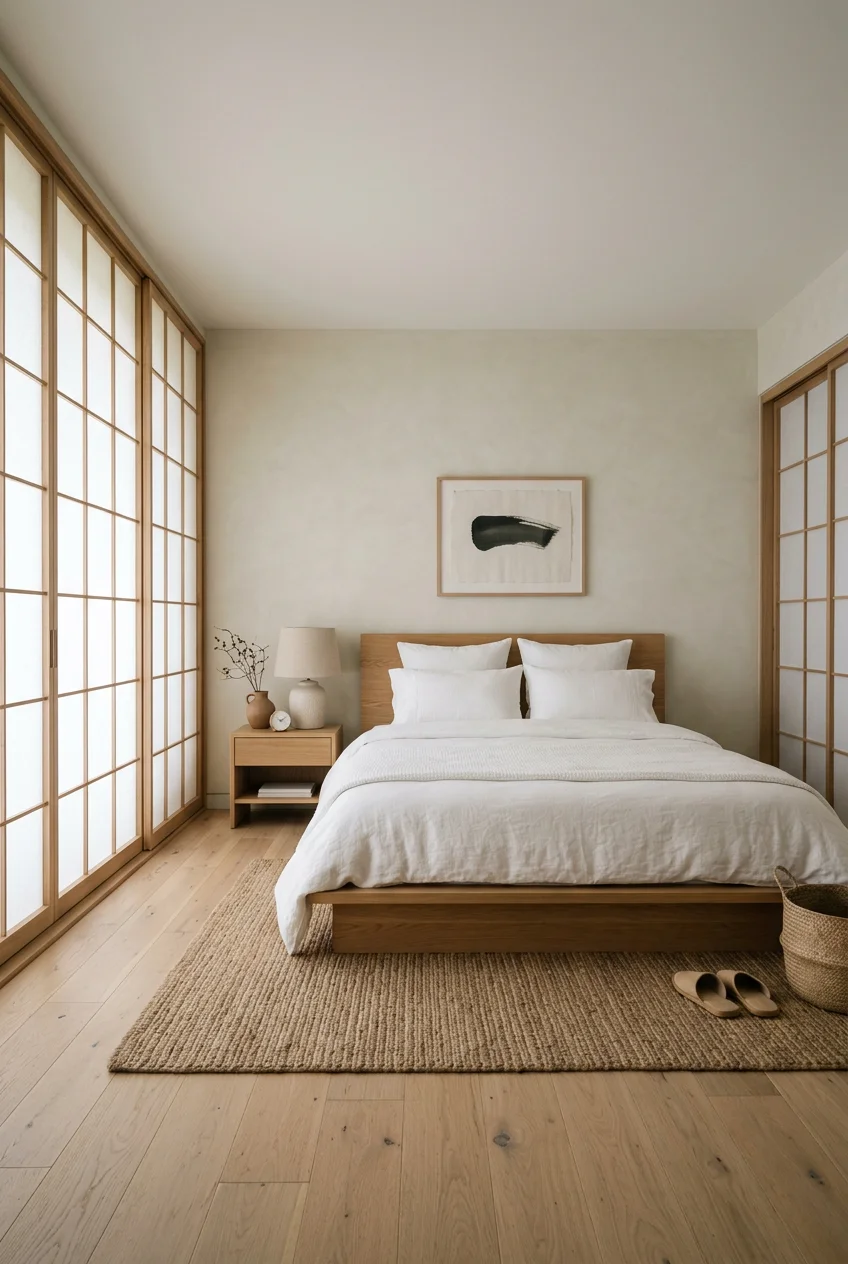
Last October, I tried to build a Japanese bedroom aesthetic by throwing a cheap cotton futon directly onto my hardwood floor. It was a massive failure. I woke up with severe lower back pain and a dust mite allergy flare-up that lasted three days. A true Japanese bedroom aesthetic requires rigid structure and specific materials, not just an empty room with a mattress on the floor. I spent the next six months researching actual interior architecture. Let’s break down the exact pieces, measurements, and materials you’ll need to build this correctly.
1. The Foundation of a Japanese Bedroom Aesthetic

The YUKI Japanese Low Height Bed Frame costs $349.99 for a Queen size. It sits exactly 5.5 inches off the floor. I bought this in November after my $45.99 metal frame from Walmart started squeaking. The YUKI uses a 48mm hollow core board construction with PVC edging. The low profile forces you to physically lower yourself closer to the ground, altering how you perceive the ceiling height. Your room immediately looks taller. A common mistake is buying a low frame and putting a 14-inch pillow-top mattress on it. That defeats the architectural purpose. You need a firm, thin mattress. I use an 8-inch memory foam hybrid. It takes a few weeks to get used to standing up from that low angle, and my knees complained for the first week. If you’re building this alone, do it in the exact spot you want it. It weighs 85 pounds.
2. Authentic Igusa Tatami Mats

You can’t achieve this look with standard carpet. I purchased the Ikehiko Japanese Traditional Igusa Tatami Mattress for $119.50. It measures 39 by 83 inches and is exactly 1.2 inches thick. The core is a firm polyester fiberboard, covered in woven rush grass. When you first unbox it, the grass has a pungent, earthy smell. I left my window open for two days to let it air out. I placed two of these side-by-side under my bed frame. Don’t spill water on these. Last Tuesday, I dropped a glass of water on the edge of the mat, and the rush grass warped within twenty minutes. You have to wipe it dry immediately. Vacuuming tatami requires specific technique. You must run the vacuum brush exactly parallel to the woven grass lines. If you vacuum against the grain, you’ll fray the grass and ruin a $120 mat instantly.
3. Filtering Light With Shoji Screens

Harsh, direct sunlight ruins the muted atmosphere of this style. I use the Oriental Furniture 4-Panel Shoji Screen, which costs $99.99. It stands 71 inches tall and each panel is 17.5 inches wide. The frame is built from Scandinavian spruce, and the shade is fiber-reinforced pressed pulp rice paper. I placed this directly in front of my east-facing window. The paper turns glaring morning light into a soft, glowing box. The major negative here is durability. The paper is thick, but it’s still paper. My cat punched a hole through the bottom right panel on the second day I owned it. I had to patch it with white masking tape. The hinges are double-action, meaning you can fold the panels in either direction. I keep mine folded in a slight zig-zag pattern to ensure it won’t tip over when the ceiling fan is running. Trust me on this.

50×70 Inch Rust Throw Blanket – Soft & Fluffy Fleece
Honestly, 50×70 Inch Rust Throw Blanket – Soft & Fluffy Fleece surprised me — sturdier than it looks in the photos, and over 11 buyers gave it 4.5 stars.
4. Muted Washed Cotton Bedding

Skip the shiny, high-thread-count sateen sheets. They look completely out of place here. You need matte textures. I bought the Muji Washed Cotton Duvet Cover in Light Brown for $59.90. It is 100 percent organic cotton that has been pre-washed to remove stiffness. The texture feels slightly rumpled, almost like linen, but without the scratching sensation. I’ve used this specific cover for two years now. A frustrating detail is the closure system. It uses small plastic snaps instead of buttons or a zipper. Two of the snaps broke in the washing machine after six months. I still use it because the fabric quality is excellent, but I have to tuck the open end under the mattress. Wash this in cold water with a mild detergent. If you use hot water, it shrinks by about two inches on all sides, and your duvet insert will bunch up.
5. Strategic Greenery With Bonsai Trees

Adding live plants is necessary, but a massive tropical houseplant conflicts with the minimalist scale. You need small, deliberate greenery. I picked up a Juniper Bonsai at Trader Joe’s last Thursday for $12.99. It came in a 6-inch glazed ceramic pot. I placed it on a low wooden stool in the corner of the room. The dark green needles provide a sharp contrast against the white walls. Juniper bonsai trees are notoriously difficult to keep alive indoors. I killed my first one by overwatering it. The roots rotted in less than three weeks. You have to let the top inch of the soil dry out completely before adding exactly 1/4 cup of water. I use a wooden chopstick to test the soil moisture. Push the chopstick into the dirt. If it comes out clean, add water. The tree also requires circulating air from a small fan.
6. Warm Walnut Nightstands

Mixing different wood tones creates visual chaos. You need to pick one wood finish and stick to it. I chose walnut. I use Thuma The Nightstand, which retails for $195.00. It measures 16 by 14 inches and stands 18 inches tall. It is constructed from repurposed wood and uses traditional joinery instead of metal screws. You literally just slot the pieces together. The drawer slides on wooden tracks, not metal rollers. This means it requires a firm pull to open, and it sometimes sticks if the humidity in the room is high. I rub a plain white wax candle along the wooden tracks once a month to keep it sliding smoothly. The surface area is very small. You can fit a lamp, a phone, and exactly one glass of water. This is intentional. It forces you to keep your bedside area completely clear of clutter. You might also like: 20 Apartment Bedroom Decor That Actually Work

QEEIG Floating Shelves for Wall Bathroom Shelf Bedroom
A dependable everyday pick — QEEIG Floating Shelves for Wall Bathroom Shelf Bedroom Kitchen Living pulls in 45 ratings at 4.5 stars. Not flashy, just solid.
7. Warm 2700K Paper Lantern Lighting

Overhead ceiling lights are too harsh for a bedroom. You need diffused, omnidirectional light. I bought a 15-inch ribbed paper table lamp from Target for $39.99. It sits directly on the floor in the corner of my room. The shade is made of thick rice paper stretched over a thin steel wire frame. The most critical detail here is the lightbulb. Don’t use a standard 3000K or 4000K LED bulb. The light will look blue and sterile. You must use a 2700K warm white bulb. I use a Philips 60W equivalent LED that emits 800 lumens. The paper shade softens the light, casting a warm orange glow across the lower walls. The paper shade is incredibly fragile. I accidentally kicked it while walking to the closet in the dark, and the wire frame bent permanently. It leans slightly to the left now. You might also like: 15 Stunning Painting Dresser Ideas You Can Try Today
8. Zaisu Floor Chairs for Seating

If you spend time reading in your bedroom, you need seating. Standard armchairs look gigantic and out of proportion next to a low bed. I use a Nitori Wooden Zaisu Floor Chair. It costs $45.00. A zaisu is a traditional Japanese chair with a backrest but no legs. It sits completely flat on the floor. The frame is molded plywood with a natural oak finish. Sitting directly on the floor is uncomfortable after ten minutes. The zaisu provides rigid lumbar support. I pair it with a 2-inch thick square cotton cushion. The negative here is the angle. The backrest is fixed at a 90-degree angle. You can’t lean back and lounge. It forces you to sit with perfect posture. If I try to slouch, the hard wooden edge digs into my spine. It’s excellent for reading a book, but terrible if you want to relax. You might also like: 20 Inspiring Bedroom Wall Lights That Are Totally Worth It
9. Flat Neutral Paint Formulations

Bright white walls look like a hospital room. You need a white paint with warm, earthy undertones to soften the shadows. I painted my bedroom walls using Behr Premium Plus in the shade Swiss Coffee. It costs $34.98 per gallon. It’s a creamy, off-white color that looks slightly beige in the evening light. The finish is critical. You must use a flat or matte finish. I used an eggshell finish on my first attempt, and the slight gloss reflected my lamps like a mirror. I had to sand the walls and repaint them. Flat paint absorbs light and creates a velvety texture on the walls. The massive downside to flat paint is that it’s impossible to clean. If you scuff the wall with a shoe, you can’t wipe it off with a wet sponge. The water will leave a permanent dark mark on the paint.

KSIPZE 100ft Led Strip Lights RGB Music Sync Color Changing
If you want something that just works, KSIPZE 100ft Led Strip Lights RGB Music Sync Color Changing Led Lights is a safe bet (376 reviews, 4.5 stars).
10. Natural Jute Rugs for Texture

If authentic tatami mats are too expensive, a natural jute rug is the best alternative. I bought a Safavieh Natural Fiber Jute Rug in a 5 by 8 foot size at Costco for $85.99. It provides the necessary organic texture to ground the room. The rug is 0.5 inches thick and has a very coarse, knobby texture. Walking on it with bare feet feels like a mild foot massage. However, jute sheds constantly. For the first three months, I found fine, sandy dust underneath the rug every time I lifted it. You have to vacuum under the rug weekly, or the dirt will scratch your hardwood floors. I also learned that you can’t use a standard vacuum beater brush on jute. The rotating bristles pull the woven fibers apart. You have to use the flat suction attachment, which takes twice as long.
11. Opaque Polypropylene Storage for a Japanese Bedroom Aesthetic

Visual clutter destroys a Japanese bedroom aesthetic immediately. Open shelving is a mistake. You need to hide your possessions. I use MUJI Polypropylene Storage Cases to organize my closet. They cost $24.90 each. The dimensions are 13.4 inches wide by 17.5 inches deep. The plastic is semi-opaque. You can vaguely see the shape of the folded clothes inside, but you can’t see the specific colors or logos. I stacked four of these cases inside my closet. The drawers pull out smoothly, but there’s no locking mechanism at the back. If you pull the drawer out more than halfway, the entire bin tips forward and dumps your clothes on the floor. I’ve done this three times when rushing to get dressed. You have to pull them carefully. I specifically avoided clear plastic bins from big-box stores because seeing a chaotic pile of shirts ruins the visual calm.
12. Earthy Linen Sprays for Scent

Aesthetic isn’t just visual. The room needs to smell earthy and grounded. Synthetic plug-in air fresheners smell like cheap candy and give me a headache. I use the Zum Mist Sandalwood-Citrus Aromatherapy Room Spray. I bought a 4-ounce bottle at Sprouts for $11.95. The ingredient list is just water, glycerin, and essential oils. The sandalwood provides a deep, woody base note. I spray exactly three pumps onto my duvet cover every morning after making the bed. The scent fades after about two hours, which is exactly what I want. The spray nozzle on this specific bottle is terrible. Instead of a fine mist, it shoots a concentrated stream of liquid. I actually ruined a silk pillowcase because the concentrated oil left a dark water spot that never washed out. I had to unscrew the cap and pour the liquid into a higher-quality glass spray bottle. Learned that the hard way.

upsimples Floating Shelves for Wall
A dependable everyday pick — upsimples Floating Shelves for Wall pulls in 4 ratings at 4.5 stars. Not flashy, just solid.
13. Fresh Eucalyptus for Air Quality

I incorporate natural scents by hanging fresh eucalyptus in the bedroom. I buy a bundle of fresh silver dollar eucalyptus from the floral section at Kroger for $5.99. I tie the stems together with a piece of plain cotton twine and hang it upside down from a small hook near my window. As the leaves dry out over a month, they release a sharp, clean scent that clears your sinuses. The muted, dusty green color perfectly matches the neutral color palette of the room. The major issue is the mess. Once the eucalyptus is fully dry, the leaves become brittle. If you brush against the bundle, the leaves shatter and drop dusty fragments all over the floor. I have to sweep under it constantly. When it’s time to replace the bundle, I take a garbage bag and carefully pull it up over the hanging plant.
14. Humidifiers to Preserve Wood and Paper

If you use real tatami mats, shoji screens, and solid wood furniture, you must control the humidity in the room. Dry winter air will cause the rush grass to snap and the wood joinery to shrink and rattle. I use the Levoit Classic 160 Top-Fill Humidifier. I bought it at Target for $29.99. It holds 2.5 liters of water and runs for about 24 hours on the lowest setting. The design is a plain white cylinder. You have to clean this machine constantly. Last winter, I ignored it for two weeks, and a thick layer of pink mold grew inside the water tank. I had to scrub it with pure white vinegar and a toothbrush for an hour. Now, I empty the tank and wipe it dry every Sunday morning. I only use distilled water. Tap water creates a fine white mineral dust that ruins dark wood furniture.
15. Layering Blackout Curtains for Sleep

Shoji screens are beautiful, but they don’t block light. If you want to actually sleep past 6 AM, you need blackout curtains. I layer Sun Zero Blackout Panels behind my shoji screen. I bought them at Walmart for $19.99 per panel. They measure 54 by 84 inches. I installed a cheap tension rod directly inside the window frame, behind the shoji screen. At night, I pull the heavy curtains closed. During the day, I push them entirely to the sides, and the screen hides them. The fabric is 100 percent polyester and feels stiff. They arrive covered in permanent wrinkles from the packaging. I tried ironing them on a low setting, and the plastic blackout backing actually melted onto my iron. I ruined a $40 iron instantly. You have to use a handheld garment steamer to get the wrinkles out. It took me an hour per panel.

200 FT Led Lights for Bedroom (2 Rolls 100 FT)
A dependable everyday pick — 200 FT Led Lights for Bedroom (2 Rolls 100 FT) pulls in 987 ratings at 4.5 stars. Not flashy, just solid.
16. Essential Oil Diffusers for Nighttime Routine

Incorporating a sensory routine before bed improves the entire space. I use a small ceramic ultrasonic diffuser. I buy the Aura Cacia Lavender Essential Oil from Whole Foods for $9.99. It comes in a 0.5-ounce amber glass bottle. I add exactly five drops to the diffuser water 30 minutes before I go to sleep. The scent is herbaceous and sharp, not sweet. The major mistake people make is leaving the diffuser running all night. The constant moisture will settle on your bedding and make the cotton feel damp and cold by 3 AM. I set the timer on my diffuser to shut off after one hour. Also, essential oils degrade plastic. My first diffuser was a cheap plastic model, and the lavender oil literally ate through the water tank after six months. Always buy a diffuser with a glass or heavy ceramic reservoir. No exaggeration.
17. Bamboo Trays for Floor Dining

Because the bed and seating are on the floor, you need a stable surface for morning tea. I use the Greenco Bamboo Breakfast Tray. I found it at Costco for $15.99. It measures 20 by 12 inches and has folding legs that elevate it 9 inches off the ground. I use it sitting on my zaisu chair. It keeps hot mugs off the tatami mat. Don’t ever place a hot ceramic mug directly on a tatami mat. The heat will scorch the rush grass and leave a permanent brown ring. I did this on my first mat, and there’s no way to fix it. The folding legs on this specific tray are incredibly loose. If you slide the tray across the floor, the legs fold inward and the tray collapses. I spilled a full cup of green tea on my duvet cover last month because of this.
18. Wabi-Sabi Ceramics for Minimal Decor

You need to apply the concept of wabi-sabi to your bedroom decor. Wabi-sabi is the appreciation of imperfection and natural materials. I don’t use framed posters or shiny metal trinkets. I keep a single Hasami Porcelain Mug on my nightstand. It holds 11 ounces and costs $28.00. The exterior is unglazed and has a rough, sandy texture. The color is a raw, matte beige. I use it to hold water at night. Because the exterior is unglazed, it stains easily. If you spill coffee down the side of it, the porous clay absorbs the dark liquid permanently. I only use this specific mug for clear water. The rim is perfectly flat, allowing multiple mugs to stack perfectly flush. I don’t buy matching sets. I have one Hasami mug and one dark brown stoneware bowl. The mismatched, organic textures provide visual interest without cluttering the room.
Building a true Japanese bedroom aesthetic requires discipline. It’s not about buying a bunch of paper lanterns and calling it a day. It’s about selecting specific, low-profile furniture, utilizing natural materials like rush grass and walnut, and eliminating visual clutter. I’ve spent hundreds of dollars replacing cheap items that broke or ruined the calm atmosphere. Stick to the exact measurements and materials I listed above. Your sleep quality will improve when your environment is rigidly organized. Save this guide and pin the images to your mood board so you have the exact dimensions and brand names when you’re ready to start buying furniture.
Frequently Asked Questions
How do I clean a woven tatami mat?
You must vacuum exactly parallel to the woven grass lines using a flat suction attachment. If you vacuum against the grain or use a spinning beater brush, you will instantly fray the rush grass. Never use wet chemicals.
What is the best paint finish for a minimalist bedroom?
Always use a flat or matte finish. Eggshell or semi-gloss paints reflect light like a mirror, which ruins the soft, diffused shadows necessary for this style. Flat paint absorbs light and creates a velvety texture.
Can I put a standard mattress on a low-profile bed frame?
No. Placing a 14-inch pillow-top mattress on a floor bed defeats the architectural purpose. You need a firm, thin mattress, typically an 8-inch memory foam or a traditional cotton futon, to maintain the correct visual proportions.
What color lightbulbs should I use in paper lanterns?
You must use 2700K warm white LED bulbs. Standard 3000K or 4000K bulbs emit a harsh blue light that looks sterile. A 2700K bulb creates the warm, orange glow required for a calming nighttime routine.
