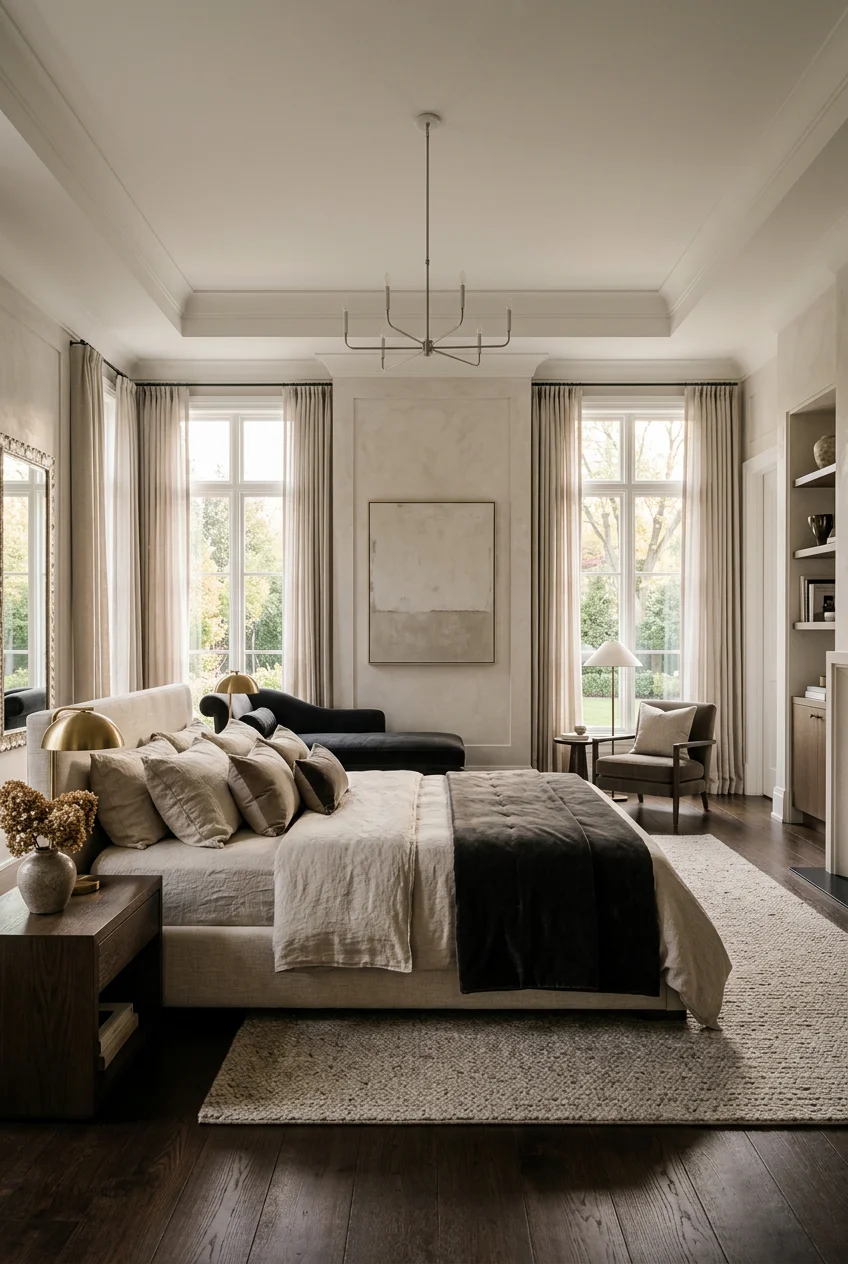
What’s Inside
- Invest in a Premium Mattress
- Choose Quality Linens Over Thread Counts
- Make a Statement with a Sculptural Bed Frame
- Master Layered Lighting
- Prioritize Quality Over Quantity in Furniture
- Anchor Your Space with a Proportionate Rug
- Embrace Warm, Earth-Toned Color Palettes
- Integrate Biophilic Design
- Use Smart Home Tech for Comfort
- Engage the Senses with Sound and Scent
- Implement Drawer Organization
- Upgrade Window Treatments
- Create a Dedicated Seating Area
- Curate Minimalist Accent Decor
- Maintain Optimal Air Quality
- Prepare a Nighttime Hydration Station
Last October, I spent three weeks sleeping on a deflating air mattress because I ripped my room apart trying to nail a luxury bedroom concept without a plan. The drywall dust wrecked my sinuses for a month, and I wasted hundreds of dollars on impulsive decor that didn’t match. Don’t make my mistakes. Creating a cohesive space takes methodical planning, precise measurements, and a focus on textures rather than passing trends. I’m going to show you how to build a high-end space, down to the exact dimensions and brands. The goal is a room that works as well as it looks, without that cold, sterile hotel vibe.
1. Invest in a Premium Mattress

The foundation of a master suite is the bed. I tried saving cash with a cheap 8-inch memory foam bed in my twenties. It trapped so much heat I woke up sweating every night in July. Now, I suggest a high-end innerspring or hybrid mattress. The Saatva Classic costs $1,995 for a queen. It uses a dual-coil system that stops the lower back from sagging after months of use. Tempur-Pedic and Stearns & Foster are great picks in the $2,000 to $10,000 range. Saatva gives you a 365-night trial, which is smart because lying on a bed for five minutes in a showroom tells you nothing. The trade-off? It’s heavy. Getting a 120-pound mattress up a narrow staircase means hiring professional movers. But the firm edge support means you won’t slide off when tying your shoes. Skip the compressed bed-in-a-box options if you want real, decade-long support.
2. Choose Quality Linens Over Thread Counts

Most people get this wrong. Buying 1200-thread-count sheets is a scam. Manufacturers twist thin, weak threads together to inflate the number. The result is a heavy, unbreathable fabric that feels like a tarp. I bought a $150 set of 1000-thread-count sheets three years ago. They pilled after four washes and felt like sandpaper. You need single-ply, long-staple Egyptian cotton. I use the Hampton & Astley 500 thread count set, which runs $189 for a queen. It breathes well enough that I don’t kick the covers off at 2 AM. A 700-thread count Giza cotton sateen set is another solid choice for a smoother finish. The sateen weave has a 10 percent sheen that looks expensive under warm light. Just know that sateen sleeps warmer than percale. Wash them in cold water with mild detergent. Heavy powder detergent leaves a chalky residue that ruins the soft texture—I learned that the hard way.
3. Make a Statement with a Sculptural Bed Frame

Your bed frame dictates the room’s visual weight. A basic metal frame with a flimsy 24-inch headboard screams college dorm. For 2026, sculptural frames with rounded edges and organic shapes are replacing sharp, tufted rectangles. I recently sourced an upholstered bed from Bernhardt for a client. It costs $2,450 and uses a stain-resistant performance fabric. This matters because leaning against a headboard with damp hair or night cream will ruin standard linen in a month. I learned that the hard way with a cheap beige headboard that developed a permanent grease spot right where I read. If you want a bolder look, a deep green velvet paneled bed provides strong contrast against neutral walls. The velvet catches the light beautifully. The downside? It’s a magnet for cat fur. Keep a lint roller in your nightstand if you have pets. Otherwise, stick to tightly woven performance linen.

Bedsure 3D Fleece Bubble Blankets for Couch
A dependable everyday pick — Bedsure 3D Fleece Bubble Blankets for Couch – Cute Pink Throw Blanket pulls in 539 ratings at 4.5 stars. Not flashy, just solid.
4. Master Layered Lighting

Relying on one ceiling fixture is the fastest way to make a bedroom feel like a dentist’s office. You need layers. Ambient light for dressing, task light for reading, and decorative light for mood. I installed dimmable recessed perimeter lights in my room. Then, I added adjustable wall sconces from Pooky. Their alabaster and brass fixtures cost $185 each. The 1/2-inch thick alabaster diffuses the bulb, casting a soft glow that doesn’t blind you at 6 AM. I also hung two 8-inch glass pendant lights ($120 each) above the nightstands. This frees up 20 square inches of surface space. The installation is a headache. You’ll need an electrician to run wires behind the drywall, which costs $300 to $500. But the result is a clean, uncluttered surface for your books. Always use 2700K temperature bulbs. Anything higher looks blue and harsh.
5. Prioritize Quality Over Quantity in Furniture

A high-end space isn’t about cramming a dresser, armoire, two nightstands, a bench, and a desk into one room. It’s about buying fewer, better pieces. I used to buy cheap particleboard dressers. The tracks warped after six months, and the veneer peeled. Now, I look for solid wood from brands like Baker Furniture, Henredon, or Bernhardt. A low-sheen wood dresser from Bernhardt costs around $1,800. It highlights the natural grain without looking plastic. Look for nightstands with dovetail joints and soft-close drawers. You don’t want a drawer slamming shut and waking up your partner at midnight. The drawback of solid wood is maintenance. You can’t set a wet glass down without a coaster, or you’ll get a white water ring. Keep a stack of 4-inch marble coasters ($25 for four) on your nightstand to protect the finish. You might also like: 15 Cozy Small Bedroom Decor That Make a Real Difference
6. Anchor Your Space with a Proportionate Rug

A common mistake is buying an 8×10 rug for a king-size bed. It looks like a postage stamp and makes the room feel cramped. Your rug needs to extend at least 18 to 24 inches beyond the sides and foot of the bed. For a queen, get a 9×12 rug. For a king, go up to a 10×14. I recommend organic New Zealand wool. It handles foot traffic without crushing. The Ambiente sells a plush wool rug for $1,200. It sheds terribly for the first two months. I had to vacuum every three days because white fibers coated my dark floors. But once the shedding stops, the 0.5-inch pile is dense and supportive. If your bedroom sees low traffic, a hand-knotted bamboo silk rug offers a beautiful shine. Just know that bamboo silk stains instantly. Stick to wool if you drink beverages in bed. Place a 1/4-inch felt rug pad underneath. You might also like: 17 Aesthetic Black Bedroom for Every Budget

Ultra Soft Cozy Faux Fur Throw Blanket
Ultra Soft Cozy Faux Fur Throw Blanket has been one of the most consistently praised picks in this category. 1 reviewers averaged 4.5/5.
7. Embrace Warm, Earth-Toned Color Palettes

The cold, gray trend is finally dying. For 2026, walls are shifting toward warm neutrals and spiced earth tones. I painted my guest room a stark, cool gray years ago, and it always felt like a waiting room. Last month, I repainted my primary suite using Sherwin-Williams’ Universal Khaki ($75 per gallon). It’s a grounding shade with a Light Reflectance Value of 40 that changes from beige in the morning to a warm taupe at night. Another great option is Clare’s Turbinado, a rich, spiced brown ($64 per gallon). These earthy tones pair perfectly with sage green or terracotta. When you test paint, buy the $8 sample pots. Paint a 24-inch square on a wall with direct light and another on the darkest wall. Check them at 8 AM, 2 PM, and 9 PM with the lamps on. The khaki looked muddy in my bathroom, so I had to switch to a lighter cream there. You might also like: 17 Cozy Bedroom Decor Worth Trying
8. Integrate Biophilic Design

Biophilic design brings nature indoors to lower stress. This means using materials like 6-inch wide oak flooring, unbleached linen curtains, and solid marble side tables. It also means incorporating actual plants. I bought a 5-foot Fiddle Leaf Fig for $150. It died in four weeks because I put it in a dark corner. They need bright, indirect light. Now, I keep a trailing Golden Pothos on my top dresser shelf. I grabbed it at Trader Joe’s last Tuesday for $8.99. It requires almost no attention. I water it with 1 cup of tap water every ten days. The green leaves break up the rigid lines of the furniture. If you have low light, buy a ZZ plant or a Snake plant. Both tolerate neglect. Use a heavy ceramic planter with a drainage hole and a saucer. I ruined a wood floor by letting water seep through a cheap plastic pot—trust me.
9. Use Smart Home Tech for Comfort

Walking across a cold floor to turn off the light is annoying. A modern room needs integrated tech. I use the Lutron Caséta smart lighting system. The starter kit costs $99 and replaces your wall switch. You can control lights from your phone or set a schedule. I also use Philips Hue smart bulbs ($45 each) in my bedside lamps. I program them to shift from a bright 3000K white light at 4 PM to a dim, warm 2200K amber light by 9 PM. This mimics the sunset and helps signal that it’s time to sleep. I also installed automated blackout shades from Bali. They cost around $350 per window. The motor makes a slight mechanical buzzing sound for five seconds, but waking up to sunlight because the shades open at 7 AM is worth it. Make sure your WiFi reaches the bedroom, or the switches will disconnect.

SILFU Neon Rope Lights, 50FT RGB LED Strip Lights
SILFU Neon Rope Lights punches above its price — 112 buyers rated it 4.5 stars. I would buy it again.
10. Engage the Senses with Sound and Scent

A room shouldn’t just look expensive; it should smell and sound intentional. I used to burn cheap vanilla candles. They coated my ceiling in black soot and gave me headaches. Now, I use the Pura Smart Diffuser ($44). It plugs into the wall. I load it with a cedarwood scent cartridge ($18) and schedule it to run at low intensity for two hours before bed. For larger spaces, a cold-air diffuser like the AromaPlan ($170) pushes the scent through the HVAC system. I add 2 ounces of pure lavender oil. Scent is subjective, so start low. A strong floral smell will keep you awake. For sound, I hid a Sonos Era 100 speaker ($249) behind my reading chair. I play low-volume rain sounds. The white noise masks traffic outside. Don’t use your phone speaker; the tinny audio ruins the effect.
11. Implement Drawer Organization

You can’t relax if your drawers are filled with tangled cords and loose receipts. I spent years digging through a chaotic nightstand for a hair tie. Last month, I drove to Target and bought a set of clear acrylic drawer organizers from the Brightroom line. They cost $14 for a 4-piece set. I measured my nightstand drawers first (14 inches deep and 18 inches wide) to ensure they’d fit. I use the small 3×3 inch squares for earplugs and lip balm, and the larger 6×9 inch trays for my kindle. I also lined the drawers with an adhesive gray velvet liner ($12 a roll). This stops the trays from sliding when you pull the drawer open. The velvet also dampens the sound of metal objects. The mistake here is buying organizers that are too tall. Measure your interior drawer height. If the tray is 3 inches tall and your clearance is 2.8 inches, it won’t close.
12. Upgrade Window Treatments

Flimsy, unlined curtains make a room look cheap. Custom drapery adds massive visual weight and dampens sound. I ordered custom faux-linen drapes through Costco’s Graber blinds program. A pair of 96-inch panels with a blackout lining cost me $450. The lining is thick. It blocks streetlights completely and stops cold drafts. You must hang the curtain rod high and wide. I mount my 1.5-inch matte black steel rod four inches below the ceiling and extend it 10 inches past the window frame on each side. This tricks the eye into thinking the window is much larger. The downside of heavy drapes is the installation. You can’t use standard drywall anchors. The weight of the fabric will rip the bracket out of the wall. I had to use heavy-duty toggle bolts ($8 at the hardware store) to secure the rod. Steam the panels with a handheld steamer ($35) after hanging them to remove creases.

upsimples 6 Pack Wooden Floating Shelves
upsimples 6 Pack Wooden Floating Shelves punches above its price — 46 buyers rated it 4.5 stars. I would buy it again.
13. Create a Dedicated Seating Area

A well-designed space shouldn’t just be a place to sleep. It needs a transition zone. Having a dedicated seating area gives you a spot to read, put on shoes, or throw yesterday’s jeans. I used to sit on the edge of the bed to put my boots on, which eventually caused the mattress edge to sag. I set up a small reading nook in the corner. I found a sturdy boucle accent chair at Walmart for $198 under the Beautiful by Drew Barrymore line. The textured fabric looks high-end, and the 22-inch deep seat is perfect for curling up. I paired it with a 16-inch round brass side table ($65) for my coffee. The chair is slightly firm, so I added a 20×20 inch down-filled lumbar pillow ($45) for support. Leave at least 36 inches of walking clearance between the chair and the bed. If you cram furniture too close, you’ll constantly bump your shins at night.
14. Curate Minimalist Accent Decor

Clutter destroys the aesthetic. You don’t need fifteen framed photos and a collection of figurines on your dresser. I follow the rule of three for surface styling. On my dresser, I place a large textured ceramic vase ($85), a stack of two oversized hardcover architecture books ($50 each), and a small brass tray ($28) for jewelry. Every Friday, I buy a $12 bouquet of fresh white hydrangeas from Whole Foods. I trim the stems at a 45-degree angle. Fresh flowers immediately brighten the room. The mistake I made early on was buying heavily scented lilies. The sticky pollen stained my dresser yellow, and the intense smell gave my partner a migraine—no exaggeration. Stick to unscented or mildly scented blooms like hydrangeas or ranunculus. Keep your personal items hidden. I store my daily moisturizer and deodorant in a decorative woven box ($35) on the dresser. It keeps ugly labels out of sight.
15. Maintain Optimal Air Quality

You can’t sleep well in a stuffy room with dry air. Air quality is a hidden part of good design. During the winter, the central heating dries out my sinuses and makes my skin flake. I bought a Levoit 6-liter ultrasonic humidifier for $79. I run it on medium every night from November to March. It keeps the humidity around 45 percent. I also add 5 drops of eucalyptus oil from Sprouts ($9.99) into the aroma pad. Do not put essential oils directly into the water tank of a standard humidifier. I melted the plastic basin of a cheap humidifier doing that three years ago. I also run a Coway HEPA air purifier ($199) in the corner. It pulls dust and pet dander out of the air. The purifier has a bright blue LED light that drove me crazy, so I covered it with black electrical tape.

QEEIG Floating Shelves for Wall Bathroom Shelf Bedroom
Honestly, QEEIG Floating Shelves for Wall Bathroom Shelf Bedroom Kitchen Living surprised me — sturdier than it looks in the photos, and over 46 buyers gave it 4.5 stars.
16. Prepare a Nighttime Hydration Station

Waking up thirsty and walking to the kitchen at 3 AM ruins your sleep cycle. A bedside hydration station is a simple upgrade. I keep a 32-ounce glass carafe with a matching tumbler lid ($45) on my nightstand. I fill it with ice and filtered water before bed. Sometimes, I stock a mini-fridge ($150) in my closet with 12-ounce cans of lime sparkling water. Popping a cold sparkling water while reading in bed feels indulgent. The glass carafe is heavy when full. I accidentally knocked a cheap, thin pitcher off my table last year. It shattered, and water soaked into my rug. Buy a carafe made from thick borosilicate glass. It resists breaking and doesn’t sweat condensation all over your wood furniture. Always place the carafe on a 5-inch silicone or stone coaster. The silicone prevents the glass from clinking against the table when you set it down in the dark.
Building a high-end room takes time, and you shouldn’t feel pressured to buy everything on this list in one weekend. I’d suggest starting with the mattress and the lighting, as those two elements impact your physical comfort the most. If you found these specific measurements and brand recommendations helpful, save this article to your home design Pinterest board so you can reference the exact paint colors and dimensions when you’re ready to start measuring your own space.
Frequently Asked Questions
What is the most important element in a luxury bedroom design master suite?
The mattress and bedding are the most critical components. Investing in a high-quality hybrid mattress and 500-thread-count single-ply Egyptian cotton sheets ensures the room functions primarily as a comfortable, restorative sleep environment.
How large should a rug be in a master bedroom?
Your rug should extend at least 18 to 24 inches beyond the sides and foot of your bed. For a standard queen bed, a 9×12 foot rug is ideal, while a king bed requires a 10×14 foot rug.
What paint colors are trending for luxury bedrooms?
Warm, earthy tones are replacing cool grays. Colors like warm khaki, spiced brown, and soft taupe provide a grounding, biophilic atmosphere that feels more inviting and sophisticated than stark white or icy blue.
How can I make my bedroom lighting look more expensive?
Avoid relying on a single overhead fixture. Implement layered lighting by combining dimmable recessed lights, warm 2700K wall sconces for reading, and glass pendants. This creates a soft, customizable ambiance.
