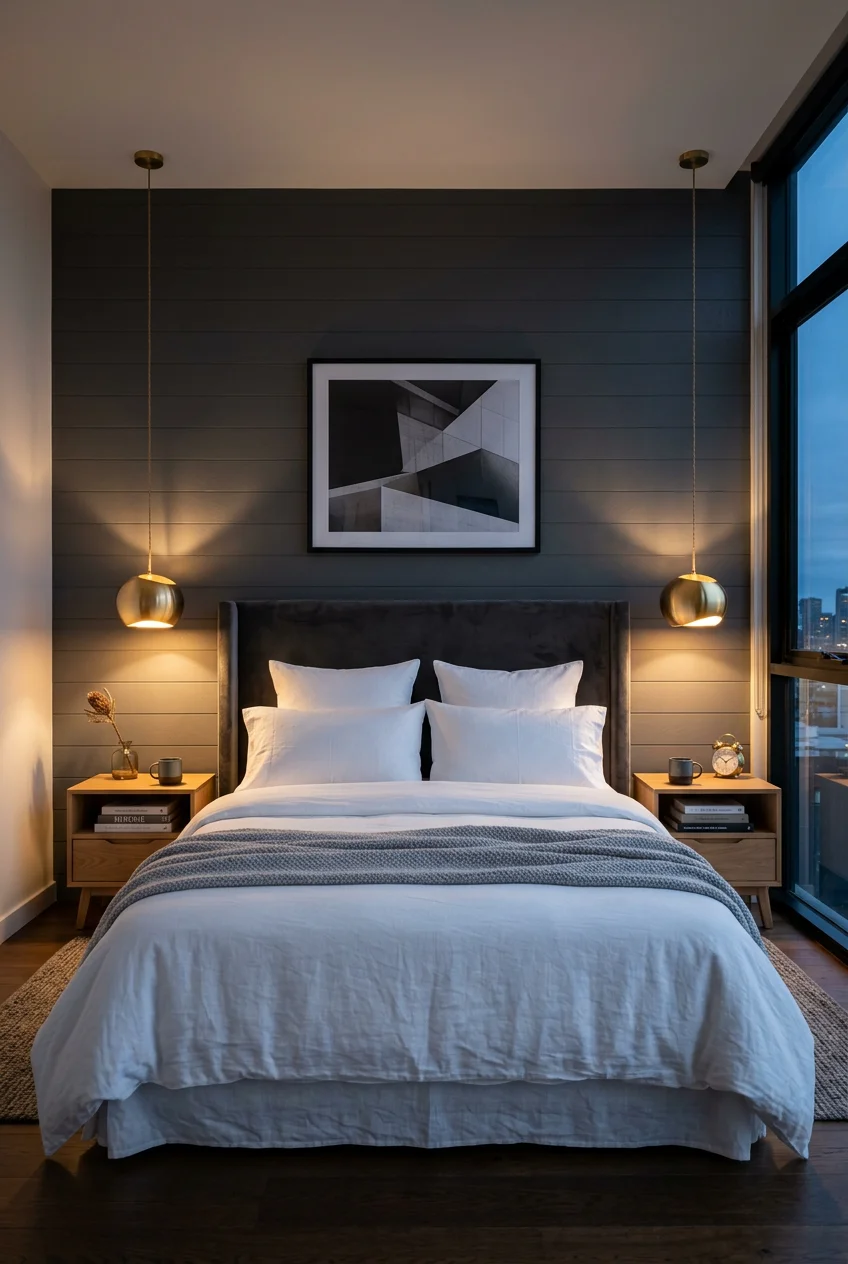
What’s Inside
- Embrace a Three-Tiered Layered Lighting Approach
- Prioritize Warm Color Temperatures Between 2700K and 3000K
- Install Dimmers for Optimal Modern Bedroom Lighting
- Calculate Your Exact Lumen Requirements
- Stop Relying on the Single Overhead Light
- Invest in Smart Lighting for Sleep Routines
- Mount Your Bedside Lighting on the Wall
- Space Recessed Lighting Strategically
- Hide LED Strips Behind Your Headboard
- Get Your Table Lamp Height Right
- Ditch the Exposed Edison Bulbs
- Try Human-Centric Tunable Bulbs
- Treat Your Fixtures as Sculptural Art
- Upgrade and Relocate Your Switches
- Unconventional Modern Bedroom Lighting: Under-Rug LED Strips
- Use 4000K Lighting in the Closet
- Add a Dedicated Floor Lamp for Reading Nooks
- Install Battery-Operated Picture Lights
- Layer Artificial Light with Window Treatments
Last November, I sat on my mattress on the floor of my new apartment and flipped the switch on my ceiling fan. The single, harsh bulb blasted me with a blue-white glare that made my skin look gray and my bedroom feel like a Walmart interrogation room. I realized right then that getting modern bedroom lighting right isn’t just about picking a pretty shade. It’s about math, placement, and exact color temperatures. I spent the next six months testing bulbs, returning fixtures, and rewiring switches. Most of my early attempts failed miserably. I bought a cheap floor lamp that tipped over if I looked at it wrong, and I installed LED strips that peeled the paint off my baseboards. Eventually, I figured out the exact formulas that work. Here are 19 specific ways to fix your lighting, based on what I actually use and install for clients.
1. Embrace a Three-Tiered Layered Lighting Approach

Most bedrooms suffer from flat, one-dimensional lighting because people only install a ceiling fixture. You need a three-tiered approach: ambient for general illumination, task for specific activities, and accent to highlight architectural features. I tried living with just a ceiling fan light for three months before I finally gave up and bought the Globe Electric 67-inch floor lamp for $45.99. That single addition proved how necessary layered lighting is. Your ambient light comes from a central dimmable fixture. Your task lighting comes from bedside reading lamps. Your accent lighting might be a small picture light over a piece of art. If you skip any of these three layers, the room feels incomplete and harsh. I’ve learned that the hard way. When I tried to read a paperback using only my overhead light, I ended up with a massive headache. Layering fixes this instantly.
2. Prioritize Warm Color Temperatures Between 2700K and 3000K

Color temperature dictates how a room feels, and anything above 4000K belongs in a hospital hallway, not a bedroom. For a cozy and relaxing atmosphere, you need bulbs that emit a warm white glow. Specifically, look for the 2700K to 3000K range on the packaging. I bought a four-pack of Feit Electric 5000K daylight bulbs at Costco for $14.99 last year because they were on sale. I installed them in my bedroom and immediately felt like I was standing in a commercial kitchen. Cooler temperatures suppress melatonin production, which actively disrupts your sleep cycle. I returned them two days later and swapped them for 2700K bulbs. The difference is immediate. The 2700K temperature mimics the soft, amber tones of sunset. It signals to your brain that it’s time to wind down for the night.
3. Install Dimmers for Optimal Modern Bedroom Lighting

I consider dimmer switches a non-negotiable requirement for modern bedroom lighting. A standard toggle switch gives you two options: pitch black or blindingly bright. Dimmers allow you to adjust the brightness based on the time of day. I use the Lutron Caseta smart dimmer switch, which costs $59.95. It requires a neutral wire in your switch box, which I didn’t realize until I had already taken my wall plate off. I had to hire an electrician to fix my mistake. Took me years to figure out that simple wiring. Once installed, it completely changed how the room functions. You need bright light at 7:00 AM when you’re digging through your dresser for matching socks. You need a soft, ten-percent glow at 10:00 PM when you’re getting ready for bed. Not including a dimmer switch is the most common bedroom lighting mistake I see clients make.

BOLUO Stackable Storage Drawers Closet Organizers and
Honestly, BOLUO Stackable Storage Drawers Closet Organizers and Storage Fabric W surprised me — sturdier than it looks in the photos, and over 420 buyers gave it 4.5 stars.
4. Calculate Your Exact Lumen Requirements

Guessing how bright your bulbs should be usually results in a room that feels either cavernous or aggressively bright. You need to calculate your lumen needs based on the square footage of your bedroom. The standard formula requires 10 to 20 lumens per square foot. If you have a standard 150-square-foot bedroom, you need a total of 1500 to 3000 lumens distributed across all your light sources. I bought a pack of EcoSmart 60-watt equivalent bulbs at Home Depot for $9.98. Each bulb outputs 800 lumens. If I put three of them in a ceiling fixture, that’s 2400 lumens. This sits perfectly in the middle of the recommended range. I used to just buy whatever wattage sounded right, which left my previous apartment feeling like a dim cave. Doing the actual math prevents this issue entirely.
5. Stop Relying on the Single Overhead Light

Using only one central ceiling light creates harsh, downward shadows that highlight every flaw on your face and make the room feel sterile. I can’t stand this interrogation room effect. You need to combine a central ceiling light with perimeter lighting to spread the illumination evenly. I removed the generic dome light my landlord installed and replaced it with a West Elm Sculptural Glass flush mount for $199.00. I hooked it up to a dimmer, but I rarely turn it past fifty percent. Instead, I rely on my table lamps and wall sconces to push light into the corners of the room. When light comes from multiple directions at different heights, it eliminates the harsh shadows under your eyes and furniture. Relying solely on the ceiling fixture is a lazy habit that ruins the ambiance of an otherwise well-decorated room.
6. Invest in Smart Lighting for Sleep Routines

Smart bulbs used to be a gimmick, but they’re incredibly practical for regulating your sleep schedule. I use the Philips Hue Twilight lamp, which retails for $279.00. It’s expensive, but the functionality justifies the price. You control the brightness and color temperature through a smartphone app. I set mine to automatically dim to a warm, amber glow at 9:00 PM. Last Tuesday, I made a late-night run to Sprouts for sparkling water. When I walked back into my bedroom, the lamp had already transitioned to its sleep soundscape mode. It felt incredibly calming. You don’t have to remember to turn the lights down manually. The system does it for you. Smart lighting systems from brands like Govee or Philips Hue give you total control over the exact mood of your space without leaving your mattress. You might also like: 15 Stunning Bedroom Design India Ideas for a Beautiful Space

KSIPZE 100ft Led Strip Lights RGB Music Sync Color Changing
KSIPZE 100ft Led Strip Lights RGB Music Sync Color Changing Led Lights punches above its price — 392 buyers rated it 4.5 stars. I would buy it again.
7. Mount Your Bedside Lighting on the Wall

Table lamps take up valuable real estate on your nightstand. Wall-mounted sconces free up that space and provide a sleek, modern aesthetic. I installed a pair of Novogratz x Globe electric plug-in sconces for $34.99 each. Because they plug directly into the wall, I didn’t have to hardwire anything. The placement math is highly specific. You need to position the center of the wall sconce roughly 60 to 66 inches above the floor, and exactly 30 to 36 inches from the center of the bed on each side. I initially mounted mine too high, and the light shone directly into my eyes when I sat up to read. I had to patch the drywall and lower them by four inches. Getting the height right ensures the light hits your book, not your face. You might also like: 16 Glam Bedroom Decor for Every Budget
8. Space Recessed Lighting Strategically

Recessed lighting provides excellent ambient light, but poor placement ruins a bedroom. You should use 4-inch recessed lights and space them approximately 4 feet apart. Each fixture should output between 100 and 300 lumens. I use the Halo 4-inch LED retrofit downlights, which cost $18.47 each. The biggest mistake you can make is placing a recessed light directly over the head of the bed. I did this in my first house, and waking up to a spotlight shining directly into my retinas was miserable. You should position recessed lights around the perimeter of the room, washing the walls with light rather than pointing them straight down at the mattress. This bounces the light off the walls, creating a softer, more diffused glow that doesn’t cause eye strain when you’re lying on your back. You might also like: 18 Aesthetic Green Bedroom for Every Budget
9. Hide LED Strips Behind Your Headboard

Indirect lighting adds depth to a room without adding glare. Installing LED strips behind your headboard creates a soft, glowing halo effect that makes your bedroom look like a boutique hotel. I use the YUJILEDS dim-to-warm LED strip, which costs $149.00. It’s significantly more expensive than the cheap strips you find online, but the color rendering is flawless. I tried a cheap $15 strip first, and the adhesive failed after three days. Half the strip fell down behind my bed and collected dust bunnies. The YUJILEDS strip stays exactly where I put it. I ran it along the back edge of my wooden headboard and plugged it into a smart plug. It provides just enough light to navigate the room at night without turning on the main overhead fixture.

Govee RGBIC LED Strip Lights
Govee RGBIC LED Strip Lights punches above its price — 251 buyers rated it 4.5 stars. I would buy it again.
10. Get Your Table Lamp Height Right

If you prefer traditional table lamps over wall sconces, you have to measure the height of the shade relative to your mattress. The ergonomic rule for bedside lamps is simple: the bottom of the lampshade must be exactly at eye level when you’re sitting up in bed. I bought a Threshold ceramic table lamp from Target for $45.00. I liked the base, but the shade sat two inches too high. Every time I turned it on, the bare bulb glared right into my peripheral vision. I’d buy a shorter harp for the lamp to lower the shade to the correct height if I did it again. This prevents the harsh light from shining directly into your eyes while still providing enough downward illumination to read the pages of a book comfortably.
11. Ditch the Exposed Edison Bulbs

Exposed Edison bulbs look great in a moody cocktail bar, but they’re terrible for bedroom lighting. An exposed filament creates a sharp, piercing glare that strains your eyes, especially when the room is otherwise dark. You need diffused light in a bedroom. I replaced my exposed bulb fixtures with the IKEA FADO table lamp, which costs $29.99. It’s essentially a large globe of frosted white glass. The frosted material diffuses the light perfectly, casting a soft, even glow in every direction. I tried to make an exposed filament bulb work for months because I liked the industrial look, but I ended up with a headache every time I tried to read next to it. Always choose fixtures with shades made of fabric, frosted glass, or tinted materials to soften the output.
12. Try Human-Centric Tunable Bulbs

Human-centric lighting is designed to mimic the natural progression of sunlight throughout the day. You achieve this using tunable white LED bulbs. I use the Chromalux A19 7W full spectrum LED bulb, priced at $17.50. It allows you to shift the color temperature manually or on a schedule. You start with a slightly brighter, neutral 3000K light in the morning to help you wake up. As the evening progresses, you transition the bulb to a very warm 1800K to 2400K amber tone. I set this up last winter when I was struggling with insomnia. Shifting the light to a deep amber an hour before sleep noticeably helped my circadian rhythm. The warm light mimics a fire, telling your brain that the day is over. It’s a highly effective, functional upgrade.

Govee RGBIC LED Strip Lights, Smart LED Lights for Bedroom
Govee RGBIC LED Strip Lights has been one of the most consistently praised picks in this category. 251 reviewers averaged 4.5/5.
13. Treat Your Fixtures as Sculptural Art

Light fixtures don’t just provide illumination; they act as decorative focal points. A statement chandelier or a unique pendant light adds personality to the room even when the switch is off. I installed the CB2 Vega flush mount for $299.00 in the center of my bedroom. It has a matte black finish with brass accents and geometric arms. Before I bought it, I had a standard builder-grade dome light that made the entire room look cheap. Replacing it with a sculptural piece completely changed the visual weight of the ceiling. You shouldn’t settle for generic fixtures just because they’re functional. Treat your lighting choices the same way you treat your art choices. A well-designed fixture draws the eye upward and makes the ceiling feel intentionally designed rather than ignored.
14. Upgrade and Relocate Your Switches

The physical switches on your wall matter just as much as the fixtures they control. Standard white plastic switch plates look cheap and collect dirt easily. I upgraded all my bedroom switch plates to unlacquered brass plates from Rejuvenation, which cost $12.50 each. They develop a natural patina over time and look substantially better against my dark green walls. Switch placement is also critical. You need a switch accessible from the bed. I spent my first two years in this apartment getting out of bed to turn off the main light, then stumbling back to the mattress in the dark. I eventually bought a smart button that sits on my nightstand and connects to my smart bulbs. You shouldn’t have to leave the covers to turn off the overhead lights.
15. Unconventional Modern Bedroom Lighting: Under-Rug LED Strips

This is a highly unconventional lighting tactic, but it provides incredible low-level ambiance. You can install flexible LED strips discreetly under the edges of a thick bedroom area rug. I used a Govee M1 LED strip, which retails for $99.99, and ran it along the perimeter of my wool rug, tucking it just under the binding. It creates a subtle floating effect on the floor. I bought a bag of pistachios at Kroger last week, dropped one in the dark, and found it instantly because of this floor glow. No exaggeration. It provides subtle nighttime navigation without requiring you to turn on any overhead lighting. You just have to ensure the LED strip is flat and doesn’t create a tripping hazard. It looks incredibly futuristic and solves the problem of navigating a dark room.

AMADA HOMEFURNISHING Floating Shelves
Honestly, AMADA HOMEFURNISHING Floating Shelves surprised me — sturdier than it looks in the photos, and over 116 buyers gave it 4.5 stars.
16. Use 4000K Lighting in the Closet

While the main bedroom requires warm 2700K lighting, your closet requires something entirely different. If you use warm lighting in a closet, it distorts the colors of your clothing. Navy blue looks black, and white looks yellow. You need a cooler temperature, specifically between 4000K and 5000K, for accurate color rendering. I installed a GE Reveal 4000K LED bulb, which costs $11.49, in my walk-in closet. Before I made this switch, I walked out of the house wearing a black shirt and navy pants more times than I care to admit. The 4000K temperature provides crisp, neutral white light that shows exactly what color your clothes actually are. Keep the cozy warm lights near the bed, but use clinical, accurate lighting where you’re actually getting dressed.
17. Add a Dedicated Floor Lamp for Reading Nooks

If you have an armchair or a small seating area in your bedroom, it requires its own dedicated task lighting. A bedside lamp won’t throw enough light across the room to illuminate a reading nook properly. I placed an Adesso floor lamp, which I bought for $68.00, directly behind my bedroom armchair. The shade directs the light downward over my shoulder. Last Sunday, I sat there eating a massive honeycrisp apple I bought at Trader Joe’s while reading a hardcover book. The targeted light made the text crisp without lighting up the rest of the bedroom. I used to try reading in that chair using just the ambient ceiling light, and my eyes would start burning after twenty minutes. A dedicated floor lamp solves this by putting the light source exactly where you need it.
18. Install Battery-Operated Picture Lights

Highlighting the art on your bedroom walls adds a sophisticated layer of accent lighting, but hardwiring picture lights requires tearing open your drywall. I avoid this by using battery-operated, rechargeable picture lights. I bought the Luxsway wireless picture light on Amazon for $29.99. I mounted it directly above a large canvas print on my wall using two standard screws. It comes with a remote control that lets me adjust the brightness and color temperature. The battery only lasts about a week if I leave it on every night, which is a mild annoyance because I have to take it down to charge it via USB. However, the visual impact is worth the hassle. It washes the canvas in warm light and draws attention to the artwork, adding a high-end gallery feel to the room.
19. Layer Artificial Light with Window Treatments

Modern bedroom lighting isn’t just about electric fixtures; it’s about controlling the natural light that enters the room. You have to layer your artificial lighting with proper window treatments. I use a double-rod system with sheer curtains on the back and heavy blackout curtains on the front. I purchased the Eclipse blackout panels at Walmart for $24.99 per panel. During the day, I pull the blackout curtains back and let the sheer panels diffuse the harsh sunlight. At night, I pull the blackout curtains completely closed to block the streetlamps outside my window. If you don’t block the exterior light pollution, your carefully planned 2700K bedside lamps won’t matter. The streetlights will bleed through thin blinds and ruin the warm, cozy atmosphere you just spent time and money creating.
Fixing your bedroom lighting requires careful attention to color temperatures, precise measurements, and multiple light sources. I highly recommend starting with dimmers and 2700K bulbs before making any expensive fixture purchases. The right lighting completely changes how a space functions. Let’s fix your lighting by saving this guide and pinning these specific measurements for your next bedroom update so you don’t repeat my early mistakes.
Frequently Asked Questions
What is the best color temperature for modern bedroom lighting?
You need warm white bulbs between 2700K and 3000K. This temperature mimics sunset, signaling to your brain that it’s time to sleep. Anything cooler than 4000K feels clinical and disrupts melatonin production.
How many lumens do I need for a bedroom?
Calculate 10 to 20 lumens per square foot. A standard 150-square-foot bedroom requires 1500 to 3000 total lumens. Distribute this brightness across multiple fixtures rather than relying on a single overhead bulb.
Where should I place recessed lights in a bedroom?
Space 4-inch recessed lights about 4 feet apart around the perimeter of the room. Never place them directly above the bed, as this creates a harsh glare right into your eyes when you’re lying down.
How high should I mount bedside wall sconces?
Position the center of the sconce 60 to 66 inches above the floor and 30 to 36 inches from the center of the bed. This ensures the light hits your book instead of shining directly into your eyes.
