What’s Inside
- Embrace Warm Neutral Color Palettes (2026 Trend)
- Invest in a Storage Bed for Hidden Organization
- Utilize Wall-Mounted Nightstands for Simple Small Bedroom Ideas
- Strategically Place Large Mirrors to Amplify Space
- Implement Layered Lighting with Wall-Mounted Fixtures
- Opt for Multi-functional Furniture Beyond the Bed
- Go Vertical with Tall, Narrow Storage
- Choose Compact Bed Sizes for Simple Small Bedroom Ideas
- Select Light, Floor-to-Ceiling Window Treatments
- Declutter Ruthlessly and Embrace Hidden Storage
- Incorporate Natural Materials and Textures
- Avoid Over-Furnishing and Incorrect Scale
- Optimize Closet Space with Smart Organizers
- Integrate Compact Smart Home Devices
- Add Greenery with Small, Air-Purifying Plants
Most people shove a massive queen bed into a ten-by-ten box. They flank it with bulky wooden dressers, then wonder why they feel suffocated. Creating breathing room requires strict geometry, not just buying smaller things. When searching for simple small bedroom ideas, the layout dictates everything. You must manipulate light, structural scale, and vertical space to trick the eye. I’m always surprised by how many people ignore the ceiling height and focus entirely on the floor plan. If you only try one idea from this list, make it #2. A hydraulic storage bed kills the need for a floor-hogging dresser. It gives you back precious square footage immediately.
Skip this if: You’re working with a primary suite larger than 300 square feet, or if your design style leans heavily toward Victorian maximalism. These concepts rely on strict visual boundaries and minimal surface clutter. They won’t work if you insist on displaying large collections of knick-knacks on every flat surface. Trust me.
1. Embrace Warm Neutral Color Palettes (2026 Trend)

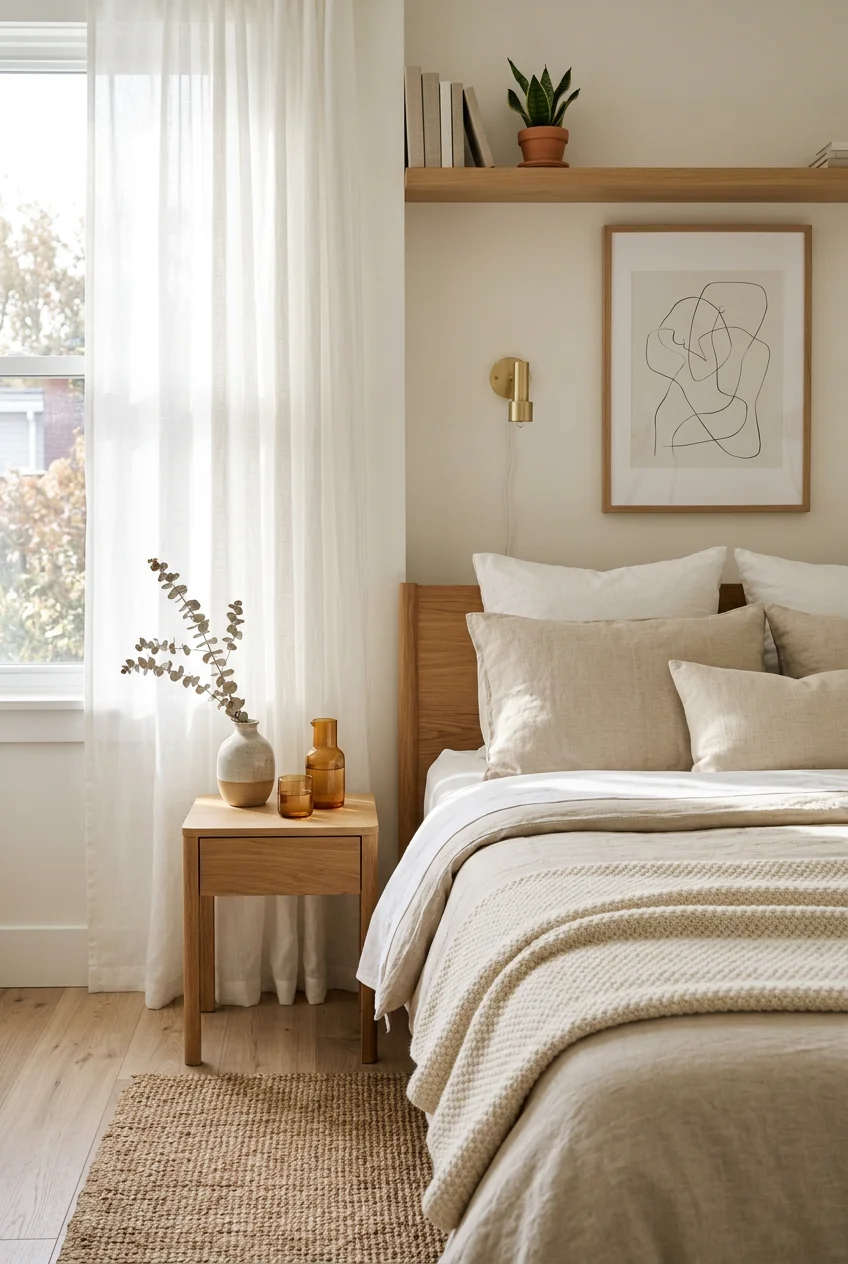
Let’s talk about paint. The default advice for tiny rooms is a quick coat of stark, hospital-grade white. That’s a mistake. Pure white in a room with limited natural light just looks gray, flat, and dingy. Instead, the current shift toward warm minimalism works much better. You want creamy whites, sandy beige, muted olive, or soft clay. These tones absorb harsh shadows rather than highlighting them. Grab a standard 8 oz paint sample of a warm taupe from a brand like Behr at Home Depot (usually under $10). Paint a three-by-three foot square on your darkest wall. You’ll notice immediately how the warmer undertones make the drywall visually recede. Layering a dusty brown linen throw over a beige cotton duvet creates texture without visual noise. The catch: Warm neutrals require careful lighting. If you use cool-toned LED bulbs (anything over 4000K), your warm beige walls will instantly turn a sickly, institutional green. I learned that the hard way.
2. Invest in a Storage Bed for Hidden Organization

A standard bed frame wastes roughly 30 square feet of potential storage space. Shoving plastic bins underneath just creates a dust trap. A dedicated storage bed is the most efficient solution for a tiny footprint. Look for a frame with a hydraulic lift mechanism rather than pull-out drawers. Drawers require an extra three feet of clearance to open, which a tight room rarely has. The West Elm Pivot Storage Bed Frame is a solid benchmark for this category, typically running in the $1,200 to $1,600 range. The mattress lifts up on gas struts, exposing a massive cavity perfect for off-season clothing, extra bedding, or bulky luggage. You effectively gain an entire horizontal closet.
Best for: Renters with zero closet space.
The catch: These beds are heavy. Once assembled, you aren’t moving it across the room by yourself without disassembling the entire hydraulic track system.
3. Utilize Wall-Mounted Nightstands for Simple Small Bedroom Ideas

Floor space is your most valuable currency. Traditional nightstands eat up a two-by-two foot square on either side of the mattress. A wall-mounted floating shelf performs the same function without breaking the visual line of the baseboards. You only need a surface depth of 12 to 18 inches to hold a glass of water, a phone charger, and a paperback book. Target sells basic wooden floating shelves in their Room Essentials line for under $25 that do the job. Mount them directly into the wall studs roughly 24 to 28 inches from the floor, depending on your mattress height. This leaves the floor underneath open for slippers or just empty space, which tricks your brain into perceiving a wider room. Because the floor is visible, the room feels lighter. The catch: You can’t lean on them. If you use your nightstand to push yourself out of bed, a floating shelf will rip right out of the drywall.

Bedsure GentleSoft White Throw Blanket for Couch
A dependable everyday pick — Bedsure GentleSoft White Throw Blanket for Couch – Cozy Soft Fleece Su pulls in 24 ratings at 4.5 stars. Not flashy, just solid.
4. Strategically Place Large Mirrors to Amplify Space

Most people hang a cheap over-the-door mirror and call it a day. That does nothing for spatial perception. A mirror is a tool to bounce photons. You need a large, frameless floor mirror placed directly opposite your primary window. The mirror needs to be at least 30 inches wide to make an impact. A frameless design prevents the glass from looking like heavy, imposing furniture. Brands like Mainstays at Walmart offer basic 30-by-60 inch frameless options in the $40 to $70 range. For an average height person, the center of the mirror should sit roughly 57 to 65 inches from the floor. This placement captures the maximum amount of natural daylight and reflects the outdoors, effectively faking a second window. The catch: A mirror opposite a window also reflects whatever mess is in front of it. If your room is cluttered, the mirror just doubles the visual chaos.
5. Implement Layered Lighting with Wall-Mounted Fixtures

Relying on a single overhead dome light makes a room feel like an interrogation chamber. It casts harsh shadows into the corners, shrinking the perimeter. Proper lighting requires deliberate layers: ambient, task, and accent. Start by replacing bulky bedside table lamps with hard-wired or plug-in wall sconces. A matte black swing-arm lamp from a specialty retailer like onefortythree (budget around $90 to $130) frees up your nightstand surface. Mount them precisely 30 inches above the mattress top. For accent lighting, running a basic warm-white LED strip behind the headboard creates a soft, diffused glow that pushes the wall backward.
Best for: Small dark rooms that only have one tiny window.
The catch: Hard-wired sconces require an electrician and cutting into drywall. If you rent, you’re limited to plug-in versions with visible cords, which requires clever cord-hiding channels. You might also like: 17 Modern Minimalist Bedroom Worth Trying
6. Opt for Multi-functional Furniture Beyond the Bed

Single-use furniture is a luxury small spaces don’t have. Every piece needs to justify its footprint by serving at least two functions. A basic storage ottoman at the foot of the bed provides a place to sit while putting on shoes, while hiding bulky winter blankets inside. You can find sturdy linen-wrapped options at HomeGoods or Target ranging from $50 to $150. Another highly efficient piece is a headboard with integrated shelving. The IKEA Mandal headboard uses solid wooden slats with adjustable shelves that clip directly on, eliminating the need for separate bedside tables. You gain storage without sacrificing an inch of floor space. The catch: Storage ottomans frequently become dumping grounds for clean laundry. Because the lid is flat and accessible, it’s too easy to stack clothes on top, defeating the purpose of hidden storage.

upsimples 6 Pack Wooden Floating Shelves
upsimples 6 Pack Wooden Floating Shelves is sturdier in person than the photos suggest — over 47 buyers gave it 4.5 stars.
7. Go Vertical with Tall, Narrow Storage

Horizontal dressers are floor-space killers. A standard six-drawer dresser is usually 60 inches wide. In a ten-by-ten room, that consumes almost an entire wall. The solution is forcing your storage to go vertical. Look for tall, narrow drawer chests, sometimes called lingerie chests. You want a footprint that is no wider than 18 to 24 inches, but reaches 50 inches or taller. Similarly, if you need a bookshelf, choose a tall spine tower or a skinny 10 to 12-inch deep unit. This utilizes the dead air space near the ceiling while leaving the floor open for walking paths. You get the same cubic volume of storage without the massive horizontal footprint. The catch: Tall, narrow furniture is unstable on carpet. You must drill into the wall and use heavy-duty anti-tip anchors, which is annoying but non-negotiable for safety. You might also like: 19 Bedroom Inspirations Master That Actually Work
8. Choose Compact Bed Sizes for Simple Small Bedroom Ideas

We need to talk about mattress sizes. A queen-size bed measures 60 by 80 inches. In a very tight room, that leaves almost zero clearance for walking or opening closet doors. Downgrading the mattress size is an immediate, structural fix. If you sleep alone, a full-size bed (54 by 75 inches) saves crucial inches in both width and length. A twin XL is an even more aggressive space-saving option. Pair the smaller mattress with a low-profile platform frame. A bed that sits just 10 inches off the floor increases the visual distance to the ceiling, making the room feel taller. For extreme cases, a mechanical Murphy bed folds vertically into the wall, giving you the entire floor back during the day. You might also like: 19 Grey Bedroom Decor for Every Budget
Best for: Single occupants, college students, or dedicated guest rooms.
The catch: A full-size bed provides less sleeping width per person than a baby’s crib. It’s a tight squeeze for two adults trying to sleep comfortably.
9. Select Light, Floor-to-Ceiling Window Treatments

Heavy, dark curtains cut a wall in half visually. They create dark vertical blocks that make a small room feel boxed in. Window treatments in tight spaces should manipulate the perception of ceiling height. Buy curtains that are significantly longer than your window. If your ceiling is 8 feet high, buy 96-inch panels. Mount the curtain rod exactly two inches below the ceiling line, not right above the window frame. Let the fabric kiss the floor. Use sheer, lightweight linen or cotton blends. Lowe’s carries the Allen + Roth line, which offers decent textured sheer panels in the $25 to $45 range. This vertical line draws the eye upward, faking architectural height. The catch: Sheer curtains offer zero light-blocking properties. If a streetlamp shines directly into your window at night, you’ll need a secondary blackout roller shade.

YUFLINX 16’’White Floating Shelves for Wall Set of 4
YUFLINX 16’’White Floating Shelves for Wall Set of 4 has been one of the most consistently praised picks in this category. 658 reviewers averaged 4.5/5.
10. Declutter Ruthlessly and Embrace Hidden Storage

Visual clutter is the enemy of spatial perception. Having lotion bottles, books, jewelry, and loose change scattered across every flat surface makes the walls feel like they’re closing in. You must edit your belongings aggressively. Keep only essential items visible. Everything else must go into closed storage. Woven baskets made from water hyacinth or seagrass are excellent for hiding ugly electronics or extra cables. The Container Store sells opaque decorative boxes in various sizes (budget $15 to $40 each) that stack neatly on a closet shelf. A clean, empty surface reflects light and allows the eye to rest. The catch: Out of sight often means out of mind. Storing daily-use items in decorative boxes adds friction to your morning routine, and you’re likely to just leave the box lids off eventually out of laziness.
11. Incorporate Natural Materials and Textures

Sterile, glossy modern furniture makes a small room feel like a cheap hotel. The 2026 design consensus favors natural materials to ground the space and add tactile warmth without visual clutter. Focus on matte finishes. A light oak slatted headboard, unbleached textured cotton sheets, and handmade ceramic lamps add necessary dimension. A 100% linen duvet cover from a mid-range brand like Brooklinen or Quince (typically $130 to $180) provides a rumpled, lived-in texture that feels organic. You want materials that look slightly imperfect. This softness counteracts the harsh, boxy angles of a tiny square room. The catch: Pure linen bedding wrinkles instantly and sheds lint like crazy during the first five wash cycles. It requires maintenance if you hate the wrinkled look.
12. Avoid Over-Furnishing and Incorrect Scale

Scale is where most DIY decorators fail. Putting an overstuffed, rolled-arm armchair into a bedroom corner chokes the space. Conversely, filling the room with a dozen tiny, spindly side tables makes it look like a dollhouse. You need fewer, but correctly proportioned pieces. Measure your walking paths. You need a minimum of 24 inches of clearance around the bed to walk comfortably. If a dresser leaves you with 18 inches of clearance, it’s too deep. Choose furniture with slim legs rather than solid bases that sit on the floor. Seeing the floor continue underneath the furniture tricks your brain into thinking the room stretches further. The catch: Finding perfectly scaled furniture is exhausting. You’ll spend weeks measuring and rejecting pieces because they are exactly two inches too deep.

QEEIG Floating Shelves for Wall Bathroom Shelf Bedroom
If you want something that just works, QEEIG Floating Shelves for Wall Bathroom Shelf Bedroom Kitchen Living is a safe bet (46 reviews, 4.5 stars).
13. Optimize Closet Space with Smart Organizers

When the bedroom is tiny, the closet has to work overtime. A standard closet with a single wooden rod wastes 50 percent of its vertical volume. First, install a tension-mounted double hanging rod (around $15 to $30 from Amazon Basics). This instantly doubles your capacity for short items like shirts and folded pants. Second, throw away every plastic and wooden hanger you own. Buy a 50-pack of slim velvet hangers (usually under $25). These hangers are a fraction of the thickness of plastic tubes, allowing you to compress garments tightly together and reclaim horizontal rod space.
Best for: Tight budgets and renters who can’t install custom systems.
The catch: Velvet hangers are brittle. If you try to yank a heavy winter coat off the rack without unhooking it first, the plastic neck of the hanger will snap.
14. Integrate Compact Smart Home Devices

A bedside table cluttered with a bulky alarm clock, a white noise machine, and a lamp switch is unnecessary. Consolidation is key for tight surfaces. A Google Nest Mini (typically $30 to $50) or an Amazon Echo Dot with Clock takes up less than four inches of surface area. It replaces your alarm clock, speaker, and weather station in one tiny footprint. You can also pair it with smart plugs to control your layered lighting via voice, so you aren’t fumbling for cords behind the bed. For window treatments, a retrofit motor like the SwitchBot Curtain 3 (roughly $90 to $110) automates your sheer panels without requiring a massive, hardwired track system. The catch: Smart speakers require a constant internet connection and an always-listening microphone, which is a hard boundary for anyone concerned about digital privacy.
15. Add Greenery with Small, Air-Purifying Plants

A sterile room feels dead. Bringing in live plants adds organic shapes that break up the rigid geometry of a small bedroom. Skip the massive Ficus trees that eat up floor space. Stick to small, hardy varieties in 4-inch or 6-inch nursery pots. A Snake Plant (Sansevieria) or a Parlour Palm fits perfectly on a narrow floating shelf. You can usually find healthy starter plants in the floral section at Trader Joe’s or Sprouts for under $10. If you have zero surface area left, hang a trailing Pothos in a simple cotton macrame planter from a ceiling hook in the corner.
Best for: Beginners who routinely kill fussy houseplants. No exaggeration.
The catch: Hanging plants drip water. If you don’t use a sealed pot without drainage holes (which risks root rot), you’ll end up with muddy water dripping onto your floor or furniture after every watering.
How we chose these ideas: We evaluated bedroom organization strategies based on renter-friendliness, overall cost, implementation effort, and immediate visual impact. The focus remained strictly on spatial efficiency and accessible materials rather than structural renovations.
Designing a tiny bedroom is just a rigid geometry puzzle. You must stop fighting the dimensions and start working with them. Ditching the massive dresser for a storage bed and pushing your lighting to the walls makes an immediate, undeniable difference. I’d suggest picking two or three of these concepts to start, and always measure your space before buying anything. It took me years to figure out that lesson. Pin this list so you have the exact measurements handy when you’re standing in the store aisle deciding between frames.

upsimples Floating Shelves for Wall
upsimples Floating Shelves for Wall punches above its price — 47 buyers rated it 4.5 stars. The kind of pick people reorder.
Frequently Asked Questions
What colors make a small bedroom look bigger?
Warm neutral tones like creamy whites, sandy beige, and soft clay expand a small room by absorbing shadows. Avoid stark, hospital-grade white, which can look dingy and flat in rooms with limited natural light.
How can I add storage to a small bedroom without a dresser?
Use a hydraulic storage bed to utilize the massive cavity under your mattress. Additionally, install tall, narrow lingerie chests or floating wall shelves to take advantage of vertical space without consuming valuable floor area.
Where should I place a mirror in a small bedroom?
Place a large, frameless mirror (at least 30 inches wide) directly opposite or adjacent to your primary window. The center should be 57 to 65 inches from the floor to reflect the maximum amount of natural light.
Are sheer curtains good for small bedrooms?
Yes, floor-to-ceiling sheer curtains draw the eye upward, making the ceiling appear taller. Mount the rod two inches below the ceiling. However, you will need a secondary blackout shade if you require darkness for sleeping.
