What’s Inside
- Embrace the Oversized Leaning Mirror Trend
- Strategically Place for Natural Light Amplification
- Avoid Mirrors Directly Facing the Bed
- Opt for Organic Puddle Mirrors
- Use Illuminated Arch Mirrors for Modern Functionality
- Nail the Correct Hanging Height
- Create an Eclectic Mirror Gallery Wall
- Consider Convex Mirrors for Dimension
- Scale Matters: Go Big, Not Small
- Curate the Reflection Deliberately
- Match Bedside Mirrors for Symmetry
- Integrate Mirrored Furniture Pieces
- Build a DIY Custom Plywood Frame
- Ditch Faux Gold and Matchy-Matchy Sets
- Install Floor-to-Ceiling Mirror Panels
- Layer Your Bedroom Mirror Decor
- Utilize Tight Corners with Narrow Slices
I’m always shocked by how many people get this wrong. Hanging a flat, cheap mirror directly facing the bed is the fastest way to ruin a room’s entire vibe. Nailing your bedroom mirror decor requires more than just slapping a reflective surface onto a piece of drywall and hoping it looks good. It’s about manipulating natural light, playing with visual scale, and avoiding those terrible faux gold finishes that look like plastic. Let’s fix those blank walls with some actual strategy instead of guesswork. If you only try one idea from this list, make it #1. Here’s why: an oversized leaning mirror instantly fakes architectural height and makes cramped, dark rooms feel double their size without forcing you to lift a hammer or drill into studs. Trust me on this.
Skip this guide if your bedroom is purely functional and you refuse to dust. Mirrors attract fingerprints, pet smudges, and floating lint like magnets. If wiping down the glass weekly sounds miserable, stick to canvas art. These techniques require upkeep.
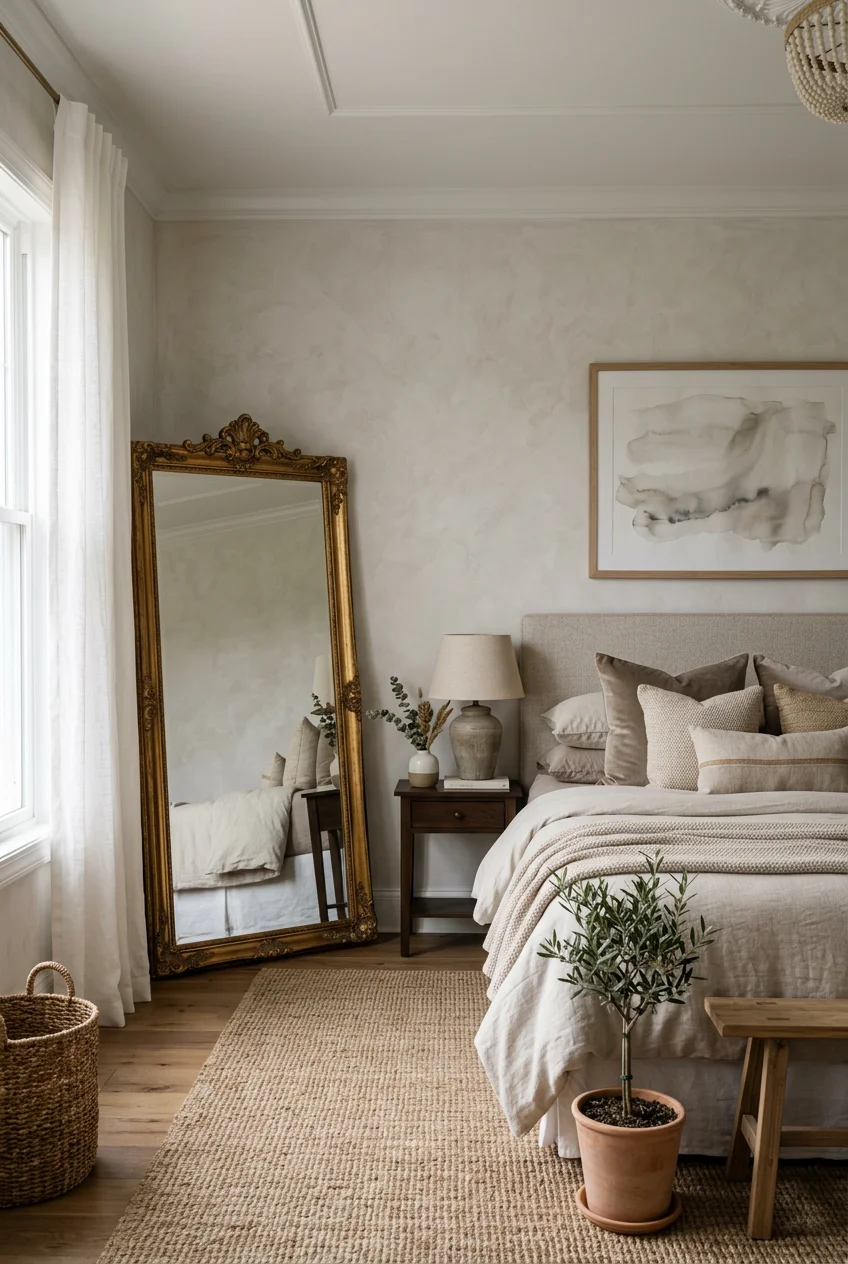
1. Embrace the Oversized Leaning Mirror Trend

Most people buy a tiny, cheap mirror, stick it on the back of a bedroom door, and call it a day. That’s a massive missed opportunity. The oversized leaning mirror is a dominant 2026 trend for a very specific reason. Pushing a massive, heavy frame directly against the wall creates a relaxed, architectural vibe that hanging a standard mirror just can’t match. Look for thick, natural walnut wood frames or sleek matte black metal edges. The BEAUTYPEAK 64″x21″ Arch Floor Mirror is a standard example that typically runs in the budget to mid-range category. To get the angle exactly right, pull the bottom edge roughly 8 to 12 inches away from the baseboard. This prevents the funhouse distortion effect while effectively bouncing ceiling light down into the center of the room.
Best for: renters who are strictly prohibited from drilling large holes.
The catch: you’re giving up valuable, usable floor space, and leaning mirrors still require heavy-duty wall anchors anyway to prevent fatal tipping accidents if you have large dogs or toddlers running around.
2. Strategically Place for Natural Light Amplification

Hanging a mirror in a dark, windowless corner won’t magically generate light. Mirrors need a light source to function as room-brighteners. Positioning a large, flat mirror on a wall directly adjacent to or exactly opposite your bedroom window catches the morning sun and bounces it across the drywall. Interior designer Paula McHugh notes that reflecting the trees or sky outside actually brings the exterior landscape indoors, making cramped square footage feel expansive. When shopping at places like Target or Walmart, look for frames with minimal beveling to maximize the flat reflective surface. A standard 4×6 foot rectangular piece does the heavy lifting here.
Best for: small dark rooms that feel like a cave during the afternoon.
The catch: placing a mirror exactly opposite an east-facing window means blinding morning glare right in your eyes. Angle it slightly to catch the light without creating a laser beam.
3. Avoid Mirrors Directly Facing the Bed

Here’s a blunt truth: waking up and immediately making eye contact with your own groggy reflection is unsettling. It’s a massive design mistake and a core violation of basic Feng Shui principles. Placing any reflective surface directly opposite the mattress is thought to amplify stress and bounce restless energy around the room all night. Feng Shui experts consistently advise against this layout, noting it disrupts REM cycles. If your sleep is terrible, try throwing a thick blanket over your closet mirrors for three nights to see if the room’s energy shifts. Move the mirror to a side wall or angle it toward the door instead. You’ll have to get creative with folding screens or sliding covers if your floor plan forces this layout. A simple tension rod with a linen curtain works wonders.
The catch: in tiny studio apartments or narrow bedrooms, avoiding the foot-of-the-bed placement is geometrically impossible without blocking a walkway.

Tenmiro Led Lights for Bedroom 100ft (2 Rolls of 50ft)
A dependable everyday pick — Tenmiro Led Lights for Bedroom 100ft (2 Rolls of 50ft) Music Sync Colo pulls in 786 ratings at 4.5 stars. Not flashy, just solid.
4. Opt for Organic Puddle Mirrors

Rigid rectangles and perfect circles are taking a back seat. The 2026 trend forecast points heavily toward the organic puddle mirror. These pieces feature amorphous, free-flowing edges that mimic spilled water or polished river stones. They function more like sculptural art than practical dressing tools. Hanging one of these breaks up the harsh, straight lines of standard bedroom furniture like boxy dressers and square headboards. Treat these exactly like high-end art pieces, centering the bulk of the shape right at eye level. Stores like CB2 often stock these in mid-range to premium pricing tiers. Additionally, their distorted shapes mean they aren’t practical for checking your outfit before work; they exist purely for aesthetic softening.
The catch: the wavy, irregular edges make these notoriously annoying to clean, as dust settles into the odd curves of the frame. You’ll spend more time detailing the edges than wiping the glass. I learned that the hard way.
5. Use Illuminated Arch Mirrors for Modern Functionality

Relying on a harsh overhead ceiling fixture while getting dressed casts terrible shadows. Illuminated arch mirrors solve this by integrating LED backlighting directly behind the frosted glass border. This creates a soft, diffused glow that actually flatters the face instead of highlighting under-eye bags. The TOTOUS LED Bathroom Mirror is a popular example that hovers in the budget-friendly category and works perfectly above a bedroom vanity desk. If you’re mounting it above a makeup table, ensure the bottom edge sits exactly 5 to 10 inches above the tabletop to give your makeup brushes and organizers clearance. This hidden wiring adds significant cost to what is otherwise an inexpensive weekend upgrade.
The catch: you’ll have an ugly black power cord trailing down your wall unless you hire an electrician to install a hidden outlet directly behind the glass. You might also like: 20 Small Guest Bedroom You Need to See
6. Nail the Correct Hanging Height

Most people hang their wall decor way too high and wonder why the room feels entirely disconnected. A floating mirror hovering near the crown molding looks ridiculous. For standard wall-mounted pieces, the absolute center of the glass should sit roughly 57 to 65 inches from the floor. This aligns with the average human eye level, which is generally accepted as 60 inches. Keeping it at this height anchors the piece to the furniture below it, creating a cohesive visual unit rather than a random shiny square floating in space. Measure twice before drilling into the drywall. Using a piece that is at least 40 inches tall ensures both tall and short residents can actually use it. You might also like: 17 Small Room Ideas Bedroom for Every Budget
The catch: if you live with a partner who is six-foot-four, the standard 60-inch center means they’ll be staring at their own chest. You’ll need to compromise on a slightly higher placement or buy a taller mirror. You might also like: 19 Cozy Aesthetic Bedroom Ideas You Need to See

ANROYE 2 Tier Macrame Boho Wall Hanging Shelf
A dependable everyday pick — ANROYE 2 Tier Macrame Boho Wall Hanging Shelf pulls in 351 ratings at 4.5 stars. Not flashy, just solid.
7. Create an Eclectic Mirror Gallery Wall

Gallery walls aren’t just for family photos and canvas prints. Grouping a collection of mirrors in wildly different shapes, sizes, and eras creates an eclectic, highly textured focal point. The secret to making this work without looking like a thrift store clearance bin is varying the frame materials intentionally. Mix a chunky vintage brass frame with a minimalist matte black circle and a woven rattan oval. Sourcing these from places like HomeGoods or local antique shops keeps the budget manageable. Lay them out on the floor first to lock in the spacing before committing to holes in the wall.
Best for: homes with large, intimidating blank walls that need character.
The catch: hanging ten different mirrors requires a massive amount of wall anchors, precise measuring, and leaves your drywall looking like Swiss cheese if you ever decide to take them down.
8. Consider Convex Mirrors for Dimension

Convex mirrors are making a massive comeback for 2026. These feature a distinct bulging, outward-curving surface that reflects a distorted, panoramic view of the entire room. Designer Jeanne Hayes recommends treating these strictly as architectural focal points rather than functional mirrors. They add unexpected movement and a slightly moody, historical vibe to a modern space. Try hanging a trio of staggered convex mirrors in an odd strip of horizontal wall space, like the awkward gap directly over a wide window frame. Because they catch light from nearly 180 degrees, they also highlight every single speck of dust in the room, meaning your cleaning routine needs to be flawless.
The catch: the fish-eye distortion is completely useless for checking your reflection. If you rely on your bedroom mirror to do your hair, a convex piece will only frustrate you. They are purely decorative.
9. Scale Matters: Go Big, Not Small

Hanging a tiny 12-inch mirror on a massive empty wall makes the space look cheap and poorly planned. Design expert Vern Yip consistently advises that a single, massive mirror is vastly superior to a cluster of small ones when the goal is expanding visual space. Going oversized creates immediate architectural drama. The NISSEDAL Mirror from IKEA, measuring 25 5/8 by 59 inches, is a perfect example of a budget-friendly piece (typically under $100) that carries enough visual weight to anchor a room. Don’t be afraid to let a large frame dominate the wall. If you try to hang a 50-pound frame with a flimsy picture nail, it will rip through the drywall and shatter. No exaggeration.
Best for: tight budgets looking for maximum impact.
The catch: oversized mirrors are incredibly heavy, notoriously fragile during transport, and usually require two people and heavy-duty toggle bolts to safely install.

Bedsure GentleSoft White Throw Blanket for Couch
Bedsure GentleSoft White Throw Blanket for Couch – Cozy Soft Fleece Su punches above its price — 24 buyers rated it 4.5 stars. The kind of pick people reorder.
10. Curate the Reflection Deliberately

A mirror is essentially a picture frame for whatever sits on the opposite side of the room. Mirrors magnify exactly what they show. If you hang a gorgeous brass mirror directly across from your overflowing laundry basket or a cluttered desk, you’ve just doubled the visual mess in your bedroom. Always sit on your bed and check the exact angle before mounting. You want the glass to capture natural light, a striking piece of art, or a tidy architectural detail like a fireplace mantel. If your bedroom is naturally messy, angle the mirror toward the ceiling or a blank wall to avoid doubling the chaos.
The catch: this requires keeping the reflected area impeccably clean at all times. A beautifully framed reflection of an unmade bed and a pile of dirty clothes ruins the aesthetic instantly. You’ll be forced to maintain a tidier room.
11. Match Bedside Mirrors for Symmetry

Symmetry tricks the human brain into feeling calm, which is exactly what a bedroom needs. A lesser-known styling trick is mounting identical, tall mirrors on the wall directly above both nightstands. This creates an immediate illusion of taller ceiling height and anchors the bed frame. When you place matching table lamps in front of these mirrors, the glass catches the bulb’s glow and essentially doubles your ambient lighting. It’s a classic hotel design trick that translates perfectly to residential spaces. Plus, if your nightstands are cluttered with water glasses, phone chargers, and half-read books, the mirrors will proudly display that clutter to anyone walking into the room.
Best for: couples with symmetrical layouts and matching nightstands.
The catch: you have to buy two of everything. Purchasing two identical, high-quality mirrors and two identical lamps significantly increases the overall cost of the room’s decor.
12. Integrate Mirrored Furniture Pieces

Wall space isn’t the only place for reflective surfaces. If your walls are already full of art or windows, mirrored furniture is the logical next step. A mirrored nightstand or a reflective storage console bounces light around the lower half of the room, which is typically shadowed by the bed. Retailers like West Elm frequently offer mirrored collections in the premium price tier. These pieces instantly make a cramped floor plan feel less dense because the furniture visually disappears into the reflection of the rug and floorboards. You’ll need a dedicated microfiber cloth and a bottle of glass cleaner in your nightstand just to maintain sanity.
The catch: mirrored furniture is an absolute nightmare to keep clean. Every single time you open a drawer, your fingers leave oil smudges on the glass. If you have a dog with a wagging tail, expect permanent nose prints on the bottom drawers.

Bedsure GentleSoft Sage Green Throw Blanket for Couch
Bedsure GentleSoft Sage Green Throw Blanket for Couch – Checkered Cute punches above its price — 98 buyers rated it 4.5 stars. The kind of pick people reorder.
13. Build a DIY Custom Plywood Frame

Basic frameless builder-grade mirrors are incredibly cheap, but they look completely unfinished leaning against a wall. You can completely customize a plain full-length mirror by building a backing frame out of plywood and peel-and-stick tiles. Head to a local hardware store and have the lumber department cut a standard 4×8 sheet of 1/2-inch thick plywood down to your exact dimensions. You want to leave a rigid 4-inch border around the entire perimeter of your 1/4-inch thick mirror glass. Stick the mirror directly to the center of the wood using heavy-duty construction adhesive. Then, cover that exposed 4-inch plywood border with high-quality peel-and-stick metallic or stone tiles. It yields a heavy, custom luxury look for a fraction of retail showroom prices.
Best for: beginners who want a custom look without owning expensive power tools.
The catch: construction adhesive is permanent. Once you glue that glass to the wood backing, you can’t ever change the frame without shattering the mirror into a thousand dangerous pieces.
14. Ditch Faux Gold and Matchy-Matchy Sets

Buying a bedroom furniture set where the bed, dresser, nightstands, and mirror all perfectly match is a terrible idea. Interior designers like Samantha-Jane Agbontaen bluntly warn against this, noting it makes a bedroom look like a cheap catalog showroom rather than a curated home. You need contrast. If your dresser is dark walnut, hang a matte black or polished brass mirror above it. When incorporating gold tones, be ruthless about quality. Faux gold finishes often skew bright yellow and look incredibly cheap under artificial bedroom lighting. Hold out for genuine polished brass or antique bronze finishes. Stick to a maximum of two metal finishes per room to maintain a cohesive, intentional aesthetic.
The catch: mixing wood tones and metal finishes requires a bit of trial and error. If you mix too many competing textures, like shiny chrome, brushed brass, and matte black all in one corner, the room will feel visually chaotic.
15. Install Floor-to-Ceiling Mirror Panels

If you want to fundamentally alter the architecture of your bedroom without tearing down drywall, install massive, floor-to-ceiling mirror panels. Covering an entire accent wall in reflective glass visually doubles the square footage and makes standard 8-foot ceilings feel infinitely higher. You can find this treatment in sleek, frameless modern styles or broken up by grid-like mullions for a vintage, Parisian apartment vibe. It’s the ultimate commitment to maximizing light. It’s a permanent architectural choice that requires absolute certainty before you sign the contractor’s estimate. Additionally, if you ever decide to move or change the room’s aesthetic, removing glued-on mirror panels will destroy the drywall behind them, guaranteeing a massive repair bill.
The catch: this is not a DIY weekend project. Hauling 8-foot sheets of fragile glass into a bedroom and adhering them perfectly flush to the wall requires hiring professional glaziers, which pushes this well into the premium pricing tier.

Fixwal Black Floating Shelves for Wall
Fixwal Black Floating Shelves for Wall is sturdier in person than the photos suggest — over 46 buyers gave it 4.5 stars.
16. Layer Your Bedroom Mirror Decor

Hanging a mirror flat on the wall is standard, but layering it creates depth. Advanced bedroom mirror decor involves resting a medium-sized, heavily framed mirror on a dresser or mantel and casually leaning a smaller piece of framed art directly in front of it. The mirror acts as a glowing, reflective backdrop that highlights the artwork while still bouncing light around the room. It feels collected, casual, and highly intentional. You can source heavy, ornate vintage frames from local antique malls to contrast with modern, minimalist dressers from places like CB2. You have to be willing to sacrifice functional storage space for the sake of the visual aesthetic.
The catch: layering objects on a dresser eats up valuable surface area. If you use your dresser top to store jewelry boxes, perfume bottles, and daily clutter, adding a leaning mirror and artwork will make the surface feel incredibly cramped and messy.
17. Utilize Tight Corners with Narrow Slices

Not every mirror needs to be a massive focal point. Those awkward, 12-inch gaps between your closet door and the corner of the room are prime real estate. Installing a tall, incredibly narrow mirror (think 10 inches wide by 60 inches tall) fills the dead space and pulls light into the darkest shadows of the room. It’s a brilliant way to add reflection without eating up prime wall space needed for larger furniture. You can often find these slim profile mirrors at places like Costco or Target during the back-to-college season for well under $50. Treat it as a decorative light-catcher rather than a practical addition to your morning routine.
The catch: a 10-inch wide mirror is practically useless for checking your outfit. You’ll constantly be stepping side to side trying to see your entire reflection. It’s an architectural trick, not a functional dressing tool.
How we chose these ideas: We evaluated these concepts based on their real-world practicality, cost-effectiveness, and renter-friendliness. The focus was heavily weighted toward ideas that maximize natural light and visual square footage without requiring major structural renovations or contractor budgets.
Wrapping up a room’s design doesn’t have to be complicated. The right glass placement fixes dark corners, low ceilings, and cramped floor plans instantly. I’ve seen bad lighting ruin great furniture, so I’d highly recommend starting with the oversized leaning trend if you have the floor space, or the matching bedside mirrors if you crave symmetry. Don’t let bare walls drag your room down. Pin your favorite ideas to your bedroom mood board, measure your wall space twice, and start bouncing that natural light around.
Frequently Asked Questions
Where should I place a mirror in my bedroom?
Position your mirror opposite or adjacent to a window to catch and bounce natural light across the room. Avoid placing it directly across from the foot of your bed, as this creates a distracting reflection that can disrupt your sleep cycle.
How high should a bedroom wall mirror be hung?
The center of the mirror glass should sit approximately 57 to 65 inches from the floor. This aligns with the average human eye level, anchoring the piece visually to the room rather than leaving it floating awkwardly near the ceiling.
Can I put a mirror directly facing my bed?
Feng shui experts and interior designers strongly advise against this. Waking up to your own reflection is jarring and amplifies restless energy in the room. If your layout forces this placement, consider draping a linen cloth over the glass at night.
What size mirror is best for a small bedroom?
Always go larger than you think you need. A massive floor-to-ceiling piece or an oversized leaning mirror expands the visual square footage. Small mirrors chop up the wall space and make cramped rooms feel even more cluttered and claustrophobic.
