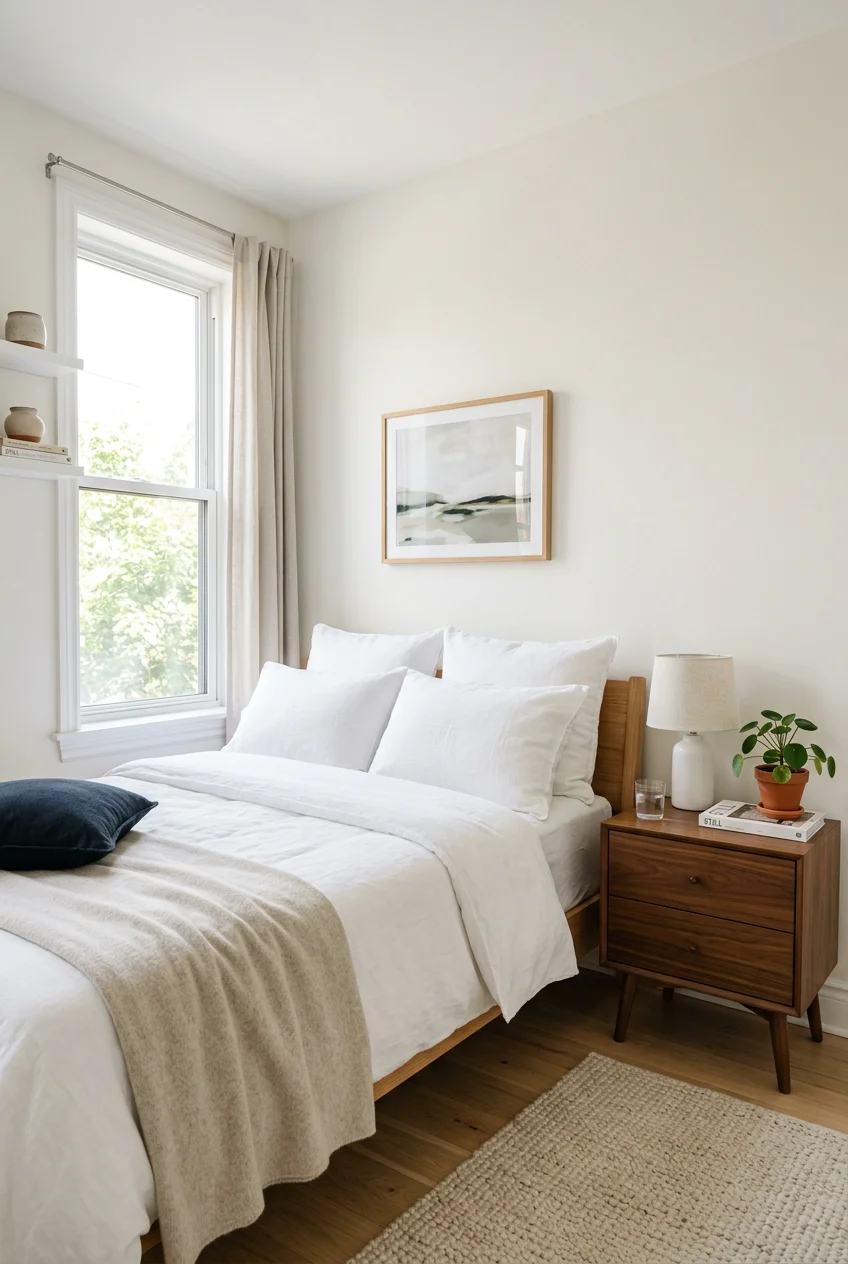
What’s Inside
- Prioritize a Slim-Profile Bed Frame and Position it Strategically
- Embrace Vertical Storage with Floor-to-Ceiling Solutions
- Install Floating Nightstands to Free Up Floor Space
- Utilize Wall-Mounted Lighting Instead of Table Lamps
- Strategically Place Mirrors to Expand the Room Visually
- Choose Light, Reflective Paint Colors for Walls and Ceilings
- Incorporate Multifunctional Furniture
- Utilize Under-Bed Storage Solutions
- Avoid Bulky, Oversized Furniture
- Layer Lighting for Ambiance and Functionality
- Consider a “Color Drenching” Approach
- Integrate Floating Shelves for Display and Light Storage
- Embrace Curtains Instead of Traditional Doors for Closets
- Avoid High-Contrast Colors and Busy Patterns
- Place Dressers Inside Closets (If Space Allows)
Most folks shove their bed into the corner of a long, narrow room, stare at the awkward bowling-alley floor plan, and wonder why the space feels like a prison cell. Figuring out small rectangle bedroom ideas isn’t about buying smaller furniture. It’s about manipulating sight lines. You’re dealing with a tunnel. You’ve got to break up that visual length without blocking the traffic path. I learned that the hard way. A common mistake is treating a narrow room like a square one, resulting in blocked walkways and bruised shins. If you only try one idea from this list, make it #11 (Color Drenching). Here’s why: erasing the stark contrast between walls and ceiling visually removes the tight boundaries of the room, tricking the eye into perceiving a much larger, cohesive space instead of a restrictive, hard-angled box.
Skip this list if you’re working with a perfectly square room or a primary suite larger than 12×12 feet. The spatial rules outlined here are specifically engineered for tight, narrow footprints where every inch of floor clearance matters. If you have the luxury of floating a king-size bed in the absolute center of your room, these aggressive space-saving tactics will just look sparse and entirely unnecessary.
1. Prioritize a Slim-Profile Bed Frame and Position it Strategically

Let’s start with the biggest footprint in the room. A common mistake is buying a massive, upholstered sleigh bed for a narrow space. The thick footboard immediately chops the room in half and ruins the traffic flow. In a rectangular bedroom, placing your bed against the longest wall is usually the only way to maintain a clear pathway from the door to the closet. You need a bed frame with a remarkably slim profile. The IKEA MALM bed frame (typically ranging from $200 to $400 depending on size and under-bed storage additions) is a solid baseline. It’s got flat, flush edges that don’t steal an extra four inches of walking space. If you prefer legs, choose a frame that sits at least 6 inches off the floor to create visual lightness. Seeing the floor continue under the bed makes the room register as wider. Trust me on this.
Best for: Tight budgets and ultra-narrow spaces.
The catch: Flush-to-the-floor frames like the basic MALM look incredibly heavy and can collect serious dust bunnies in the dark corners where the vacuum can’t reach.
2. Embrace Vertical Storage with Floor-to-Ceiling Solutions

Floor space is dead currency in a tight rectangle. You’ve got to use the walls. Most people buy a standard 3-foot-tall dresser, drop it against a wall, and leave 5 feet of empty air above it. That’s wasted real estate. Install tall wardrobes or shelving units that reach entirely to the ceiling. This draws the eye upward and forces the brain to register the height of the room rather than the narrow width. The IKEA PAX wardrobe system (customizable, generally running anywhere from $300 to over $1000) is the industry standard for faking custom built-ins. If you just need open shelving, standard BILLY bookcases (usually under $100 each) stacked with height extension units do the job perfectly. Anchor them securely to the wall studs using heavy-duty 2-inch wood screws.
The catch: Floor-to-ceiling units require perfectly level floors. If you live in an older house with sloped floors, the tall doors won’t align without serious shimming.
3. Install Floating Nightstands to Free Up Floor Space

Bulky traditional nightstands act like visual roadblocks on either side of the bed. They anchor the corners and make the room feel immediately heavier. Wall-mounted floating nightstands fix this by creating breathing room and exposing the floor beneath. Brands like Room & Board sell the Linear Wall-Mounted Nightstand (usually around $150 to $170), while you can easily find budget-friendly sets on Target or Walmart (expect to pay $50 to $70 for a set of two). The installation height is critical. Mount them so the top surface aligns exactly with the top of your mattress. If you mount them too high, you’re reaching awkwardly up for your phone; too low, and it looks like a mistake. Use heavy-duty drywall anchors rated for at least 50 lbs.
Best for: Renters who are allowed to drill holes and people who hate vacuuming around furniture legs.
The catch: You lose the deep drawer storage of a traditional nightstand, meaning you have to be ruthless about bedside clutter.

Yieach Bedside Shelf for Dorm Bed,Rv
Yieach Bedside Shelf for Dorm Bed is sturdier in person than the photos suggest — over 117 buyers gave it 4.5 stars.
4. Utilize Wall-Mounted Lighting Instead of Table Lamps

Table lamps eat up 50% of the usable surface area on a small nightstand. It’s a terrible trade-off. Wall-mounted sconces or pendant lights completely free up that bedside surface and reduce visual clutter. Hard-wired swing-arm lamps, like the brass options from onefortythree (typically around $90 to $110), provide targeted reading light exactly where you need it without requiring a bulky base. If you can’t hardwire, plug-in sconces with cord covers painted to match the wall color work just as well. Mount the sconce base exactly 30 to 36 inches above the top of the mattress. This ensures the light casts downward over your shoulder for reading, rather than blinding you directly in the eye when you sit up.
The catch: Plug-in sconces mean dealing with visible cords trailing down the wall, which ruins the clean aesthetic unless you meticulously cover them.
5. Strategically Place Mirrors to Expand the Room Visually

Mirrors are the oldest trick in the book for making a cramped space feel larger, but most people place them completely wrong. Hanging a small mirror above a dresser does nothing for spatial perception. You need a massive, floor-to-ceiling mirror positioned directly opposite a window or your primary light source. This bounces the natural light back into the room and creates a fake sense of depth, essentially doubling the visual width of your narrow rectangle. Mirrored closet doors are highly functional here. The IKEA PLATSA wardrobe system offers mirrored door panels that subtly enhance the sense of space without requiring extra wall real estate. If you’re buying a freestanding floor mirror, get one that is at least 65 inches tall and 24 inches wide.
The catch: Large mirrors reflect everything. If your room is messy, the mirror just doubles the visual clutter and makes the space feel twice as chaotic. You might also like: 20 Creative Cozy Small Bedroom for Any Style
6. Choose Light, Reflective Paint Colors for Walls and Ceilings

Dark colors absorb light and pull walls inward. In a tight rectangular layout, that’s exactly what you want to avoid. Light colors like whites, creams, pale blues, and soft greens reflect light, making the walls recede. Benjamin Moore’s White Dove or Sherwin-Williams’ Alabaster are reliable, non-sterile whites that provide a soft, neutral base without looking like a hospital corridor. You need a paint finish with a slight sheen, like eggshell or satin, rather than dead flat. The slight gloss helps bounce light from your windows deeper into the room. A common mistake is painting the ceiling dead white when the walls are cream; it creates a stark contrast line. Tint the ceiling paint with 25% of your wall color for a smoother visual transition. You might also like: 16 Aesthetic Blue Bedroom for Every Budget
Best for: North-facing rooms that get zero direct sunlight. You might also like: 19 Modern Luxury Bedroom Design Master Suite for Every Budget
The catch: Light, reflective walls show every single scuff, fingerprint, and furniture ding. You’ll be touching up the paint constantly.

BAYKA Floating Shelves for Wall
BAYKA Floating Shelves for Wall punches above its price — 96 buyers rated it 4.5 stars. The kind of pick people reorder.
7. Incorporate Multifunctional Furniture

A small rectangular bedroom can’t accommodate single-use furniture. Every piece needs to pull double duty. If you put a chair in the corner, it’s just going to become an expensive laundry basket. Instead, look for storage ottomans that serve as seating while hiding bulky items. The Pacific Lifestyle Catania Bouclé Storage Bench (usually around $350 to $450 equivalent) sits neatly at the foot of a bed and swallows three extra blankets. If you need a workspace, skip the traditional bulky desk. The IKEA NORBERG wall-mounted fold-down desk drops flat against the wall when you aren’t using it, instantly restoring 30 inches of walking clearance. This is non-negotiable in a room where two people need to walk past each other.
The catch: Fold-down desks force you to completely clear your workspace every single time you want to put the desk away.
8. Utilize Under-Bed Storage Solutions

The 15 to 30 square feet beneath your mattress is the most underutilized storage zone in a bedroom. Leaving it empty is a massive waste. Opt for bed frames with integrated drawers, or buy low-profile plastic bins equipped with wheels. You need bins that are no taller than 6 inches if you have a standard metal frame. Costco sells excellent heavy-duty latching bins (usually under $40 for a pack) that slide perfectly underneath. Store out-of-season clothing, extra sheets, and bulky winter coats down here. This immediately frees up hanging space in your primary closet. Do not use cardboard boxes under the bed; they attract dust mites and silverfish. Stick to hard plastic with latching lids to keep textiles clean.
The catch: Under-bed drawers require at least 24 inches of clearance on the side of the bed to pull open fully. If your bed is pushed tight against a wall, half your storage is completely inaccessible.
9. Avoid Bulky, Oversized Furniture

One of the fastest ways to ruin a small room is by stuffing it with oversized, heavily carved wood furniture. A chunky, 1990s-style oak dresser with thick molding will suffocate a narrow space. You need pieces that are strictly proportionate to the room’s square footage. Choose sleeker, mid-century modern-inspired styles with exposed, tapered legs. Furniture that sits up on legs allows light and air to pass underneath, maintaining an expansive visual flow. A dresser should be no deeper than 18 inches. Anything deeper encroaches too far into your walking path. If you only have 3 feet of clearance between the end of the bed and the wall, a deep dresser makes the room feel like an obstacle course.
The catch: Sleek, shallow dressers hold significantly less clothing. You’ll likely need to implement a strict capsule wardrobe or store off-season items elsewhere.

Floating Shelves 3 inch Thick for Wall Set of 2
A dependable everyday pick — Floating Shelves 3 inch Thick for Wall Set of 2 pulls in 72 ratings at 4.5 stars. Not flashy, just solid.
10. Layer Lighting for Ambiance and Functionality

Relying entirely on a single overhead fixture in the center of the ceiling casts harsh, unflattering shadows into the corners of a long room. It makes the space look like a cheap motel. You need three distinct layers of lighting: ambient (the main overhead source), task (reading lights by the bed), and accent (to highlight architectural features or art). Add LED strip lighting under your floating shelves or behind the headboard to create a soft, glowing wash of light against the wall. You can find reliable 16-foot LED strips at places like Walmart or Target for under $25. This layered approach eliminates dark, dead corners and makes the rectangular footprint feel intentional and cozy rather than dark and confining.
The catch: Layering multiple light sources requires multiple outlets. Older homes rarely have enough strategically placed receptacles, meaning you might be relying on ugly extension cords.
11. Consider a “Color Drenching” Approach

Color drenching is an aggressive but highly effective tactic for small rectangle bedroom ideas. It involves taking your wall color and painting the baseboards, window trim, doors, and the ceiling in the exact same shade. When you paint the ceiling white and the walls a different color, you create a harsh visual line that screams “this is exactly where the room stops.” Color drenching blurs those boundaries entirely. Without stark contrasting lines, the eye can’t easily measure the dimensions of the room, making the space feel larger and infinitely more cohesive. Use a flat finish on the ceiling and an eggshell finish on the walls in the identical color code.
Best for: Small dark rooms that lack interesting architectural details.
The catch: Painting a ceiling a dark or saturated color requires serious skill. Roller marks and uneven coverage are painfully obvious when the light hits a drenched ceiling.
12. Integrate Floating Shelves for Display and Light Storage

Floor-standing bookcases are too heavy for narrow walls. Floating shelves are the superior alternative for displaying books or decor without eating up a single inch of floor space. If you’re using a floating shelf as a nightstand replacement, the measurements matter immensely. Mount a single shelf exactly 24 to 26 inches from the floor. The shelf itself should be 20 to 24 inches wide and no more than 10 inches deep. This provides just enough surface area for a phone, a glass of water, and a book. Brands like Room & Board sell high-end metal Float Wall Shelves, while Wayfair and Target offer hundreds of wood-veneer options (usually ranging from $30 to $80). Use heavy-duty toggle bolts, not the cheap plastic anchors included in the box.
The catch: Floating shelves have strict weight limits. Overload them with heavy hardcover books, and they will rip straight out of the drywall.

Amazon Basics Bedroom Closet Organizer with 5-Fabric
A dependable everyday pick — Amazon Basics Bedroom Closet Organizer with 5-Fabric Storage Drawers f pulls in 41 ratings at 4.5 stars. Not flashy, just solid.
13. Embrace Curtains Instead of Traditional Doors for Closets

Traditional swinging closet doors require a massive three-foot radius of clearance just to open. In a tight rectangular bedroom, that clearance zone usually dictates exactly where you can and can’t place your bed. Remove the closet doors entirely and hang a tension rod with heavy-weight linen or velvet curtains. This eliminates the clearance requirement, immediately giving you back usable floor space. It also adds a massive dose of much-needed texture and softness to a room dominated by hard angles. Hang the curtain rod as close to the ceiling as possible, not just right above the closet frame. This draws the eye up and makes the ceilings look taller.
The catch: Curtains don’t block sound or smells. If your closet is next to an en-suite bathroom, damp air and odors will drift directly into your wardrobe.
14. Avoid High-Contrast Colors and Busy Patterns

A common mistake is treating a small bedroom like a maximalist funhouse. High-contrast colors (like black furniture against stark white walls) and loud, busy wallpaper patterns interrupt the visual flow. Every time the eye hits a sharp contrast, it stops. In a narrow room, you want the eye to glide smoothly across the space. Stick to a cohesive, low-contrast color scheme. If your walls are soft sage green, opt for light oak or white furniture rather than heavy, dark espresso woods. Keep your bedding solid or feature a very subtle, small-scale texture rather than a massive geometric print. This creates a sense of continuity that prevents the walls from feeling like they are closing in on you. No exaggeration.
The catch: Low-contrast, tonal rooms can easily cross the line into boring and flat if you don’t aggressively mix different tactile textures like bouclé, linen, and matte ceramics.
15. Place Dressers Inside Closets (If Space Allows)

If you are lucky enough to have a closet that is wider than 4 feet, you need to relocate your dresser. Shoving a bulky dresser inside the closet is a brilliant way to instantly regain 6 to 8 square feet of floor space in the main bedroom area. Measure the interior width and depth of your closet carefully, accounting for the door frame. You need a dresser that is no more than 16 to 18 inches deep so it doesn’t block your hanging clothes. Take the doors off the closet or use the curtain trick from Idea #13 so you aren’t fighting to open a closet door just to access your sock drawer.
Best for: Homes with kids or pets where you want to lock away clothing and keep the main floor completely clear.
The catch: You sacrifice a significant amount of long-hanging space for dresses or coats, forcing you to fold items that you might prefer to hang.
How we chose these ideas: These strategies were selected based on their strict adherence to renter-friendliness, overall cost, and immediate visual impact in tight spaces. Priority was given to low-effort modifications that don’t require major structural renovations or expensive contractor labor.
At the end of the day, arranging a narrow room is just a puzzle. Stop fighting the dimensions and start using the vertical space you’re ignoring. I highly recommend mapping out your floor plan with painter’s tape before you buy a single piece of furniture. Pin this list for your next weekend project, and don’t let a tight floor plan dictate your comfort.

Govee RGBIC LED Strip Lights
A dependable everyday pick — Govee RGBIC LED Strip Lights pulls in 252 ratings at 4.5 stars. Not flashy, just solid.
Frequently Asked Questions
Where should I put the bed in a small rectangular bedroom?
Place the bed against the longest wall to maintain a clear pathway. If the room is extremely narrow, pushing the bed into a corner maximizes floor space, though it limits access to one side.
What colors make a narrow bedroom look wider?
Light, reflective colors like soft whites, pale blues, and light greens make walls recede. Alternatively, color drenching (painting walls and ceiling the same color) blurs harsh lines and makes the room feel expansive.
How do I add storage to a small rectangular bedroom?
Utilize vertical space with floor-to-ceiling wardrobes like the IKEA PAX. Swap traditional nightstands for floating shelves, and use low-profile bins under the bed to store off-season clothing.
Are bulky dressers a bad idea for narrow bedrooms?
Yes. Deep dressers block traffic flow and make the room feel cramped. Opt for sleek dressers no deeper than 18 inches, or move the dresser inside the closet to free up floor space.
