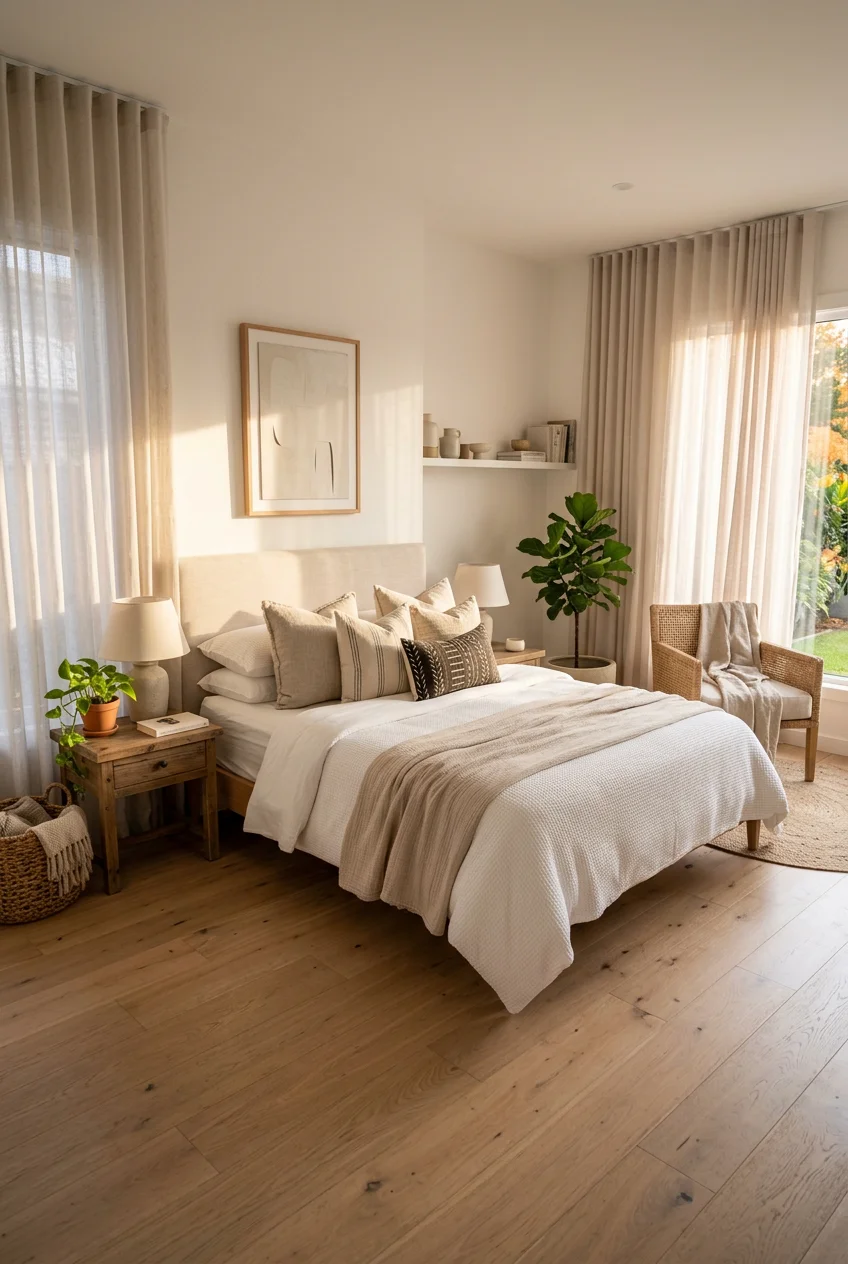
What’s Inside
- Hang Curtains High and Wide
- Double the Width for Luxurious Fullness
- Layer Blackout Shades with Sheers
- Automate with Smart Blinds
- Prioritize Blackout Functionality First
- Switch to Sustainable, Organic Materials
- Nail the Kiss the Floor Length
- Upgrade to Heavy-Duty Hardware
- Tailor the Look with Roman Shades
- Add Custom Trim to Ready-Made Panels
- Embrace Maximalist Wall-to-Wall Drapes
- Measure Everything Twice
- Warm Up the Room with Woven Wood Shades
- Repurpose a Fabric Shower Curtain
- Secure Everything with Heavy-Duty Wall Anchors
- Install a Faux Pelmet Box
- Frost Lower Panes for Instant Privacy
Most folks treat bedroom window decor as an afterthought. They slap up a flimsy rod right on the window frame and call it a day. It makes ceilings look low and blocks half the natural light. Good window treatments fix architectural flaws while hiding the fact that you’re sleeping next to a noisy streetlamp. If you only try one idea here, make it #1. Moving the rod up and out changes the room’s perceived size without a drop of paint. Trust me.
Skip this guide if your lease bans drilling holes, or if you refuse to spend more than a fast-food lunch budget. Proper treatments require heavy-duty hardware and enough fabric to cover the glass. Cheap spring rods and single, flat panels won’t cut it.
1. Hang Curtains High and Wide

Let’s talk about a major rookie error. Most people mount their curtain rod directly on the window molding and wonder why the room feels like a cave. Go high and wide. Mount the rod 4 to 6 inches above the frame. If the ceiling is close, push it to the crown molding. Extend the rod 6 to 12 inches beyond the frame on each side. This lets the fabric stack off the glass, tricking the eye into thinking the window is massive. Designers like Emily Henderson use this constantly. A basic rod from Target works, provided it spans the distance. The catch: this needs longer, pricier panels to reach the floor. Best for: small, dark rooms.
2. Double the Width for Luxurious Fullness

Skimpy curtains look cheap. If a panel pulls taut across the glass like a flat sheet, you’re doing it wrong. For a hotel-like drape, the total width of your panels should be 2 to 2.5 times the window width. This guarantees rich folds even when shut. When shopping at places like Pottery Barn (where blackout panels run $90 to $500), check the width before buying. Don’t assume one panel covers a standard window. You almost always need two per side. The catch: doubling the fabric doubles your budget.
3. Layer Blackout Shades with Sheers

A single treatment rarely solves everything. You need total darkness for sleep, but soft light during the day. Layering is the answer. Mount a cellular blackout shade inside the frame and frame it with sheer linen curtains. Hunter Douglas Duette honeycomb shades ($300 to $800 per window) block light and insulate, while the sheers soften the look. The texture contrast between the crisp pleats and flowing linen adds depth. The catch: two treatments require deep casings and extra clearance for hardware.

Yieach Bedside Shelf for Dorm Bed,Rv
If you want something that just works, Yieach Bedside Shelf for Dorm Bed is a safe bet (117 reviews, 4.5 stars).
4. Automate with Smart Blinds

Motorized shades aren’t just a novelty. Opening blinds with a voice command is practical, especially for windows behind a bed. IKEA FYRTUR blackout rollers ($129 to $179) integrate with smart home setups. If you have basic roller shades, a retrofit motor like the Aqara Roller Shade Driver E1 (under $70) handles the chain. The morning whir of the motor beats a blaring phone alarm. The catch: batteries need charging every few months, which gets old. Best for: tech enthusiasts.
5. Prioritize Blackout Functionality First

Don’t buy a treatment just because the fabric is pretty. Bedroom decor must function as a sleep aid first. Designer Alice Moszczynski notes that blackout curtains create the dark environment needed for rest while regulating temperature. Heavy velvet panels from West Elm absorb street noise and block morning sun, keeping the room cool. Check the lining before buying. A good lining feels thick, not like cheap tissue paper. The catch: high-quality blackout lining often has a stiff, plastic feel that makes curtains flare out at the hem.
6. Switch to Sustainable, Organic Materials

Plastic blinds off-gas chemical smells when baked by the sun. Switching to natural materials improves air quality. Brands like Graber focus on renewable resources for woven wood collections, while Bali Blinds offers fabrics made from recycled bottles. Linen, organic cotton, and bamboo offer a tactile, earthy feel polyester can’t touch. The smell of warm bamboo in the sun is a nice bonus. The catch: pure natural fibers like unblended linen wrinkle and require constant steaming.

Venusmiles Floating Shelves for Wall 24 inch Long
A dependable everyday pick — Venusmiles Floating Shelves for Wall 24 inch Long pulls in 412 ratings at 4.5 stars. Not flashy, just solid.
7. Nail the Kiss the Floor Length

High-water curtains are a design crime. Curtains stopping two inches above the floor make ceilings look lower and the room unfinished. Your panels should barely kiss the floor, hovering a half-inch above the wood. For a romantic look, let the fabric puddle by adding 1 to 3 inches to the length. This requires precise measuring from where the rod sits. The catch: puddled curtains are dust magnets that tangle in your robotic vacuum. You might also like: 16 Bedroom Decor Ideas For Women That Actually Work
8. Upgrade to Heavy-Duty Hardware

Flimsy hardware ruins expensive curtains. A thin rod that bows under heavy fabric looks sloppy. For windows wider than 60 inches, you need a rod at least 1 inch in diameter. You also need a center support bracket. Treat your hardware like jewelry. Heavy brass rings that make a solid metallic clink add a sense of quality. You can find solid options at Home Depot or Lowe’s. The catch: thick rods require big brackets that often interfere with crown molding. You might also like: 16 Aesthetic LED Lights Bedroom You Need to See
9. Tailor the Look with Roman Shades

Drapes don’t fit every space. If a bedroom has baseboard heaters or a window seat, floor-length curtains are a hazard. Roman shades provide a clean, tailored look that sits inside the frame. A 100% linen Roman shade pulls up into crisp folds, adding structure without taking up floor space. They look custom and avoid the messy look of fabric pooling on a radiator. The catch: custom sizes take weeks and cost more than off-the-shelf panels. Best for: tight spaces. You might also like: 18 Small Bedroom Storage Ideas Worth Trying

Govee RGBIC LED Strip Lights, Smart LED Lights for Bedroom
If you want something that just works, Govee RGBIC LED Strip Lights is a safe bet (252 reviews, 4.5 stars).
10. Add Custom Trim to Ready-Made Panels

Custom drapery costs thousands, but you can fake it. Buy inexpensive panels, like the IKEA RITVA, and attach high-quality trim to the edges. Velvet ribbon or Greek key trim makes a $40 curtain look bespoke. You can sew it on, or if you can’t sew, use 2 tablespoons of fabric glue per yard to secure it. It adds weight, helping the curtain hang straighter. The catch: cheap trim often shrinks at a different rate than the fabric, ruining the panel in the wash.
11. Embrace Maximalist Wall-to-Wall Drapes

Sometimes, more is more. A current trend involves treating drapery as architecture. Instead of just framing the window, run curtains wall-to-wall and floor-to-ceiling. This maximalist approach creates a cocooning effect that swallows echoes and feels plush. Rich fabrics like silk or heavy cotton velvet work best here. It hides awkward window placements and turns a disjointed wall into a smooth plane. The catch: covering a wall in dense fabric traps dust and dander, which is tough for allergy sufferers.
12. Measure Everything Twice

Guessing curtain length is a great way to waste money. Measure accurately, write it down, and measure again. Measure the glass width, then add 12 to 24 inches for the rod. For length, measure from the rod location to the floor. Most 8 to 9-foot ceilings need 90 to 96-inch panels. Use a steel tape measure. The catch: even with perfect math, store-bought cotton often shrinks two inches after the first wash. Best for: beginners.

AMADA HOMEFURNISHING Floating Shelves
A dependable everyday pick — AMADA HOMEFURNISHING Floating Shelves pulls in 117 ratings at 4.5 stars. Not flashy, just solid.
13. Warm Up the Room with Woven Wood Shades

Fabric isn’t the only option. Woven wood shades made from bamboo or reeds inject warmth and organic texture into a sterile room. They filter harsh sunlight into a soft glow. Brands like Graber offer sustainably sourced materials. The natural imperfections in the reeds add character to a boring drywall box. The catch: unlined woven wood shades become transparent at night when you turn on your lights, offering zero privacy.
14. Repurpose a Fabric Shower Curtain

Wide windows need lots of fabric, which gets expensive. A budget hack involves using a fabric shower curtain. They measure 72 by 72 inches, offering more width than a standard panel. You can find textured options at Walmart or Costco for a fraction of the price of drapes. Hang them using heavy metal clip rings on a tension rod (under $15) for a no-drill install. The catch: the 72-inch length is too short for a floor-to-ceiling look, so this works best for smaller windows. Best for: tight budgets.
15. Secure Everything with Heavy-Duty Wall Anchors

Drywall is basically chalk wrapped in paper. It can’t hold a heavy rod and twenty pounds of velvet. Unless you’re hitting a stud, use heavy-duty wall anchors. Skip the plastic sleeves. Buy metal toggle bolts that flare out behind the drywall. They lock the bracket firmly, ensuring the rod won’t rip out in the middle of the night. I learned that the hard way. The catch: toggle bolts require half-inch holes that you’ll have to patch with spackle when you move.

Govee RGBIC LED Strip Lights
Govee RGBIC LED Strip Lights has been one of the most consistently praised picks in this category. 252 reviewers averaged 4.5/5.
16. Install a Faux Pelmet Box

Exposed hardware isn’t for everyone. If you hate the look of rods, hide them behind a structured faux pelmet or cornice box. Build a box out of lightweight plywood, wrap it in 4 oz of quilt batting, and staple your fabric over the top. It conceals the messy top edge and blocks the light sliver that sneaks over a standard rod. It gives the room a tailored, hotel vibe. The catch: building and mounting a heavy box requires power tools and carpentry skills.
17. Frost Lower Panes for Instant Privacy

Ground-floor bedrooms have a privacy problem. You want light, but you don’t want pedestrians staring at your bed. The fix is applying frosted privacy film to the lower panes. Cut the film to size, mix 1/2 cup of water with a drop of dish soap in a spray bottle, soak the glass, and squeegee the film flat. It lets sunshine in while blurring the view. The catch: applying film without trapping air bubbles takes extreme patience. Best for: renters.
How we chose these ideas: We evaluated these based on visual impact, cost, and durability. A good treatment needs to function for light control while hiding architectural flaws, so we prioritized layered systems and proper mounting over pure aesthetics.
I’m confident that fixing your window treatments will alter how your bedroom feels. Take the time to measure, invest in the right hardware, and avoid cheap plastic. Good curtains are like a tailored suit for your room. Pin this list for your next weekend refresh.
Frequently Asked Questions
How high should I hang my bedroom window decor?
Mount your curtain rod 4 to 6 inches above the window frame, or directly below the ceiling line. This draws the eye upward and makes the ceiling appear significantly taller.
What is the best bedroom window decor for blocking light?
Layering is the most effective method. Combine an inside-mounted cellular blackout shade with heavy, lined velvet curtains on the outside to block light leaks around the edges.
How wide should curtains be compared to the window?
The combined width of your curtain panels should be 2 to 2.5 times the width of the window glass. This ensures the fabric looks full and luxurious even when completely closed.
Are smart blinds worth it for bedroom window decor?
Yes, especially for hard-to-reach windows. Automated blackout shades allow you to control natural light from bed and can be programmed to open gently with your morning alarm.
