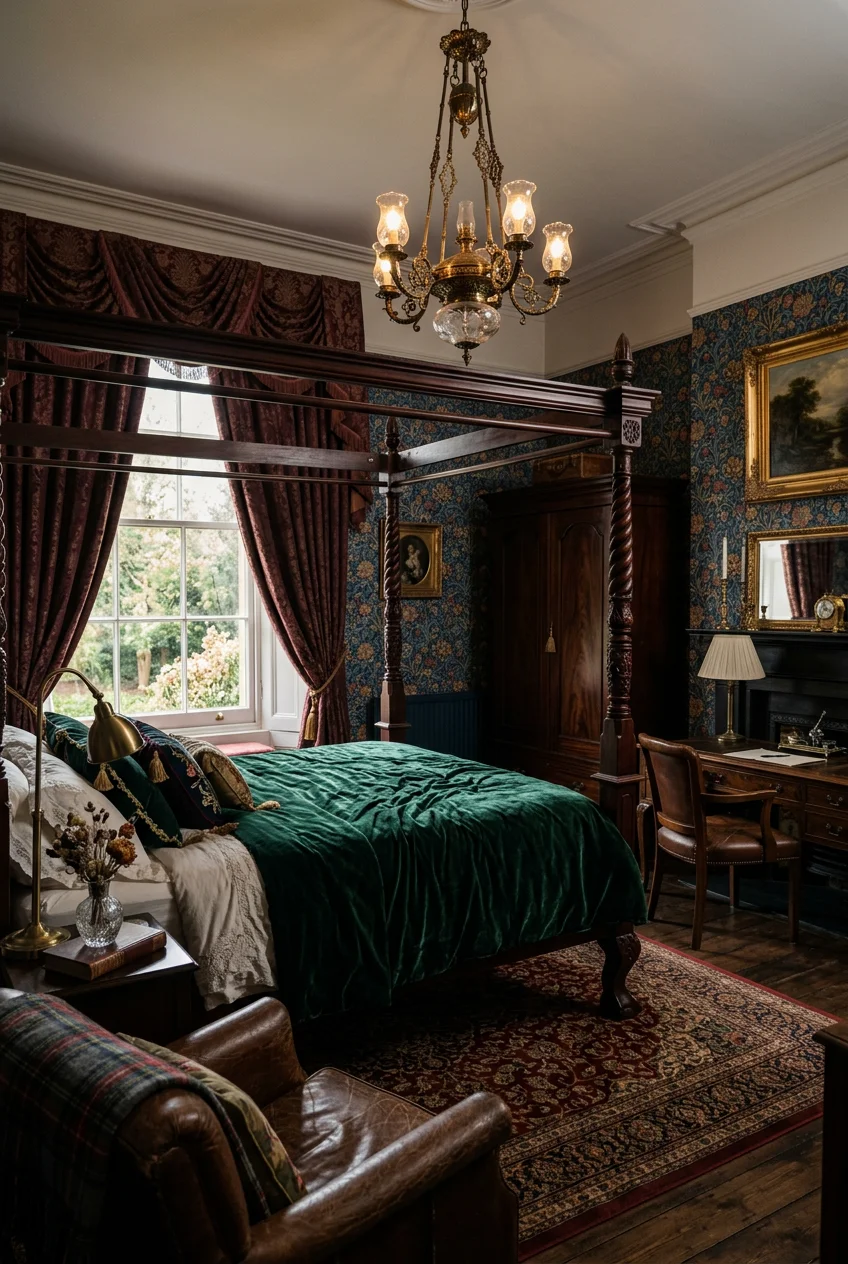
What’s Inside
- Embrace a Rich Jewel-Toned Color Palette
- Adorn Walls with Intricate Patterned Wallpaper
- Invest in an Ornate Bed Frame as the Focal Point
- Layer Luxurious Textiles for Depth and Warmth
- Install Heavy, Layered Window Treatments
- Incorporate a Chaise Lounge or Dressing Table
- Add Authentic Brass and Antique Metal Hardware
- Display Framed Vintage Botanical Prints
- Hang a Dramatic Chandelier or Pendant Light
- Roll Out a Persian or Oriental-Style Rug
- Style the Bed with Fringed and Tasseled Pillows
- Introduce Dark Wood Antique Nightstands
- Install Decorative Crown Molding and Ceiling Medallions
- Use Antique Mirrors to Reflect Light
- Add a Folding Privacy Screen
Most folks try to recreate historical spaces by buying one antique chair, throwing it in a gray room, and wondering why the space feels totally disjointed. Authentic Victorian bedroom decor isn’t about isolated pieces. It’s about layering heavy textures, embracing deep colors, and committing to ornate details that modern minimalism rejects. If you’re tired of sterile, white-box bedrooms, the Victorian aesthetic offers a masterclass in creating a moody, enveloping retreat. The key is balancing those heavy historical elements with smart, modern practicalities so the room functions for daily life instead of feeling like a cordoned-off museum exhibit. Trust me on this.
Skip this trend entirely if you prefer minimalist, low-maintenance spaces. Victorian design requires dusting intricate carvings, caring for heavy fabrics, and a high tolerance for visual density. If you want a room you can wipe down in five minutes with a microfiber cloth, this aesthetic will drive you absolutely crazy. No exaggeration.
If you only try one idea from this list, make it #2. Here’s why: authentic William Morris wallpaper instantly anchors the room’s historical context, doing the heavy lifting so your standard furniture doesn’t have to work as hard to set the mood.
1. Embrace a Rich Jewel-Toned Color Palette

Victorian bedrooms were famous for their vibrant, unapologetic color schemes. The era favored deep jewel tones like burgundy, emerald green, royal blue, and dark plum, which created a luxurious and dramatic atmosphere. For a contemporary approach that doesn’t feel suffocating, balance these rich hues with lighter ceiling colors or crisp white trim so the space doesn’t feel too heavy. A common mistake is painting a room dark without upgrading the lighting, resulting in a space that feels like a cave rather than a cozy retreat.
Consider painting an accent wall or the entire room in a bold shade like Sherwin-Williams’ “Roycroft Bottle Green” or Benjamin Moore’s “Deep Royal.” A gallon of premium interior paint from these brands typically ranges from $60 to $90. In 2026, heritage-inspired palettes featuring deep burgundy and earthy terracotta tones are trending heavily, moving away from the cooler, sterile bedroom palettes of the early 2020s. These warm, saturated colors absorb light beautifully, especially in the evening.
The catch: dark paint colors highlight every single speck of dust and drywall imperfection. You’ll need to patch and sand your walls meticulously before rolling on the color.
Best for: large bedrooms with ample natural light that can handle heavy color saturation.
2. Adorn Walls with Intricate Patterned Wallpaper

Intricate wallpaper patterns, particularly those with dense floral, leaf, vine, or damask motifs, are a defining characteristic of Victorian design. Bare painted walls just don’t carry the same historical weight. To incorporate this, select a wallpaper with a bold botanical pattern. Heritage brands like William Morris offer historically accurate designs that instantly legitimize the space. A standard double roll of high-quality reproduction wallpaper usually costs between $100 and $150.
For a less overwhelming effect, especially in smaller rooms, consider using wallpaper on just one accent wall behind the bed, or install it only above a chair rail. This approach allows you to introduce the Victorian theme without making the room feel overly busy or visually chaotic. The texture and complexity of the print add a layer of sophistication that paint alone can’t achieve.
The catch: intricate, repeating patterns are notoriously unforgiving during installation. A 1/8-inch misalignment between panels ruins the illusion of the entire wall.
Best for: homeowners with smooth, untextured drywall, as standard wallpaper won’t adhere properly to heavy orange peel or knockdown textures.
3. Invest in an Ornate Bed Frame as the Focal Point

A bedroom needs a grounding element, and in this aesthetic, a four-poster bed or an ornate metal bed frame is central to creating an authentic Victorian bedroom. Look for dark wood frames with intricate carvings or heavy cast iron frames featuring decorative spindles and brass joints. Wayfair offers several reproduction cast iron beds typically ranging from $200 to $500, depending on the size and weight.
Scale matters immensely here. A full-size Victorian iron bed frame typically measures around 51.63 inches high by 58.5 inches wide by 82.25 inches long. If you’re upgrading to a queen-size cast iron frame, expect dimensions around 61.5 inches wide by 81 inches long for the inside measurements. Highlighting one bold statement piece like an antique-style bed frame forces the eye to a central focal point, keeping the rest of the room’s dense decor from feeling scattered.
The catch: authentic or high-quality reproduction cast iron frames are brutally heavy. They will permanently gouge hardwood floors if you don’t use heavy-duty caster cups under the feet.

Govee RGBIC LED Strip Lights, Smart LED Lights for Bedroom
A dependable everyday pick — Govee RGBIC LED Strip Lights pulls in 252 ratings at 4.5 stars. Not flashy, just solid.
4. Layer Luxurious Textiles for Depth and Warmth

Victorian design heavily emphasized layering various textures and fabrics, treating the bed as an opulent display rather than just a place to sleep. Incorporate materials like velvet, silk, heavy brocade, and faux fur. For instance, a dark green velvet duvet cover paired with patterned throw pillows in complementary shades transforms a standard mattress into a commanding focal point. Target’s Threshold line often carries budget-friendly velvet quilts typically priced under $80, offering the look without the dry-cleaning bills of raw silk.
Adding a faux fur throw blanket (standard 50×60 inches) draped over the foot of the bed provides an extra layer of coziness and visual interest. In 2026, texture-maxxing is a dominant trending approach in bedroom design, with a strong focus on plush upholstery, tactile bedding, and soft, tailored drapery over flat cottons.
The catch: velvet and faux fur are absolute magnets for pet hair and ambient dust. You’ll need to keep a lint roller in your nightstand and use it daily.
Best for: cold climates or drafty older homes where heavy bedding serves a functional, insulating purpose. You might also like: 17 Small Room Ideas Bedroom for Every Budget
5. Install Heavy, Layered Window Treatments

Victorian windows were never left bare or fitted with simple plastic blinds. They were typically adorned with heavy fabric drapes, often layered over lighter net or muslin privacy curtains, and held back by ornate brass holdbacks. To replicate this, hang opulent velvet or damask curtains on thick, decorative brass poles. Fabric suppliers like The Victorian Emporium offer historically accurate textiles, though custom panels can run anywhere from $100 to $300 each. You might also like: 18 Aesthetic Posters For Bedroom That Actually Work
Layer these heavy drapes over sheer lace or muslin panels. This provides daytime privacy while diffusing harsh sunlight, protecting your dark fabrics from fading. For an authentic touch, allow the main heavy curtains to “puddle” slightly on the floor by adding 2 to 4 inches to your standard curtain length measurement. Characterful curtains with ruffles, deep pleats, and detailed headings are expected to be highly popular in 2026. You might also like: 19 Aesthetic Room Decor Ideas Bedroom Wall Worth Trying
The catch: puddled fabric acts like a floor sweep, instantly collecting dust bunnies, pet dander, and dirt. They require constant vacuuming with an upholstery attachment.
6. Incorporate a Chaise Lounge or Dressing Table

A chaise lounge or an ornate dressing table was a common and highly functional element in Victorian bedrooms, offering a dedicated space for relaxation, reading, or grooming away from the main living areas. Adding one of these pieces instantly turns the room from a simple sleeping quarter into a private suite. A proper Victorian-style chaise lounge, such as those crafted by Laurel Crown Furniture, typically measures around 73 inches wide by 31 inches deep by 35.5 inches high. These investment pieces generally range from $800 to $1,200.
If you don’t have the floor space for a chaise, a small carved mahogany dressing table with an attached mirror serves a similar historical purpose while taking up half the footprint. Pair it with a velvet-upholstered stool.
The catch: a 73-inch chaise lounge eats up massive amounts of floor space and, in many modern homes, quickly devolves into a very expensive chair for holding clean laundry.
Best for: primary suites with at least 150 square feet of floor space and an empty, unused corner.

Leeleberd Led Lights for Bedroom 100 ft (2 Rolls of 50ft)
If you want something that just works, Leeleberd Led Lights for Bedroom 100 ft (2 Rolls of 50ft) Music Sync C is a safe bet (205 reviews, 4.5 stars).
7. Add Authentic Brass and Antique Metal Hardware

Modern brushed nickel or matte black hardware instantly breaks the illusion of a Victorian space. Swapping out standard knobs and pulls on your doors, dressers, and nightstands is an inexpensive way to solidify the room’s historical feel. Look for unlacquered brass, antique bronze, or cut-glass knobs. Retailers like Home Depot and Lowe’s sell reproduction glass and brass knobs typically ranging from $5 to $15 per piece.
When replacing drawer pulls, measure carefully. Standard modern pulls are often 3 inches or 3.75 inches center-to-center, but antique reproduction hardware frequently uses non-standard measurements. Filling old holes and redrilling is a hassle you want to avoid if possible. The heavy, cold touch of solid brass hardware adds a tactile element of quality to even cheap, modern furniture. I learned that the hard way.
The catch: unlacquered brass is a living finish. It requires regular, vigorous polishing with Brasso if you want to keep it shiny, otherwise it develops a dark, muddy brown patina.
8. Display Framed Vintage Botanical Prints

Victorian society had a deep fascination with natural history, botany, and taxonomy. Reflect this in your decor by hanging a gallery wall of vintage botanical prints, insect illustrations, or ornithological drawings. You don’t need to spend a fortune on authentic antiques. Digital downloads of public domain botanical art are widely available on Etsy for $5 to $15.
Print them on heavy, textured watercolor paper and frame them in standard 8×10 or 11×14 frames. To make them look authentic, source ornate, mismatched gold or dark wood frames from local thrift stores. The key is tight, symmetrical grouping. A grid of six or eight matching botanical prints above a dresser creates a striking, organized visual break against heavy floral wallpaper or dark paint.
The catch: standard cheap frame glass creates harsh, reflective glare. Upgrading to non-reflective museum glass makes the art look authentic but often doubles or triples the framing cost.
Best for: renters who want to add significant visual impact without making permanent changes to the walls or fixtures.
9. Hang a Dramatic Chandelier or Pendant Light

Standard flush-mount “boob lights” are the enemy of Victorian bedroom decor. The lighting fixture should be a statement piece that draws the eye upward. Replace builder-grade lighting with a dramatic chandelier featuring crystal drops, brass arms, or milk glass shades. Big-box stores like Lowe’s offer surprisingly decent reproduction crystal chandeliers typically in the $150 to $400 range.
If a full crystal chandelier feels too formal, look for a brass lantern pendant or a multi-arm fixture with fabric shades. Install the fixture on a dimmer switch. Victorian homes were originally lit by gaslight or candlelight, which provided a soft, low-level glow. Bright, cool-toned LED bulbs completely ruin the moody atmosphere you’re trying to build. Stick to bulbs with a color temperature of 2700K or lower.
The catch: dusting dozens of individual glass crystals requires a stepladder, a microfiber cloth, and an immense amount of patience.
Best for: rooms with ceilings over 9 feet; otherwise, tall people will constantly hit their heads on the fixture.

BAYKA Floating Shelves for Wall
BAYKA Floating Shelves for Wall is sturdier in person than the photos suggest — over 96 buyers gave it 4.5 stars.
10. Roll Out a Persian or Oriental-Style Rug

Wall-to-wall modern carpeting does nothing for a historical aesthetic. If you have hardwood floors, or even if you’re layering over existing low-pile carpet, a large Persian or Oriental-style rug is essential. The intricate geometric and floral patterns tie together the room’s rich jewel tones. An 8×10 foot rug is usually the minimum size needed to properly anchor a queen or king bed.
Authentic hand-knotted wool rugs are incredibly expensive, but brands like Ruggable offer washable, printed versions of traditional Persian designs typically ranging from $200 to $400 for an 8×10 size. These modern alternatives give you the visual density of a traditional rug without the anxiety of ruining an expensive antique with a spilled cup of coffee.
The catch: printed, washable rugs lack the thick, luxurious pile of authentic wool. They feel flat and slightly rough underfoot compared to the real thing.
11. Style the Bed with Fringed and Tasseled Pillows

Victorian decor is all about the details, and plain, square pillows simply don’t cut it. Incorporate throw pillows adorned with heavy fringe, corner tassels, intricate embroidery, or button tufting. These small embellishments add the necessary fussiness that defines the era. Anthropologie is a reliable source for high-end, heavily embellished velvet pillows, usually priced between $50 and $100 for a standard 18×18 inch square.
For a more budget-friendly approach, buy plain velvet pillow covers and attach your own fringe or brush trim sourced from a craft store like Joann Fabrics. Mix different shapes—lumbar pillows, round bolster pillows, and standard squares—to create a layered, opulent look at the head of the bed. It’s a small detail that drastically changes the profile of your bedding.
The catch: heavy tassels and delicate fringe get completely destroyed in standard washing machines. These pillows are strictly spot-clean or dry-clean only.
12. Introduce Dark Wood Antique Nightstands

Matching, modern, particle-board nightstands look glaringly out of place next to an ornate cast iron or carved wood bed. Instead, seek out dark wood pieces made of mahogany, walnut, or cherry. You don’t need a matching set. In fact, slightly mismatched antique tables or small commodes add a more authentic, collected-over-time feel to the space.
Check local antique malls, estate sales, or Facebook Marketplace. You can often find solid wood, mid-1800s to early-1900s side tables for $50 to $200. Look for details like turned legs, marble tops, or dovetail drawer construction. The rich, dark grain of the wood provides a necessary visual weight that grounds the lighter textiles and reflective mirrors in the room.
The catch: authentic antique side tables were built for much lower antique beds. They often sit too low to comfortably reach from a modern, 25-inch-high pillow-top mattress profile.

Mkono Macrame Hanging Shelves Boho Wall Decor Set of 2
Mkono Macrame Hanging Shelves Boho Wall Decor Set of 2 Rustic Wood Flo punches above its price — 21 buyers rated it 4.5 stars. The kind of pick people reorder.
13. Install Decorative Crown Molding and Ceiling Medallions

Victorian architecture rarely left the transition between the wall and ceiling bare. Adding thick crown molding and a decorative ceiling medallion above the light fixture instantly upgrades the architectural pedigree of a basic square room. You don’t need a plaster artisan to achieve this look. Lightweight polyurethane ceiling medallions are available at Home Depot for $20 to $50.
These foam-like medallions can be painted to match the ceiling and installed easily with construction adhesive and a few brad nails. For crown molding, look for profiles that are at least 4 inches wide to ensure they make a visual impact. Painting the ceiling medallion the same rich jewel tone as the walls, rather than standard white, creates a striking, modern take on Victorian design.
The catch: cutting and installing crown molding requires a compound miter saw and precise angle calculations that severely frustrate most beginner DIYers.
Best for: homeowners doing permanent upgrades who are comfortable with power tools and caulk.
14. Use Antique Mirrors to Reflect Light

Because Victorian rooms rely on dark colors and heavy fabrics, they can quickly feel oppressive. Mirrors are the historical solution to this problem, bouncing limited natural light and soft lamplight around the room. Look for mirrors with heavy, ornate gold or brass frames featuring floral crests or beveled glass edges.
A large floor mirror leaning against the wall or a wide mirror mounted above a dressing table serves both a functional and decorative purpose. You can often find heavy, vintage mirrors at thrift stores or flea markets for $100 to $300. The slightly distressed, desilvered spots on antique mirror glass (known as foxing) actually add to the charm and authenticity of the room, so don’t pass up a piece just because the glass isn’t flawless.
The catch: authentic antique mirrors with solid wood and plaster frames are incredibly heavy. They will rip standard drywall anchors right out of the wall and must be secured directly into studs with heavy-duty lag screws.
15. Add a Folding Privacy Screen

A folding privacy screen, often called a room divider, is a classic Victorian bedroom accessory. Originally used to provide a private area for dressing in shared spaces or to block drafts from large windows, they now serve as excellent decorative backdrops. Look for screens made of carved wood, upholstered in patterned fabric, or featuring painted botanical scenes.
Wayfair and other online retailers offer 3-panel carved wood screens typically ranging from $100 to $250. A standard screen is usually around 72 inches high. Placing one in an empty corner behind a potted fern or using it to section off a small reading nook adds architectural interest to a room without requiring any construction or installation.
The catch: folding screens block natural light and take up floor space, which can make tight corners in smaller bedrooms feel cramped and claustrophobic.
How we chose these ideas: We evaluated these Victorian decor elements based on their visual impact, historical relevance, and adaptability to modern homes. The selections prioritize a mix of renter-friendly styling adjustments (like textiles and hardware) and permanent architectural upgrades (like molding and paint), ensuring options for various budgets and skill levels.
Victorian design isn’t about perfectly recreating the 1890s. It’s about borrowing the era’s best, most dramatic elements to make your modern bedroom feel like a deliberate, cozy sanctuary. Start with the dark paint or the William Morris wallpaper, and build your layers from there. Save this list to your bedroom mood board so you have the specific measurements and store references handy when you’re ready to start sourcing pieces.

50×70 Inch Rust Throw Blanket – Soft & Fluffy Fleece
If you want something that just works, 50×70 Inch Rust Throw Blanket – Soft & Fluffy Fleece is a safe bet (14 reviews, 4.5 stars).
Frequently Asked Questions
What colors are best for a Victorian bedroom?
Victorian bedrooms favor rich jewel tones like deep burgundy, emerald green, navy blue, and plum. Modern interpretations often balance these dark, saturated colors with crisp white ceilings or lighter wood trims to keep the space from feeling too heavy.
How do you make a modern bed look Victorian?
Layering is essential. Use heavy textiles like a velvet duvet, incorporate fringed or tasseled throw pillows, and add a faux fur or brocade throw blanket at the foot of the bed. A dark, ornate headboard also helps ground the look.
What kind of lighting fits Victorian decor?
Avoid modern flush-mounts and cool LED bulbs. Opt for dramatic crystal chandeliers, brass pendants, or milk glass wall sconces. Use warm bulbs (2700K or lower) on dimmer switches to replicate the soft, moody glow of historical gaslight.
Can you do Victorian decor in a small room?
Yes, but focus on scale. Skip the massive chaise lounge and heavy puddled drapes. Instead, use William Morris wallpaper on a single accent wall, install antique brass hardware, and hang a vintage botanical gallery wall to get the look without clutter.
