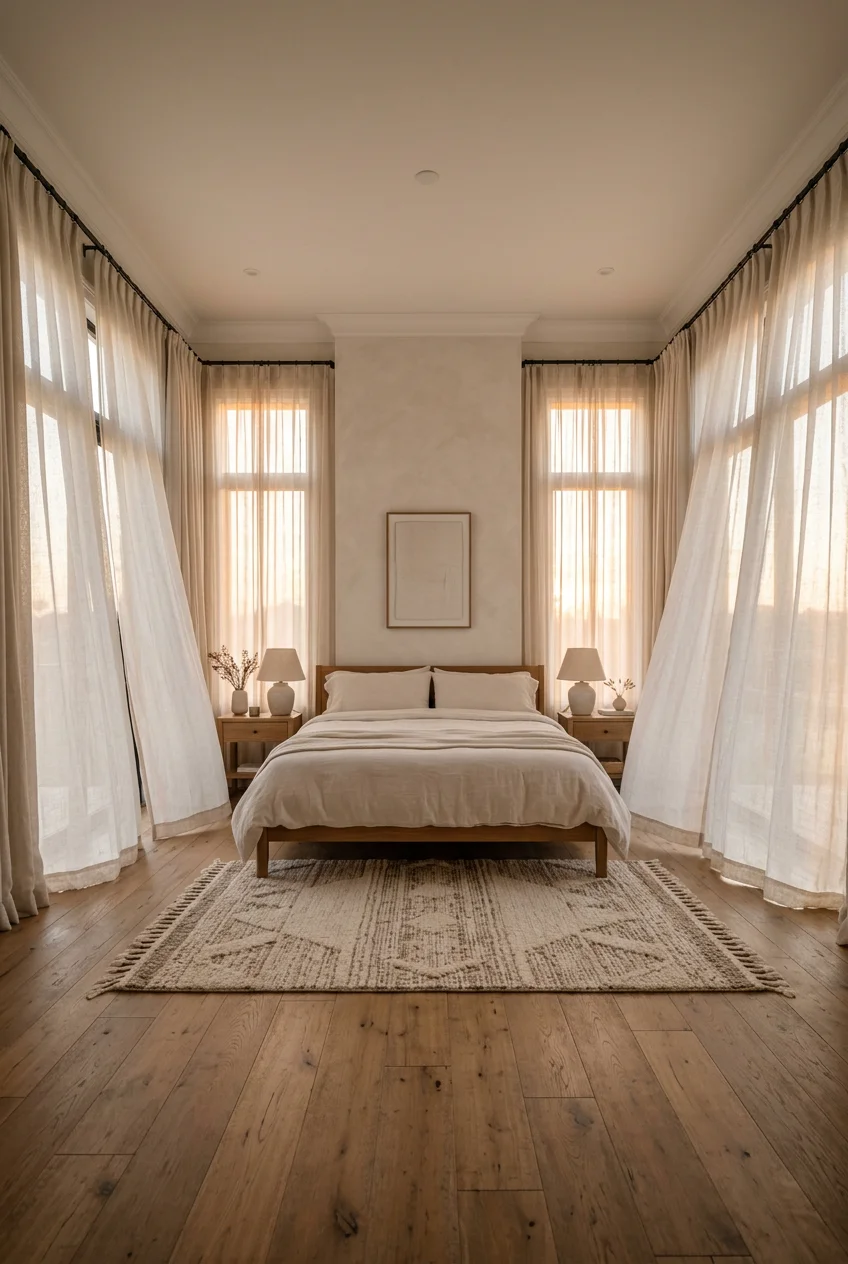
What’s Inside
- Layer Sheers and Blackouts for Functionality
- Mount Rods High and Wide
- Nail the Exact Floor Clearance
- Calculate the 1.5x to 3x Fullness Rule
- Invest in True 100% Blackout Panels
- Ground the Room with Earthy Neutrals
- Hide the Hardware for a Modern Look
- Switch to Sustainable Hemp or Organic Cotton
- Use Curtains as a Faux Headboard
- Frame Mirrors to Double Natural Light
- Stick to Subtle Patterns or Solids
- Match Undertones to Your Wall Paint
- Iron or Steam Before You Hang
- Add Thermal Liners for Drafty Windows
- Choose Pinch Pleats for Structure
- Install Curtain Tiebacks for Daytime
- Use Ring Clips for Easy Sliding
- Weight the Hems for a Straight Drop
- Wash and Shrink Before Hemming
I spent three years waking up at 5:30 AM because I bought paper-thin linen panels that turned my room into a greenhouse. Setting up bedroom curtains takes actual planning. Don’t just grab a random pattern off a shelf. You need to calculate fabric weight, light filtration, and hardware load. I tried hanging cheap rods with drywall anchors last Tuesday. The whole assembly ripped out of the wall by midnight. That was a loud lesson. I’m Danica, and I treat bedroom styling like a construction project. We’re going to look at the exact measurements, fabric types, and hardware choices that dictate how a window treatment functions. Skip the flimsy tension rods. They always fail. Let’s fix your windows properly.
1. Layer Sheers and Blackouts for Functionality

A single curtain panel rarely solves both daytime privacy and nighttime darkness. I use a double curtain rod system to handle this. You mount the sheer curtains on the inner rod closest to the glass. This diffuses harsh afternoon sunlight and stops neighbors from seeing straight into your room. On the outer rod, you hang heavy blackout drapes. I bought the Umbra Twilight Double Curtain Rod for $35.99 at Target. It curves at the ends to block light from the sides. For the sheers, the H.VERSAILTEX Natural Linen Sheer Curtains cost $22.99 for a pair on Amazon. They have a slight slub texture that catches the light nicely. I tried skipping the sheers for a year. I hated choosing between sitting in a dark cave or having zero privacy. Layering gives you mechanical control over the room’s lighting. The heavy outer panels also act as acoustic dampeners.
2. Mount Rods High and Wide

Most people mount their curtain rods directly on the window trim. This visually compresses the room. The standard rule is to mount the rod 4 to 6 inches above the window frame. If you’ve got 9-foot ceilings and standard 84-inch windows, extend that gap to 8 to 12 inches above the trim. This pulls the eye upward. You also need to extend the rod 6 to 12 inches beyond the left and right edges of the window frame. When you open the curtains, the fabric should rest against the wall, not block the glass. I bought a 120-inch Mainstays rod for $14.98 at Walmart to test this width. Pushing the fabric out past the frame exposed four extra inches of glass on each side. The room felt noticeably larger. You’ll need longer curtain panels to accommodate the height. Standard 84-inch panels won’t reach the floor.
3. Nail the Exact Floor Clearance

Curtain length dictates the formality of the room. The most common mistake I see is high-water curtains that end two or three inches above the baseboards. It looks like the curtains shrank in the wash. For a clean, architectural finish, you want a float length. This means the bottom hem hovers exactly 1/4 to 1/2 inch above the floor. It requires precise measuring from the top of the curtain rod to the floor. I use a metal tape measure for this because fabric tapes stretch. If you want a relaxed, romantic look, aim for a puddle length. This adds 3 to 6 inches of extra fabric that pools on the floor. I bought the Ikea Ritva panels for $39.99 a pair last month and let them puddle 4 inches. The drawback is that dust and pet hair collect in the folds instantly. I have to shake them out weekly. Learned that the hard way.

50×70 Inch Rust Throw Blanket – Soft & Fluffy Fleece
If you want something that just works, 50×70 Inch Rust Throw Blanket – Soft & Fluffy Fleece is a safe bet (13 reviews, 4.5 stars).
4. Calculate the 1.5x to 3x Fullness Rule

Curtains shouldn’t look stretched tight like a bedsheet when you close them. To get deep, structured folds, you’ve got to buy more fabric than the width of your window. The math is simple. The total width of all your curtain panels combined must be 1.5 to 3 times the width of your window. If your window is 50 inches wide, you need 75 to 150 inches of curtain fabric. I usually aim for 2x fullness. I bought two panels from Half Price Drapes for $45 each. Each panel was 50 inches wide, giving me 100 inches of fabric for a 48-inch window. When pulled shut, the fabric still retains deep vertical pleats. I tried using a 1x ratio in my guest room three years ago. The curtains looked flat, cheap, and sparse. Fabric volume makes window treatments look expensive. Don’t skimp on the panel count.
5. Invest in True 100% Blackout Panels

There’s a massive difference between room darkening and blackout fabrics. Room darkening panels usually block 80 to 90 percent of incoming light. They just filter the sun. True blackout curtains have a thick, coated liner that blocks 100 percent of light. I use the NICETOWN 100% Blackout Curtains, which cost $19.99 per panel. They have a black liner sewn into the back. If you hold a flashlight directly against the fabric, no light penetrates. Another solid option is the Sun Zero Oslo Theater-Grade Blackout Curtain for $30 for two panels. The thermal liner on these actually stops cold drafts from my single-pane windows in January. I tried a cheaper, unlined dark gray curtain first, thinking the dark color would block the sun. It just turned the morning light a weird, muddy gray. If you work night shifts, you need the physical barrier of a coated blackout liner.
6. Ground the Room with Earthy Neutrals

Cool grays and stark whites are fading out. The current shift is toward earthy neutrals like olive green, taupe, sand, and mushroom. These colors absorb light differently and make a bedroom feel grounded rather than sterile. I was running errands last Friday and stopped at Trader Joe’s for coffee beans. The matte, warm taupe color of their paper bags was exactly the shade I wanted for my walls. I color-matched it at the hardware store and then bought West Elm European Flax Linen curtains in a similar mushroom shade for $110 per panel. The warm undertones completely altered how the afternoon light looked in the room. It felt softer and less clinical. Solid neutral panels in these earth tones have a long visual lifespan. They don’t clash with seasonal bedding changes. Sticking to a muddy, earthy base gives you flexibility with your rugs and duvet covers later.

Bedsure GentleSoft White Throw Blanket for Couch
A dependable everyday pick — Bedsure GentleSoft White Throw Blanket for Couch – Cozy Soft Fleece Su pulls in 236 ratings at 4.5 stars. Not flashy, just solid.
7. Hide the Hardware for a Modern Look

Large, ornate curtain rods with giant decorative finials draw too much attention. The hardware should support the fabric, not compete with it. I use ceiling-mounted tracks to make the curtains look like they’re floating. The Vidga track system from Ikea costs $15 per rail. You mount the aluminum track flush against the ceiling and use small plastic gliders to hang the fabric. This eliminates the visual clutter of a metal rod and rings. It also solves the problem of light leaking over the top of the curtain rod. Because the fabric touches the ceiling, the room stays completely dark. I installed this track system in my primary bedroom last November. It took three hours of drilling into ceiling joists. It was exhausting. But the result is a clean, architectural drop. If you can’t mount hardware to the ceiling, look for a French return rod. You might also like: 18 Aesthetic Green Bedroom for Every Budget
8. Switch to Sustainable Hemp or Organic Cotton

Synthetic fabrics like polyester often have a shiny, plastic finish that looks cheap under artificial light. Natural fibers like hemp, linen, and organic cotton have a matte, irregular texture that adds depth to a room. Hemp is particularly durable and filters sunlight into a soft, diffused glow. I purchased a set of hemp panels from Pottery Barn for $129 each. The fabric has small slubs and imperfections that make it look handmade. Natural fibers require specific care. I wash them on cold using a gentle, unscented detergent I buy at Whole Foods for $14.99. Hot water will shrink natural fibers dramatically. I ruined a set of cotton panels in 2021 by washing them in warm water. They shrank four inches and became high-water curtains. You have to accept that linen and hemp will wrinkle. That relaxed, slightly rumpled texture is part of the aesthetic.
9. Use Curtains as a Faux Headboard

Curtains aren’t restricted to windows. Hanging a curtain rod directly behind your bed frame creates a massive, textured focal point that functions as a faux headboard. You mount a rod at ceiling height behind the bed and hang heavy, gathered fabric. I used Amazon Basics velvet curtains for $34.99 a panel to do this in a client’s rental apartment where we couldn’t paint the walls. We hung four panels to get deep, luxurious pleats. The velvet absorbs sound, making the sleeping area feel insulated and quiet. It also hides ugly apartment blinds or off-center windows behind the bed. You need to use a substantial fabric for this trick. Sheers will look flimsy and won’t provide the visual weight needed to anchor a king-size bed. I tried using cotton panels for this once, and it just looked like we hung a bedsheet on the wall. You might also like: 20 Aesthetic Dark Nature Bedroom for Every Budget

AMADA HOMEFURNISHING Floating Shelves
If you want something that just works, AMADA HOMEFURNISHING Floating Shelves is a safe bet (116 reviews, 4.5 stars).
10. Frame Mirrors to Double Natural Light

If your bedroom only has one small window, you can fake architectural symmetry by framing a large mirror with curtains. You place a tall floor mirror on the wall opposite or adjacent to the actual window. Then, mount a short curtain rod above the mirror and hang a pair of panels flanking the glass. I bought a 70-inch arched mirror from Target for $70 and framed it with leftover linen sheers. The mirror reflects the natural light from the real window, and the curtains trick your brain into thinking it’s a second window. This setup doubled the perceived light in my small bedroom. You have to use stationary panels for this. You just tie them back or let them hang straight down the sides of the mirror. I used cheap tension rods at first, but they kept slipping down the smooth wall. I eventually hard-mounted a 36-inch rod. You might also like: 20 Stunning Pink Bedroom Ideas You Need to See
11. Stick to Subtle Patterns or Solids

Bold, oversized geometric prints date a room faster than almost anything else. I bought loud, navy-and-white chevron curtains in 2018, and by 2020, I couldn’t stand looking at them. They dominated the room and dictated every other decor choice I made. For longevity, stick to solid colors or very subtle, small-scale patterns. Thin ticking stripes, tone-on-tone damask, or miniature florals add visual interest without taking over the space. I currently use an Anthropologie panel with a faint, tonal stripe that cost $88. From ten feet away, the curtain looks like a solid cream color. As you get closer, you see the woven stripe texture. This approach allows you to change your rug, bedding, and wall art over the years without having to replace expensive window treatments. If you really want a bold pattern, put it on a throw pillow. Curtains are structural elements. Treat them like wall paint.
12. Match Undertones to Your Wall Paint

White curtains against white walls can look incredibly chic, but only if the undertones match. If you put a cool, blue-based stark white curtain against a warm, yellow-based cream wall, the curtains will look cheap and the wall will look dirty. You have to identify the base color of your paint. My bedroom walls are painted Benjamin Moore Swiss Coffee, which has a distinct warm, creamy undertone. I brought a painted piece of drywall with me to Costco last month when I was browsing their home goods aisle. I held the paint sample up to a set of white panels they were selling for $29.99. The panels were a cool, paper-white. I put them back immediately. I ended up ordering soft ivory curtains online that shared the warm yellow base of my walls. The room looks cohesive and intentional. Never trust the color on your phone screen.

WOPITUES Wood Floating Shelves Set of 6
Honestly, WOPITUES Wood Floating Shelves Set of 6 surprised me — sturdier than it looks in the photos, and over 67 buyers gave it 4.5 stars.
13. Iron or Steam Before You Hang

Taking curtains straight out of the plastic packaging and hanging them up is a rookie mistake. The deep, square creases from the factory folding won’t fall out on their own, no matter how heavy the fabric is. Wrinkled curtains instantly degrade the aesthetic of the entire bedroom. I spent three hours last Sunday steaming a new set of linen drapes. I use a Conair Handheld Steamer that I bought for $45. I hang the curtains on the rod first, pull them taut at the bottom hem, and run the steamer slowly down the fabric. For heavy cotton or blackout fabrics, a steamer isn’t strong enough. You have to use a traditional iron and an ironing board before you hang them. I tried steaming my thick NICETOWN blackout panels, and the heat couldn’t penetrate the acrylic liner. I had to take them down and press them manually.
14. Add Thermal Liners for Drafty Windows

Older homes with single-pane windows bleed heat in the winter and trap hot air in the summer. Aesthetic curtains bedroom ideas aren’t just visual; they must solve environmental problems. You can buy separate thermal liners that clip onto the back of your existing curtains. I purchased a set of Warm Home Designs thermal liners for $18.99 on Amazon. They have small metal hooks that attach directly to the header tape of my linen drapes. This allows me to keep the lightweight, breezy look of linen on the inside of the room while adding a heavy, insulated barrier against the glass. During a freeze last January, my bedroom stayed five degrees warmer just by closing these lined curtains at dusk. The liners are stark white on the back, which looks uniform and clean from the street outside. I used to just tape plastic wrap over my windows to stop drafts.
15. Choose Pinch Pleats for Structure

Grommet curtains look casual and often cheap. They fold in a rigid, accordion style that feels very dorm-room. For an elevated, custom look, you need pleated headers. Pinch pleats gather the fabric at the top and force it to fall in deep, uniform columns. You don’t have to buy expensive custom drapes to get this look. You can buy flat curtain panels and use pleating tape and hooks. I bought a pack of two-finger pinch pleat clips for $9.99 at a craft store. You pinch the fabric, slide the clip over the fold, and hook it onto a curtain ring. I transformed a basic flat-panel cotton curtain into a tailored, structured drape in about forty minutes. The pleats hold their shape perfectly when you open and close the curtains. I tried using hidden back-tabs once, but the fabric dragged on the rod. No exaggeration.

KSIPZE 100ft Led Strip Lights RGB Music Sync Color Changing
If you want something that just works, KSIPZE 100ft Led Strip Lights RGB Music Sync Color Changing Led Lights is a safe bet (389 reviews, 4.5 stars).
16. Install Curtain Tiebacks for Daytime

When you open thick blackout curtains, they often spring back toward the center of the window, blocking the light. Heavy fabrics need to be physically restrained during the day. I installed solid brass U-shaped tieback hooks from Urban Outfitters for $14 a pair. You mount them on the wall about a third of the way up from the bottom of the window. You simply tuck the curtain panel behind the metal hook. It creates a beautiful, sweeping curve in the fabric and pulls the bulk of the material away from the glass. I used to use fabric tiebacks that Velcroed around the curtain, but they constantly slid down the slippery blackout fabric. Wall-mounted metal hooks are permanent and require zero effort to use. Just make sure you measure carefully before drilling. I mounted my first set unevenly because I didn’t use a level.
17. Use Ring Clips for Easy Sliding

Curtains with rod pockets are incredibly frustrating to open and close. The fabric binds against the metal, requiring you to yank the curtain across the rod. This eventually tears the seams. I always use metal ring clips. I buy the Amazon Basics 1-inch rings for $7.99 a pack. You slide the rings onto the rod and clip the small alligator jaws onto the top edge of your curtain panel. The metal rings glide effortlessly over the metal rod. I can flick my heavy drapes open with one hand. The clips also add about an inch of length to your curtains, which is useful if your panels are slightly too short for a float length. I tried using wooden rings on a metal rod once, and the friction made a horrible screeching sound every morning. Metal-on-metal is the only combination that slides smoothly without catching.
18. Weight the Hems for a Straight Drop

Lightweight fabrics like linen, cotton, and silk tend to flare out at the bottom. The static electricity in the room or a slight breeze from an air vent will make them billow unevenly. High-end custom drapes always have small lead weights sewn into the bottom corners of the hem to pull the fabric taut. You can replicate this easily. I bought a pack of Dritz drapery weights for $4.50 at a fabric shop next to my local Sprouts. They look like small, fabric-covered coins. I used a seam ripper to open a tiny hole in the bottom hem of my curtains, dropped one weight into each corner, and stitched it closed. The difference is immediate. The curtains hang in perfectly straight, vertical lines. I had a set of cheap sheer panels that used to blow around wildly whenever the AC kicked on. Adding weights anchored them.
19. Wash and Shrink Before Hemming

If you buy extra-long curtains with the intention of hemming them to fit your windows perfectly, you must wash them first. Natural fibers like cotton and linen will shrink by 3 to 5 percent the first time they hit water. If you have 96-inch panels, that means they could shrink up to 4.8 inches. I learned this the hard way. I spent an entire Saturday measuring, pinning, and sewing a beautiful hem on a set of cotton drapes. Six months later, I washed them using a Kroger brand gentle detergent for $6.99. When I hung them back up, they were three inches off the floor. The hem was ruined. Now, I immediately throw new cotton or linen panels into the washing machine on a cold cycle and hang them to dry. Once the fabric has fully contracted and stabilized, I take my measurements and sew the hem.
Building the right window setup takes effort, but getting your aesthetic curtains bedroom design dialed in changes the entire feel of the space. I’m telling you, fixing the rod height and switching to proper blackout liners improved my sleep quality more than a new mattress did. You don’t have to spend custom-drapery money to get a tailored look. You just have to measure carefully and iron out those factory creases. Pin this guide for the next time you’re standing in an aisle trying to remember the fullness ratio. Let me know which hardware trick ends up saving your walls.
Frequently Asked Questions
How high should I hang my bedroom curtains?
Mount your curtain rod 4 to 6 inches above the window frame to make the ceiling look taller. If you have high ceilings, you can mount it 8 to 12 inches above the trim for an even more dramatic effect.
What is the proper fullness ratio for curtains?
Your curtain panels should total 1.5 to 3 times the width of your window. For example, a 50-inch window needs 75 to 150 inches of total fabric to ensure deep, luxurious folds when closed.
Should curtains touch the floor in a bedroom?
Yes. For a tailored look, choose a ‘float’ length where the hem hovers 1/4 to 1/2 inch above the floor. For a romantic aesthetic, allow an extra 3 to 6 inches of fabric to ‘puddle’ on the ground.
What is the difference between room darkening and blackout curtains?
Room darkening curtains filter out 80 to 90 percent of light, while true blackout curtains have a thick, coated liner that blocks 100 percent of incoming light, making them ideal for bedrooms.
