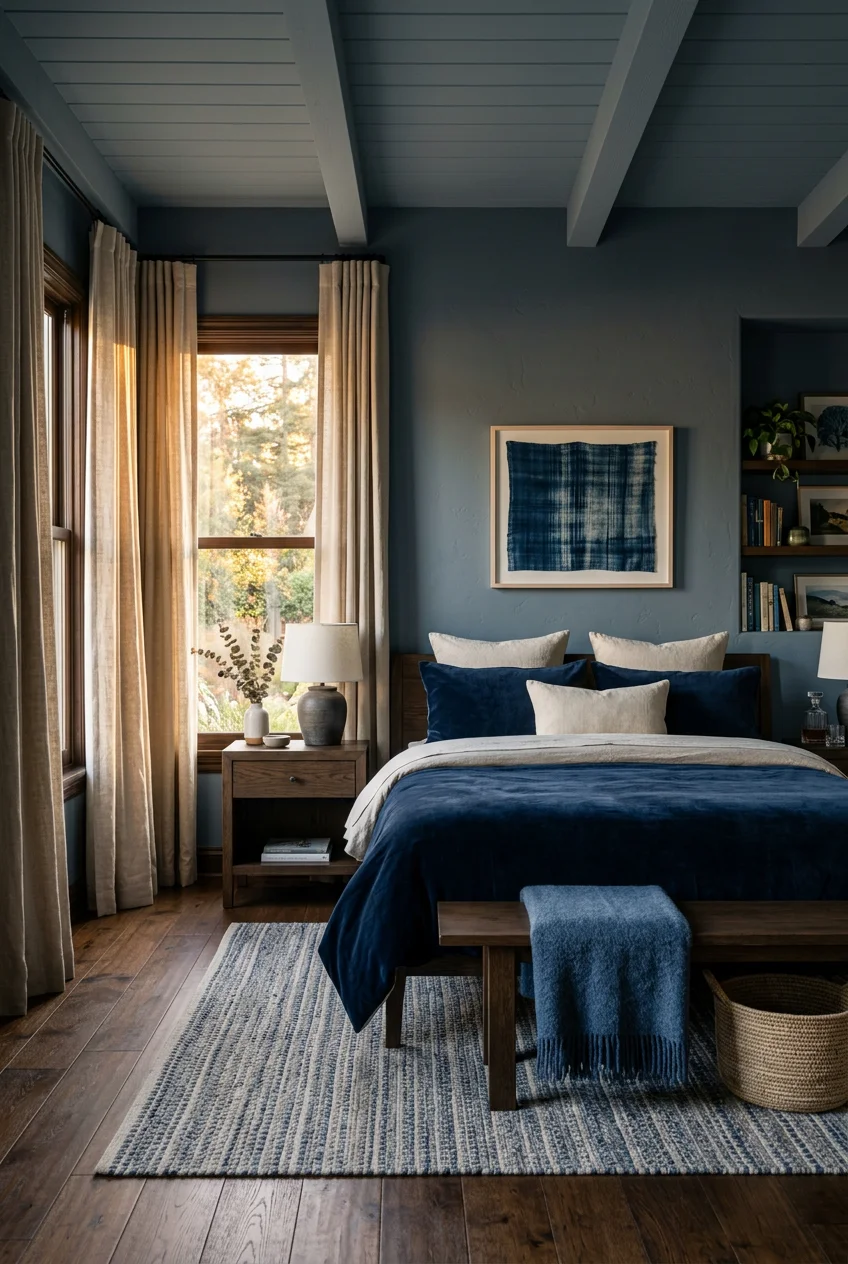
What’s Inside
- Start Your Blue Bedroom Decor With the 2026 Cool Blue Trend
- Build Depth With Blue Gradients
- Paint Small Rooms Dark Blue
- Warm It Up With Walnut and Brass
- Check Your Room’s Natural Lighting First
- Layer Heavy Textures on the Bed
- Swap to 2700K Warm Light Bulbs
- Test Out Transformative Teal
- Commit to a True Blue Accent Wall
- Bring in Oak Furniture and Live Plants
- Add Blue Chinoiserie Prints
- Keep 36 Inches of Clearance Around the Bed
- Paint the Trim to Match the Walls
- Hang Blue and White Artwork at Eye Level
- Upgrade to Solid Brass Hardware
- Install Heavy Navy Velvet Curtains
- Anchor the Room With a Chunky Jute Rug
- Upcycle a Dresser in Matte Navy
- Finish Your Blue Bedroom Decor With a Chunky Throw
Last October, I painted my master bedroom what I thought was a soothing sky blue. At 8 PM, under my harsh LED ceiling light, it looked like a sterile hospital corridor. Getting blue bedroom decor right is tricky because the color shifts with light and texture. You can’t just slap paint on the wall and call it a day. Blue has a reputation for being calming, but if you ignore the undertones, it feels cold and uninviting. I spent three days staring at those walls, realizing I’d made a mistake. I stripped the room, tested fourteen swatches, and rethought my approach. After figuring out the balance, I realized that creating a cozy blue room comes down to specific pairings. Let’s look at the exact paint colors, textures, and layouts that work.
1. Start Your Blue Bedroom Decor With the 2026 Cool Blue Trend

The cool blue shade is a muted, powdery pale sky blue that Pinterest data shows dominating 2026. I tried a generic pastel blue two years ago, and it made my bedroom look like a nursery. The trick to making this adult is pairing it with warm creamy white on your trim and bedding. Benjamin Moore’s Breath of Fresh Air is a perfect example. A gallon of their Aura interior paint runs $89.99, but the coverage is excellent. To keep the cool blue from feeling icy, you need to layer in natural textures. I use a solid oak nightstand and heavy linen sheets to ground the airy wall color. If you just use stark white and pale blue, the room feels flat. The creamy whites add the necessary warmth. You won’t regret taking the extra time to find a white with yellow undertones. Trust me.
2. Build Depth With Blue Gradients

Instead of relying on a single flat color, try layering a spectrum of blues from darkest to lightest. This creates a cohesive flow and visual depth. Last Tuesday at Target, I picked up three different throw pillows to test this. I started with a Midnight Blue (#021024) accent wall, then transitioned to a Dark Navy Blue (#031A3A) upholstered headboard, and finished with Deep Navy Blue (#052659) patterned pillows. The pillows were from the Threshold line and cost $20 each for a 20×20 inch square. This gradient method prevents the room from feeling one-dimensional. When everything is the same shade of blue, your eye doesn’t know where to focus. Staggering the tones gives the space a structured, intentional look without needing high-contrast colors like orange or yellow.
3. Paint Small Rooms Dark Blue

Most people are terrified of dark paint in small spaces. They think it shrinks the room. I painted my tiny 10×12 foot guest room in Benjamin Moore’s Hale Navy, which has a Light Reflectance Value (LRV) of just 6.3. Instead of feeling like a cave, the dark matte finish made the walls recede. The room feels twice as large now. The key is using a flat or matte finish. If you use eggshell or satin, the light bounces off the walls and highlights the corners, ruining the illusion. A gallon of Benjamin Moore Regal Select in matte finish costs $74.99. You just have to make sure you have enough light. I added a brass floor lamp in the corner to keep the dark walls from swallowing the light during the evening.

Govee RGBIC LED Strip Lights, Smart LED Lights for Bedroom
Govee RGBIC LED Strip Lights has been one of the most consistently praised picks in this category. 243 reviewers averaged 4.5/5.
4. Warm It Up With Walnut and Brass

To prevent a blue bedroom from feeling cold, you have to incorporate warm materials. Cool blue tones absorb warmth. I balance this out by using warm wood tones like walnut or mahogany. I bought a West Elm mid-century nightstand in acorn wood for $349, and the rich brown changed the feel of my pale blue walls. Brass or gold fixtures do the same thing. I swapped my silver ceiling fan for a brass pendant light, and the metallic warmth softened the room. Interior designers emphasize that incorporating textured fabrics like a heavy wool throw is crucial to balance cool tones. I keep a 50×60 inch wool blend blanket at the foot of my bed. It adds physical and visual warmth that paint alone can’t provide.
5. Check Your Room’s Natural Lighting First

The best blue shade depends on your room’s natural light. I learned that the hard way when I bought three gallons of Sherwin-Williams Naval without testing it. In a warm, south-facing room, Naval appears bright and rich. But my bedroom faces north. In cooler, north-facing light, it read as a dark, depressing blue with heavy gray undertones. I had to eat the $225 cost of the paint. North-facing rooms need warmer blues with slight green or red undertones to counteract the gray daylight. Always buy an 8-ounce sample jug for $9.99 and paint a 2×2 foot square on your wall. Look at it at 8 AM, 2 PM, and 9 PM. The color will shift throughout the day, and you need to know you like it in all three lighting conditions.
6. Layer Heavy Textures on the Bed

A blue bedroom needs a variety of textures in the bedding to look inviting. Crisp white sheets are fine, but they look flat on their own. I layer crisp white linen bedding with heavily textured blue throw pillows for a fresh look. I use a Pottery Barn Belgian Flax Linen duvet cover in a Queen size, which costs $299. Linen has a rumpled texture that feels relaxed. Over that, I toss a chunky knitted navy throw and two velvet lumbar cushions. The contrast between the rough linen, the thick knit, and the smooth velvet creates a rich environment. When I used basic cotton percale for everything, the bed looked like a cheap hotel setup. Mixing the fabric weights adds the warmth and visual interest that a solid blue color scheme needs.

Leeleberd Led Lights for Bedroom 100 ft (2 Rolls of 50ft)
If you want something that just works, Leeleberd Led Lights for Bedroom 100 ft (2 Rolls of 50ft) Music Sync C is a safe bet (199 reviews, 4.5 stars).
7. Swap to 2700K Warm Light Bulbs

The right lighting dictates how your blue paint looks after dark. Opt for soft, warm light bulbs in the 2700K to 3000K range. This prevents blue walls from feeling cold in the evening. I used to have 4000K daylight bulbs in my bedside lamps. They cast a harsh blue-tinted light that made my walls look like a frozen tundra. Plus, blue-tinted lighting suppresses melatonin and ruins your sleep cycle. I went to Home Depot and bought a 4-pack of GE Relax LED 2700K bulbs for $11.98. The warm yellow glow neutralized the icy tones of the paint. It makes the room feel like a cozy retreat. Never skip checking the Kelvin rating on your light bulbs when you have cool-toned walls.
8. Test Out Transformative Teal

If standard navy feels too traditional, look into Transformative Teal. This is WGSN’s Color of the Year for 2026. It is a deep fusion of dark blue and aquatic green. This shade offers the serenity of blue but the organic renewal of green. I painted an old wooden bench in this color last month. Teal tones complement both warm and cool palettes. To highlight its depth, I paired it with a CB2 black stone urn that cost $49.95. The dark stone against the rich teal looks sophisticated. You can introduce this color through small accents if you aren’t ready to paint a whole wall. A 5×8 foot teal vintage-style rug from Loloi runs about $145 and anchors a neutral room perfectly.
9. Commit to a True Blue Accent Wall

Painting a single focal point wall is the best way to add depth without overwhelming a small space. The wall behind your headboard is usually the best candidate. I used Benjamin Moore’s Hale Navy (HC-154) for this. Before painting, I washed the wall with a mixture of 1/2 cup of TSP cleaner and a gallon of warm water to remove dust and oils. Skipping the TSP wash is a huge mistake because the dark paint will peel off in strips a year later. An accent wall allows you to use dark, moody shades even if your room is tiny. I paired the navy wall with three soft white walls. It anchors the bed and draws the eye to the back of the room, which visually pushes the wall away and makes the room feel deeper. You might also like: 15 Inspiring Master Bedroom Wall Decor to Transform Your Space

Govee RGBIC LED Strip Lights
Govee RGBIC LED Strip Lights has been one of the most consistently praised picks in this category. 243 reviewers averaged 4.5/5.
10. Bring in Oak Furniture and Live Plants

You have to ground blue walls with natural materials to keep the room breathable. I rely on light oak furniture and fresh greenery. Last weekend, I bought a live Ficus Audrey in a 10-inch nursery pot from Sprouts for $24.99. I placed it in a woven seagrass basket next to my dresser. The organic green leaves against the blue wall made the room feel relaxed. I also swapped my heavy upholstered headboard for an IKEA MALM bed frame in light oak veneer, which costs $299 for a Queen. The light wood grain breaks up the solid blocks of color. If you only use painted furniture or metal in a blue room, it starts to feel rigid. The natural imperfections in wood and plants soften the aesthetic.
11. Add Blue Chinoiserie Prints

Chinoiserie-inspired elements add a touch of whimsy and cottage style without cluttering the space. I used a wallpaper with delicate florals and birds in a blue and white palette on the wall opposite my bed. It creates a serene backdrop. I bought two rolls of a blue floral print from Anthropologie for $128 per roll. The dichromatic fabric and paper keep the pattern from feeling chaotic. If wallpaper is too permanent, blue chinoiserie vases work just as well. I keep a 12-inch tall ceramic ginger jar on my dresser. I fill it with fresh eucalyptus branches. The earthy green against the intricate blue and white porcelain adds an elegant, historical texture to a modern bedroom setup. You might also like: 20 Creative Cozy Small Bedroom for Any Style
12. Keep 36 Inches of Clearance Around the Bed

Color doesn’t matter if you can’t walk around your furniture. You must maintain a minimum clearance of 30 to 36 inches (76 to 91 cm) around your bed. When I moved into my first apartment, I crammed a king bed into a 10×12 foot room. I had barely 18 inches of walking space. It felt like a storage unit, not a bedroom. For a standard queen bed, which measures 60×80 inches, a 10×12 foot room is the minimum to accommodate the bed and a dresser comfortably. I mapped out my layout using painter’s tape on the floor before buying anything. Keeping that 36-inch pathway clear prevents the room from feeling cluttered. A dark blue room will feel claustrophobic if you block the walking paths. You might also like: 20 Creative Bedroom Wall Design You’ll Want to Bookmark

Govee RGBIC LED Strip Lights
Govee RGBIC LED Strip Lights punches above its price — 243 buyers rated it 4.5 stars. I would buy it again.
13. Paint the Trim to Match the Walls

For a uniform, calming cocoon effect, paint your baseboards and window trim the exact same blue as your walls. Most people default to bright white trim. White trim creates a harsh visual line that chops the wall in half and makes the ceiling look lower. I used a Purdy 2-inch angled brush, which costs $14.50 at Lowe’s, to cut in the edges cleanly. If you want a subtle contrast without changing the color, use an eggshell finish on the walls and a high-gloss finish on the trim. The gloss reflects the light differently, so the trim stands out just enough to look intentional. I did this in my master bedroom, and it eliminated the choppy, disjointed feeling the old white baseboards gave the space.
14. Hang Blue and White Artwork at Eye Level

Artwork ties the color scheme together, but most people hang it too high. You need to position artwork so the center is approximately 57 to 60 inches from the floor, which is standard eye level. I bought a framed watercolor abstract print from the Studio McGee line at Target for $70. It measures 24×30 inches. I hung it directly above my low dresser. A common mistake is buying art that is too small for the furniture below it. Choose artwork that takes up about two-thirds of the wall space above your bed or dresser. Anything smaller looks like a postage stamp floating on a massive blue wall. The blue and white tones in the canvas unify the dark walls with my white bedding, making the design look cohesive.
15. Upgrade to Solid Brass Hardware

Pairing deep blues with solid brass hardware adds a touch of luxury. The warm metallic tones pop against a moody navy background. I had an old, boring white dresser that disappeared against my pale blue walls. I painted it navy and swapped the cheap plastic knobs for Rejuvenation Massey drawer pulls. I bought the 4-inch unlacquered brass pulls for $22 each. It was an expensive upgrade, but the heavy brass feels good and reflects the warm light from my bedside lamps. Copper lighting fixtures do the same thing. The shiny, warm metals cut through the dark blue paint and keep the room from feeling flat. Don’t waste money on brushed nickel or chrome in a blue room; they just add more cool tones.

200 FT Led Lights for Bedroom (2 Rolls 100 FT)
200 FT Led Lights for Bedroom (2 Rolls 100 FT) punches above its price — 987 buyers rated it 4.5 stars. I would buy it again.
16. Install Heavy Navy Velvet Curtains

Window treatments are a massive opportunity to introduce texture. I used to have flimsy white sheer curtains, and they made the room look cheap. I swapped them for heavy navy velvet drapes. I bought the 96-inch length panels from Half Price Drapes for $89 per panel. The thick velvet blocks out the early morning sun, which is crucial because I’m a light sleeper who wakes up at 5 AM. I hung the curtain rod four inches below the ceiling line and extended it eight inches past the window frame on each side. This trick makes the window look twice as large. The dark navy velvet against a lighter blue wall creates a tone-on-tone effect that feels high-end and improves the acoustics in the room.
17. Anchor the Room With a Chunky Jute Rug

A blue bedroom needs an earthy element on the floor to keep it grounded. I use a massive natural jute rug under my bed. I ordered an 8×10 foot chunky woven jute rug from RugsUSA for $185. The golden-tan color of the dried plant fibers contrasts perfectly with navy blue walls. I will admit a negative: natural jute sheds for the first two weeks. I was vacuuming up fibers constantly. But after it settles, the texture is unbeatable. You want the rug to extend at least 24 inches on the sides and foot of a queen bed. This ensures your feet hit a warm, textured surface when you wake up, rather than a cold hardwood floor. The rough texture balances out the soft, smooth fabrics on the bed.
18. Upcycle a Dresser in Matte Navy

If you aren’t ready to paint your walls, painting furniture is the next best thing. I found a solid wood dresser on Facebook Marketplace for $40 and painted it using Rust-Oleum Chalked Paint in Coastal Blue. A 30-ounce can costs $19.98 at Walmart. The matte, chalky finish absorbs light and gives the piece a soft, vintage feel. I made a huge mistake on my first attempt by skipping the sanding step. The paint chipped off the top edge within a week. You must lightly scuff the surface with 120-grit sandpaper first. Once I fixed my error, the dark blue dresser became the focal point of my neutral bedroom. It provides that necessary anchor of color without the commitment of taping off baseboards and rolling walls.
19. Finish Your Blue Bedroom Decor With a Chunky Throw

The easiest way to introduce blue into your bedroom is at the foot of the bed. I keep an upholstered bench there for putting on shoes. To tie it into the room’s color scheme, I drape an oversized knit throw over the corner. I bought a 50×60 inch chunky navy throw from Crate & Barrel for $129. The heavy cotton knit drapes beautifully and doesn’t wrinkle. This addition pulls the blue tones from the artwork and the walls down to the floor, balancing the visual weight of the room. It also provides a functional layer of warmth for cold nights. You don’t need to overthink it; just casually toss it over the edge so it looks lived-in.
Getting your blue bedroom decor to feel cozy instead of cold just takes a little planning. I’ve spent years fighting with paint undertones and lighting temperatures, but once you nail the balance of warm woods, textured fabrics, and the right 2700K bulbs, a blue room becomes the ultimate retreat. I recommend starting small with a velvet pillow or a painted nightstand before committing to a dark navy wall. Pin this guide so you have the exact paint colors and measurements handy when you’re standing in the hardware store trying to make a decision.
Frequently Asked Questions
What colors pair best with blue bedroom decor?
Warm creamy whites, natural wood tones like walnut and oak, and metallic accents like brass or gold pair perfectly with blue. These warm elements prevent cool blue tones from feeling sterile or uninviting.
Does dark blue make a small bedroom look smaller?
No, dark blue can actually make a small room feel larger if you use a matte finish. Dark matte colors like navy absorb light and make walls visually recede, creating depth instead of a cramped feeling.
What lighting should I use in a blue bedroom?
Always use warm light bulbs in the 2700K to 3000K range. Avoid daylight or 4000K bulbs, as they cast a harsh, blue-tinted light that makes blue walls look icy and disrupts your sleep cycle.
How do I choose the right blue paint for my lighting?
If your room faces north, choose a warm blue with slight green or red undertones to counteract the gray daylight. South-facing rooms get warmer light and can handle cooler, more saturated blues like true navy.
