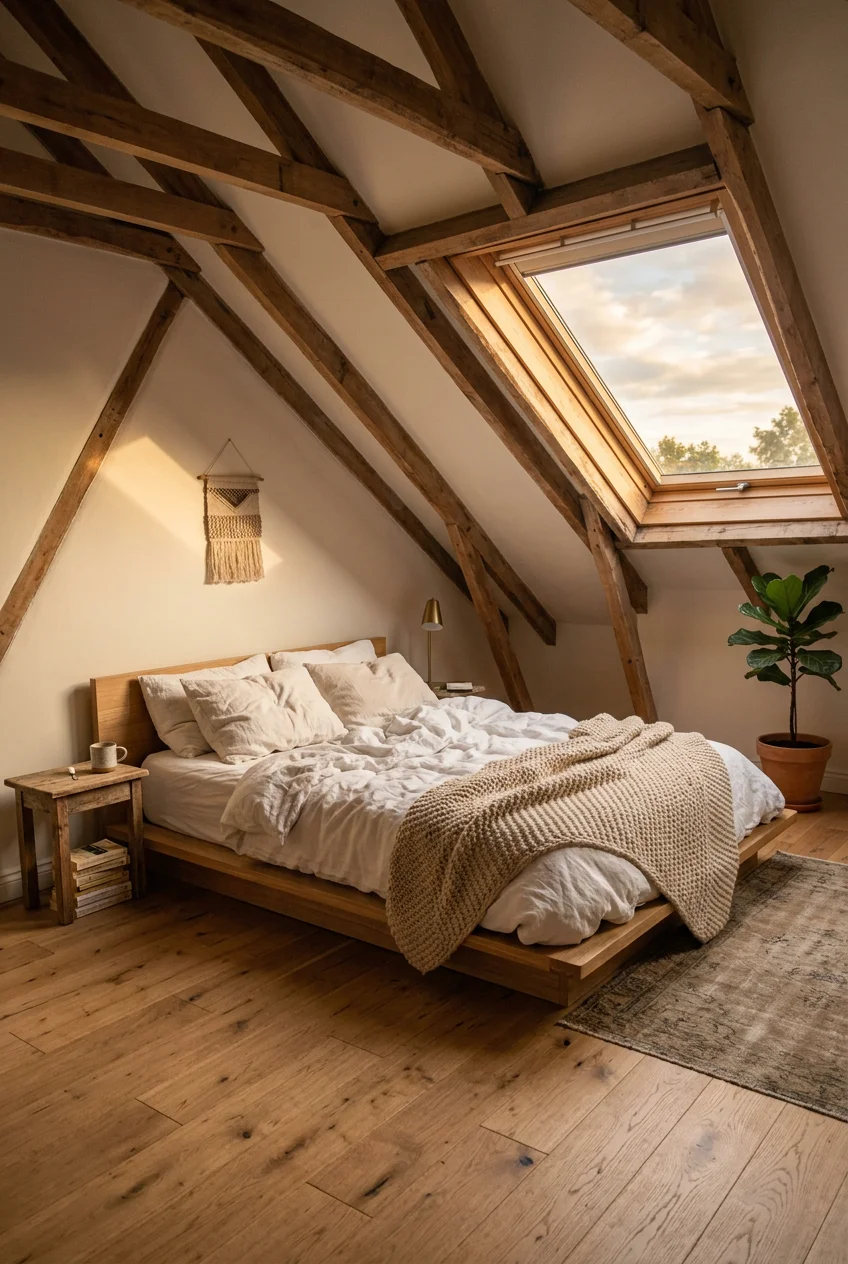
What’s Inside
- Embrace Custom Built-in Storage Along Eaves and Slopes
- Low-Profile Platform Beds for Head Clearance
- Blackout Skylight Blinds for Temperature Control
- Monochromatic Paint to Blur Harsh Angles
- Wall-Mounted Sconces Instead of Floor Lamps
- Floating Nightstands for Visual Space
- Utilizing Under-Bed Storage Boxes
- Strategic Rug Placement for Acoustics
- Lightweight Linen Bedding to Combat Stifling Heat
- Hanging Plants to Draw the Eye Up
- Floor Cushions for Low-Clearance Seating
- Minimalist Open Wardrobe Racks
- Positioning the Bed Under the Skylight
- Using Mirrors to Bounce Light
- Space-Saving Climate Control Devices
- Keep the Center Ridge Completely Clear
Last Tuesday, I stood up too fast in my guest loft and smacked my forehead against the 45-degree drywall slope. That sharp throb reminded me exactly why attic bedroom projects require actual math, not just pretty Pinterest boards. When I first moved into my 1920s bungalow, I tried shoving a standard 65-inch tall headboard against a 40-inch knee wall. The resulting gap ate up three square feet of floor space and became a dusty graveyard for lost socks. You can’t just treat an attic like a normal rectangular box. The slanted ceilings dictate your every move. I spent six months sleeping on a mattress directly on the floor before I figured out how to map the usable square footage. Let’s walk through the specific measurements, hardware, and furniture dimensions that actually work up here. I’ll share the exact items I bought, the prices I paid, and the layouts that prevent daily concussions. Trust me on this.
1. Embrace Custom Built-in Storage Along Eaves and Slopes

I learned quickly that standard dressers are useless under a 36-inch knee wall. You just end up with a massive gap behind the furniture. Instead, I installed custom built-in cabinets that follow the natural slope of the ceiling. I used 3/4-inch sanded pine plywood from Home Depot to frame out a row of cubbies exactly 34 inches high. If you want a faster route, I bought three of the IKEA Nordli modular drawer chests for $110 each. They measure exactly 21.25 inches tall. I pushed them flush against the lowest part of the eaves and finished the top with a custom-cut piece of butcher block. It gave me 12 linear feet of storage for under $400. The mistake most people make is buying tall wardrobes for attics. That forces you to put your storage in the center of the room, which kills your walking path. Keep all storage pushed to the perimeter where the ceiling is too low for you to stand anyway.
2. Low-Profile Platform Beds for Head Clearance

When your ceiling slopes down to 48 inches, a standard 24-inch high bed frame plus a 12-inch mattress leaves you with exactly 12 inches of breathing room. I swapped my bulky setup for a Zinus Joseph 10-inch Metal Platform Bed Frame. It cost $119 on Amazon. I paired it with an 8-inch memory foam mattress. Dropping the overall bed height to 18 inches completely changed the room’s proportions. Suddenly, the ceiling didn’t feel like it was crushing me. A low bed also means you can push the mattress further under the eaves, freeing up the taller center space for walking. Don’t buy a frame with a headboard. Even a short 36-inch headboard pushes the bed out from the wall. I use two 26-inch square Euro pillows propped against the drywall for reading. I picked up the Threshold washed linen Euro shams for $25 each at Target. They provide enough back support without requiring a wooden frame.
3. Blackout Skylight Blinds for Temperature Control

Attics get notoriously hot. My first summer in this space, the 2×3 foot skylight acted like a magnifying glass. The room hit 85 degrees by 10 AM. I finally bought the Velux Blackout Skylight Blind for $135. It runs on a manual track system. You pull it down with a small aluminum rod. The metallic backing blocks the light and reflects the heat outward. The temperature in the room dropped by eight degrees the day I installed it. You can’t rely on standard curtains for slanted windows. Gravity just pulls the fabric straight down, creating a weird tent effect over your bed. Track blinds stay flush against the glass. I bought mine in a basic dark charcoal gray. They take about 20 minutes to screw into the existing window frame. If you have skylights, you need these before you even think about buying decorative pillows.

QEEIG Floating Shelves for Wall Bathroom Shelf Bedroom
If you want something that just works, QEEIG Floating Shelves for Wall Bathroom Shelf Bedroom Kitchen Living is a safe bet (45 reviews, 4.5 stars).
4. Monochromatic Paint to Blur Harsh Angles

Painting an attic with contrasting trim is a disaster. If you paint the walls white, the ceiling blue, and the baseboards black, your eyes violently track every single jagged angle and awkward corner. The room looks like a geometry test. I fixed this by painting everything the exact same color. I used Sherwin Williams Alabaster in an eggshell finish for the walls, ceiling, and trim. A gallon costs about $45. When the walls and the slanted ceiling match, the sharp transition lines visually disappear. The space feels softer and less choppy. Stick to light, warm neutrals. I also skip crown molding entirely in small attic bedroom ideas. Molding just highlights the weird ceiling intersections. A seamless wash of one color tricks the brain into ignoring the low clearance. I tried a dark moody green first, but it absorbed all the natural light and made the 150-square-foot room feel like a closet.
5. Wall-Mounted Sconces Instead of Floor Lamps

Floor lamps are a tripping hazard in a room where you already have to duck. I knocked over a $60 brass floor lamp three times before the bulb shattered on my rug. I learned that the hard way. Floor space is your most valuable asset up here. I switched entirely to hardwired and plug-in wall sconces. I bought two of the Novogratz x Globe Electric 1-Light Plug-In Sconces for $42.99 each. I mounted them 40 inches off the floor, right above my low-profile bed. Because they plug in, I didn’t have to hire an electrician to fish wire through the heavily insulated attic walls. The matte black finish adds a nice industrial touch. You want fixtures with adjustable arms. The ceiling angles cast weird shadows, so being able to point the light exactly where you need it is crucial. I also grabbed a 3-pack of GE LED warm white bulbs for $8.98 at Walmart. The warm 2700K temperature prevents the attic from feeling like a sterile medical clinic at night.
6. Floating Nightstands for Visual Space

Traditional nightstands look incredibly bulky when shoved under a knee wall. The visual weight anchors the room down. I swapped out a heavy oak side table for a simple floating shelf. I used a 24-inch by 8-inch piece of solid walnut I found at a local lumber yard for $35. I mounted it using heavy-duty steel L-brackets that cost $12 at Home Depot. Leaving the floor exposed underneath makes the room feel wider. A shelf that is 8 inches deep holds a glass of water, my phone, and a paperback book perfectly. You don’t need a massive 20-inch deep drawer unit next to your bed. I keep a $14.99 woven basket from Target on the floor under the shelf to hold my charging cables and a bottle of hand lotion. It keeps the actual shelf surface completely clear of clutter while still giving me storage. You might also like: 20 Cozy Bedroom Wall Art You Need to See

Yieach Bedside Shelf for Dorm Bed,Rv
Honestly, Yieach Bedside Shelf for Dorm Bed surprised me — sturdier than it looks in the photos, and over 94 buyers gave it 4.5 stars.
7. Utilizing Under-Bed Storage Boxes

Since you can’t fit a tall dresser in an attic, your bed needs to do double duty. Even with a low-profile 10-inch frame, you have usable cubic footage underneath. I bought four of the IKEA SOCKERBIT under-bed storage boxes for $14.99 each. They’re exactly 7.5 inches tall, so they slide perfectly under my 10-inch frame. I use them to store out-of-season clothes and extra sheets. The plastic lids latch securely, which is important because attics get dusty quickly. I tried using soft fabric storage bins during my first year in this house, but they absorbed a weird musty smell after six months and the sides collapsed when I tried to pull them out. Hard plastic is much easier to wipe down and maintains its shape. To keep things smelling fresh, I toss a $4.49 Mrs. Meyer’s lavender scent sachet from Whole Foods into each box. Just measure the exact clearance from the floor to the bottom rail of your bed frame before you buy any bins. You might also like: 15 Inspiring Master Bedroom Wall Decor to Transform Your Space
8. Strategic Rug Placement for Acoustics

Attics usually have original hardwood or plywood subfloors. Because they sit right above the rest of the house, every footstep echoes downstairs. I bought a 5×7 foot Ruggable Kamran Hazel Rug for $219. It fits perfectly in the narrow center strip of my attic where the ceiling is highest. I added their 1/4-inch cushioned pad for an extra $60. The pad absorbs the impact of my heels when I walk. Without it, my roommate downstairs could hear every time I got out of bed. I place the rug exactly 12 inches away from the foot of the bed. I vacuum it twice a week with my Dyson V8, which I bought refurbished for $279. The low pile of the Ruggable handles attic dust well without trapping allergens like a thick shag rug would. Do not buy a thick wool rug for an attic. They’re too heavy to drag up narrow attic stairs and hold onto too much heat during the summer months. You might also like: 17 Minimalist Bedroom Ideas Worth Trying
9. Lightweight Linen Bedding to Combat Stifling Heat

Even with blackout blinds, attics trap warm air. Heat rises. If you use heavy flannel or polyester bedding, you’ll wake up sweating at 3 AM. I ditched my heavy cotton duvet and switched to a 100% French flax linen sheet set from Quince. It costs $129 for a Queen size. Linen is highly breathable and wicks moisture away from your skin. I don’t even use a duvet insert during the summer. I just layer a thin cotton waffle blanket over the flat sheet. I bought a $39.99 Utopia Bedding 350 GSM cotton blanket on Amazon. It provides the physical weight I need to fall asleep without the thermal insulation. Skip the synthetic fibers completely in an attic bedroom. You need materials that allow air circulation. The Quince sheets soften up noticeably after the third wash. I tried a cheap microfiber set from a discount store once, and it felt like sleeping inside a plastic bag.

Fixwal Black Floating Shelves for Wall
If you want something that just works, Fixwal Black Floating Shelves for Wall is a safe bet (42 reviews, 4.5 stars).
10. Hanging Plants to Draw the Eye Up

Small attic bedroom ideas often focus so much on the floor plan that the vertical space gets ignored. The peak of your ceiling is usually the only tall spot in the room. I hung a Golden Pothos right at the highest point of the ceiling apex. I bought the plant in a 6-inch nursery pot for $9.99 at Trader Joe’s. I used a $15 macrame hanger from Amazon and a heavy-duty swag hook drilled directly into a ceiling joist. The trailing vines draw your eye upward, making the room feel taller than it actually is. Pothos vines tolerate the dry, warm air of an attic incredibly well. I water it once a week with exactly 1.5 cups of tap water. Stick to hardy trailing plants. The organic shape of the leaves breaks up the rigid, triangular lines of the roof structure. I originally tried a Boston Fern up there, but the dry heat turned it crispy in less than a month.
11. Floor Cushions for Low-Clearance Seating

You can’t fit a standard armchair in a corner with a 4-foot ceiling. The proportions look ridiculous, and you’ll hit your head trying to stand up from it. I created a reading nook under the lowest eave using two large floor cushions. I bought the 24×24 inch square velvet floor pillows from World Market for $34.99 each. I stacked them on top of each other against the knee wall. It provides a comfortable spot to sit and put on my shoes without demanding the vertical clearance of a real chair. I keep a $12.50 woven throw blanket from Costco draped over them. It’s a highly flexible solution that respects the architectural limits of the room. Don’t try to force traditional living room furniture into an attic. Floor-level seating looks intentional and keeps the center walkway clear. When I need more floor space to pack a suitcase, I just shove them under the bed.
12. Minimalist Open Wardrobe Racks

Closets rarely exist in finished attics. I didn’t want to build out a framed closet because the drywall and framing steal 15 square feet of floor space. I opted for a freestanding metal garment rack instead. I bought the Simple Houseware Standard Rod Garment Rack for $23.87 on Amazon. It measures exactly 59 inches tall, which allows it to fit under the medium-height section of my slanted ceiling. I keep it strictly curated. I only hang my current season’s clothing on it, using slim black velvet hangers I got in a 50-pack for $16.99 at Costco. The velvet prevents silk shirts from sliding off. An open rack forces you to be tidy. I limit myself to 30 hanging items. The metal frame is visually lightweight, meaning you can see the wall behind it, which maintains the illusion of a larger room. If you buy a solid wooden wardrobe, it acts like a visual wall and shrinks the room.

Cologne Organizer for Men,Cologne Stand
Cologne Organizer for Men punches above its price — 11 buyers rated it 4.5 stars. I would buy it again.
13. Positioning the Bed Under the Skylight

Where you place your bed is the single most critical decision in an attic. I originally placed my bed in the center of the room, parallel to the roofline. It meant I had to walk hunched over to get around it. I finally rotated the bed 90 degrees and shoved the headboard directly under the lowest slope, right beneath the skylight. This opened up the entire 8-foot-tall center ridge for walking. Waking up and looking straight up at the clouds through the glass is incredible. Just make sure your skylight doesn’t leak before you put your $800 mattress under it. I had to buy a $35 waterproof mattress encasement from Target the next day after a spring storm caused a drip. As long as the window is sealed, sleeping under the slope is the best use of dead space. You don’t need vertical height when you’re lying flat. It frees up the tall areas for getting dressed.
14. Using Mirrors to Bounce Light

Attics usually have tiny windows on the gable ends. To maximize that limited natural light, I leaned a large floor mirror against the wall directly opposite the only standard window in the room. I bought the 65×22 inch NeuType Full Length Mirror for $89 on Amazon. I secured it to the wall with a $4 anti-tip furniture strap from Home Depot because the slanted floors made it slightly unstable. The mirror acts like a second window. It reflects the light from the east-facing gable back into the dark corners of the room. It also gives the illusion of depth. You need a mirror that is at least 5 feet tall to actually bounce light effectively. Just be careful not to angle it directly toward your bed, or you’ll blind yourself when the morning sun hits it. I initially hung a small 18-inch round mirror, but it wasn’t large enough to make a structural difference in the room’s brightness.
15. Space-Saving Climate Control Devices

Central air rarely reaches the attic effectively. The ductwork just doesn’t push enough pressure up three stories. I spent my first winter freezing and my first summer roasting. I didn’t have the floor space for a massive portable AC unit with a 6-inch exhaust hose. I bought the Dyson Purifier Hot+Cool HP07 for $749. Yes, it’s brutally expensive. But it has a footprint of only 8 inches, and it functions as a heater, a fan, and an air purifier. It sits perfectly in the tight corner between the knee wall and my dresser. I run the heat setting at 68 degrees in January and it warms the 150-square-foot room in ten minutes. I also keep a $3.99 box of peppermint tea from Kroger on my nightstand to sip while the room warms up. If you skip a space heater, you simply won’t use your attic bedroom for four months out of the year.

Bedsure GentleSoft White Throw Blanket for Couch
If you want something that just works, Bedsure GentleSoft White Throw Blanket for Couch – Mothers Gifts Day B is a safe bet (224 reviews, 4.5 stars).
16. Keep the Center Ridge Completely Clear

The highest point in any attic is the center ridge line. This is the only place you can stand up straight without contorting your spine. My biggest rule for small attic bedroom ideas is to never put furniture in this center path. Treat the center line of your attic like a highway. Keep it 100% unobstructed. I measure a clear 36-inch wide path straight down the middle of the room. I use a $12 tape measure from Walmart to verify the clearance when I rearrange. If a piece of furniture encroaches on that 36-inch path, it gets sold on Facebook Marketplace. Preserving your walking path is the only way an attic bedroom remains functional long-term. I initially put a small $60 storage bench at the foot of my bed, right in the middle of the room. I bruised my shins on it every single night when I walked to the bathroom before I finally moved it. No exaggeration.
Living in an attic bedroom forces you to be ruthless with your dimensions and your clutter. You can’t just buy a bedroom set and expect it to fit. But when you get the measurements right, the cozy, tucked-away feeling is unmatched. I wouldn’t trade my slanted ceilings for a standard square room now. Take a tape measure to your knee walls this weekend and figure out exactly what clearance you have. If you found these measurements helpful, pin this article to your bedroom decor board so you have the exact dimensions handy when you’re standing in the middle of IKEA trying to do mental math.
Frequently Asked Questions
How do you arrange furniture in a small attic bedroom?
Push all low-profile furniture like beds and storage bins against the knee walls where the ceiling slopes. Keep the center ridge line completely clear so you have a 36-inch wide walking path where the ceiling is highest.
What colors work best for small attic bedroom ideas?
Monochromatic light colors work best. Painting the slanted ceilings, walls, and trim the exact same warm white blurs the harsh architectural angles and makes the cramped space feel much larger and softer.
How do you add storage to an attic bedroom?
Skip tall dressers and use custom built-in cubbies or low modular drawer units like the IKEA Nordli along the eaves. You can also utilize 7.5-inch plastic bins under a low-profile platform bed to maximize dead floor space.
How do you keep a small attic bedroom cool?
Install track-mounted blackout blinds on skylights to block direct solar heat. Swap heavy duvets for 100% linen sheets that breathe, and use a slim tower fan to circulate air since central AC rarely reaches the top floor effectively.
