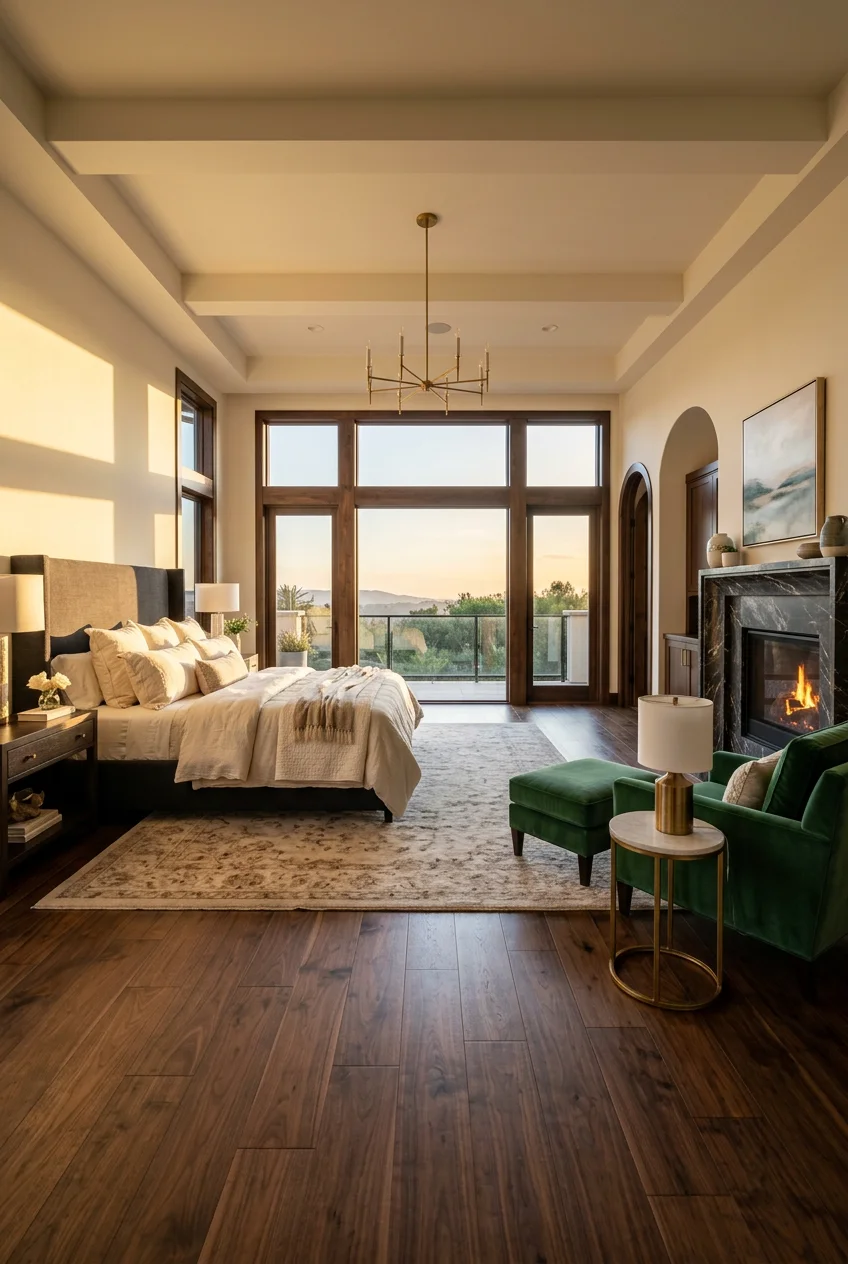
What’s Inside
- Invest in a “Wellness-First” Design Approach with Circadian Lighting
- Opt for an Oversized, Upholstered Statement Bed
- Layer Your Lighting with Precision
- Select a Generously Sized Area Rug
- Embrace “Quiet Luxury” with a Calming, Natural Color Palette
- Invest in Hotel-Quality, Layered Bedding
- Incorporate Soundproofing for a True Sanctuary
- Design a Custom, Illuminated Walk-in Closet
- Choose Floor-to-Ceiling Drapery
- Curate a Thoughtful Furniture Layout with Breathing Room
- Integrate Invisible Technology (The “Dumb Bedroom” Trend)
- Add a Lounge Element with Sculptural Furniture
- Emphasize Tactile Styling with Rich Textures
- Upgrade the Ceiling with Architectural Details
- Personalize with Oversized Art and Minimal Styling
- Incorporate a Statement Fireplace
- Install Motorized Blackout Shades
Walking into a massive, empty room often feels more like standing in a gymnasium than a personal sanctuary. A huge bedroom master suite requires serious spatial planning, or you’ll end up with your furniture pushed against the walls and a massive, awkward dance floor in the middle. Most people just buy a standard bedroom set, shove it in the corner, and wonder why the room feels cold and unfinished. The reality is that filling a large footprint requires scaling up your furniture, layering your lighting, and adding architectural weight to ground the space. If you only try one idea from this list, make it #1. Installing circadian lighting fundamentally changes how a room functions, fixing the stark, clinical feeling that plagues most large bedrooms and replacing it with warmth that adapts to your daily routine. It’s a total game changer. No exaggeration.
Skip this list if: You’re working with a standard 10×12 room, you’re a strict renter who can’t drill into walls or swap hardwired fixtures, or your total room budget is under $1,000. These concepts rely on large-scale furniture, structural modifications, and premium materials that simply won’t fit or function in compact, temporary living situations.
1. Invest in a “Wellness-First” Design Approach with Circadian Lighting

Most people slap a single, glaring flush-mount light in the center of a massive ceiling and call it a day. That’s a guaranteed way to make a huge bedroom master suite feel like a cheap motel. Instead, prioritize a wellness-first approach by integrating smart lighting systems that mimic natural daylight patterns. Brands like Lutron offer the Ketra system, which automatically shifts color temperature and intensity throughout the day. You get crisp, cool 5000K light at 8:00 AM to wake you up, and it slowly transitions to a warm, amber 2700K by 9:00 PM to help your brain produce melatonin.
This isn’t just about throwing smart bulbs into old lamps. It requires a hardwired, integrated system that washes the walls with light rather than creating harsh spotlights. Expect to budget anywhere from a few thousand to mid-five figures for a full-room professional installation. The visual warmth it adds to a large footprint is undeniable. It fills the empty vertical space with a soft glow that makes even the most cavernous room feel intimate.
The catch: This requires pulling new wiring through your walls and ceiling. It’s a messy, expensive process that requires an electrician and drywall patching.
Best for: Homeowners doing a down-to-the-studs remodel or new build.
2. Opt for an Oversized, Upholstered Statement Bed

A standard king-sized bed (76″ x 80″) looks comically small in a room that’s 15×20 feet or larger. It gets swallowed by the square footage. To anchor the space, you need an oversized, upholstered statement piece. Look into a “Wyoming King” (84″ x 84″) or an “Alaskan King” (108″ x 108″) for expansive comfort. Brands like Bernhardt and Century Furniture manufacture massive, tailored frames in performance velvet or heavy linen that command attention.
The headboard needs to be tall—at least 60 to 72 inches high—to eat up some of that empty wall space. Skip the spindly metal frames or low-profile platform beds. You need visual weight. A deeply tufted or channel-stitched headboard adds necessary texture and stops the voice-echo effect that happens in large, bare rooms. Pricing for these custom-scaled pieces typically ranges between $3,000 and $8,000, depending on the fabric grade.
The catch: Finding a mattress and fitted sheets for an Alaskan King is a logistical nightmare. You’re locked into buying expensive custom linens online, as you won’t find them on the shelves at Target or Walmart.
3. Layer Your Lighting with Precision

Relying on a ceiling fan light kit is a classic mistake that ruins the ambiance of any large bedroom. A massive suite demands a layered lighting scheme: ambient, task, and accent. For task lighting, ditch the tiny table lamps. Instead, suspend large pendant lights directly over your nightstands. Brands like Visual Comfort or Restoration Hardware offer heavy, brass or bronze pendants that drop down from the ceiling, leaving your nightstand surface completely clear.
Hang these pendants so the bottom of the fixture sits roughly 20 to 24 inches above the nightstand. This height provides perfect reading light without blinding you when you sit up in bed. Pair these with recessed ceiling lights on dimmer switches and LED strip lighting tucked behind the headboard or under the bed frame for a soft, floating effect. The budget for high-end pendants usually sits between $400 and $1,200 per fixture.
The catch: Hardwiring pendants over nightstands means your bed placement is permanently locked in. If you ever want to rearrange the room, you’re left with weirdly placed ceiling wires.

Ultra Soft Cozy Faux Fur Throw Blanket
Ultra Soft Cozy Faux Fur Throw Blanket is sturdier in person than the photos suggest — over 11 buyers gave it 4.5 stars.
4. Select a Generously Sized Area Rug

The biggest offense in bedroom design is a rug that’s too small. A 5×8 rug shoved under a king bed looks like a postage stamp. For a huge bedroom master suite, the rug must extend at least 24 to 36 inches beyond the sides and foot of the bed. If you have a massive room, you’re looking at a 10×14 or even a 12×15 rug. The goal is to leave a border of about 12 to 18 inches of bare wood flooring around the perimeter of the room.
Tactile, high-pile rugs in muted tones are the standard here. Hand-knotted wool or thick Moroccan styles add a layer of acoustic dampening to quiet the room. You can find decent oversized options at Costco or West Elm, but for true luxury, custom-cut broadloom or vintage Oushak rugs are the way to go. Expect to spend anywhere from $800 to $4,000 for a rug of this magnitude.
The catch: High-pile wool rugs shed relentlessly for the first six months. Your vacuum canister will fill up with fuzz every single time you clean.
5. Embrace “Quiet Luxury” with a Calming, Natural Color Palette

Painting a massive room stark, brilliant white is a fast track to making it feel like an art gallery rather than a bedroom. To scale down the visual vastness, lean into the “quiet luxury” trend using deep, nature-inspired tones. Soft dusty blues, creamy whites with warm undertones, sage greens, and earthy beiges pull the walls inward just enough to feel cozy.
Look at colors like Farrow & Ball’s Pigeon or Benjamin Moore’s Quiet Moments. These shades shift beautifully depending on the light, looking green in the morning and blue-gray at night. Paint the baseboards and trim the exact same color as the walls, just in a satin finish instead of matte. This monochromatic drenching technique eliminates harsh contrast lines and makes the ceiling feel higher while keeping the room grounded. A gallon of premium paint will run you $70 to $140.
The catch: Darker, muted colors absorb a lot of light. If your room only has one small north-facing window, these shades will make the space feel incredibly gloomy during the day.
Best for: Rooms with massive windows and abundant natural southern light.
6. Invest in Hotel-Quality, Layered Bedding

A giant bed looks sloppy if it’s dressed in flimsy, wrinkly microfiber. High-end hotels use a very specific formula for their beds: a premium mattress topper, crisp percale or silky sateen sheets, a heavy down duvet, and a strategic pillow arrangement. Brands like Sferra, Frette, or even higher-end lines from Brooklinen offer the crisp, heavy-weight cotton that snaps when you fold it. You might also like: 16 Teen Boy Bedroom Ideas You Need to See
You need volume. Use a duvet insert that is one size larger than your duvet cover (e.g., a king insert inside a queen cover) to get that overstuffed, fluffy look. Stack four standard pillows, add two or three large European shams (26″ x 26″) in a textured fabric like linen, and finish with a heavy knit throw blanket draped across the foot of the bed. A luxury queen or king sheet set will generally cost between $300 and $1,000. You might also like: 20 Aesthetic Comfy Bedroom You Need to See
The catch: 100% cotton percale wrinkles aggressively. Unless you’re willing to stand there with a steamer or an iron every wash day, your bed will never look perfectly crisp.

Govee RGBIC LED Strip Lights
Govee RGBIC LED Strip Lights is sturdier in person than the photos suggest — over 252 buyers gave it 4.5 stars.
7. Incorporate Soundproofing for a True Sanctuary

Luxury isn’t just visual; it’s auditory. A huge room with hardwood floors and high ceilings acts like an echo chamber. To fix this, you need acoustic wellness built into the bones of the room. Start by replacing hollow-core doors with solid wood slabs. Hollow doors let every single sound from the hallway bleed into your space. You might also like: 15 Stunning Bedroom Design India Ideas for a Beautiful Space
If you’re renovating, add specialized acoustic insulation like recycled denim or mineral wool between the wall studs. Add heavy, lined velvet curtains to the windows—even if you don’t close them often, the thick fabric absorbs high-frequency sounds. You can also mount fabric-wrapped acoustic panels behind a decorative wood slat wall. Soundproofing materials usually range from $500 for heavy curtains to several thousand for in-wall insulation and solid doors.
The catch: True in-wall soundproofing requires tearing down drywall. It’s highly disruptive and creates a massive dust mess throughout the house.
8. Design a Custom, Illuminated Walk-in Closet

A massive bedroom shouldn’t be cluttered with bulky dressers. Move the storage out of the sleeping area and into a custom, illuminated walk-in closet. Companies like Closets Las Vegas or California Closets use systems (like the Classica line) that look like built-in furniture rather than wire racks. You need a minimum depth of 24 inches for hanging sections so clothes don’t stick out past the panels.
Integration is key here. Run continuous LED strip lighting vertically down the side panels or horizontally behind the hanging rods. Add glass-front doors to protect expensive shoes or handbags from dust while keeping them visible. Include a central island with soft-close drawers for jewelry and undergarments. Custom closets of this scale easily range from $5,000 to $15,000+ depending on the finishes.
The catch: Building a massive closet eats directly into your bedroom’s square footage. You have to sacrifice floor space to get the storage.
9. Choose Floor-to-Ceiling Drapery

Nothing looks cheaper in a large room than short curtains that stop right below the window sill. To maximize the perceived height of your huge bedroom master suite, install floor-to-ceiling drapery. Mount the curtain rod exactly 1 to 2 inches below the ceiling line or crown molding, and let the fabric lightly kiss the floor.
Opt for a pinch-pleat header rather than cheap grommets. The pleats force the fabric to fall in rigid, uniform folds that look tailored and expensive. You need double the width of your window in fabric to make the curtains look full when closed. If the budget allows, add a motorized track system from Somfy so you can open them with a remote. Custom drapery for large windows typically falls in the $1,500 to $4,000 range per window.
The catch: Custom drapery is shockingly expensive because of the sheer yardage required. It often costs more than the furniture in the room.
Best for: Rooms with ceilings 9 feet or taller where visual height needs to be emphasized.

HOMIDEC Closet Organizers and Storage
A dependable everyday pick — HOMIDEC Closet Organizers and Storage pulls in 81 ratings at 4.5 stars. Not flashy, just solid.
10. Curate a Thoughtful Furniture Layout with Breathing Room

The instinct in a large room is to push all the furniture against the walls, leaving a massive void in the center. Don’t do this. You need to pull pieces inward and create distinct zones. Ensure there is a minimum of 36 inches of walking space around the bed. Instead of buying a matching 6-piece bedroom set (which looks dated), mix your finishes.
Bring in a massive, free-standing piece like a solid wood armoire from Hooker Furniture or Lexington. Place it on a wall perpendicular to the bed to balance the room’s visual weight. Add a heavy bench at the foot of the bed. The goal is to create intentional breathing room between heavy pieces so the eye rests, rather than darting from one cluttered corner to the next. High-quality armoires generally cost between $2,000 and $5,000.
The catch: It requires strict discipline to leave empty space. The temptation to fill every corner with a plant, a chair, or a basket is strong, but clutter destroys the luxury aesthetic.
11. Integrate Invisible Technology (The “Dumb Bedroom” Trend)

The 2026 design standard leans heavily toward the “dumb bedroom.” This doesn’t mean skipping technology; it means hiding it completely. A luxury suite shouldn’t look like an electronics store. Blinking router lights, tangled phone cords, and glowing TV screens ruin the sanctuary vibe.
Retrofit your nightstands with built-in charging drawers. You drill a 2-inch hole in the back of the drawer, run a power strip inside, and keep your phone, watch, and tablet hidden while they charge. If you must have a TV, mount it flush inside a wall cavity and cover it with motorized art (like the Samsung Frame, but taken a step further with custom sliding panels). The goal is zero visible wires. In-drawer charging outlets cost about $50 to $100 to install yourself.
The catch: Charging devices inside a closed wooden drawer traps heat. If you’re charging a laptop, a tablet, and a phone simultaneously, the drawer can get dangerously warm.
12. Add a Lounge Element with Sculptural Furniture

If your room is larger than 15×20, a bed and two nightstands won’t fill it. You need a dedicated seating area. Don’t just throw a flimsy accent chair in the corner. Invest in a heavy, sculptural lounge piece. A deep, plush armchair or an asymmetrical chaise lounge upholstered in heavy bouclé or mohair creates a distinct zone for reading or putting on shoes.
Brands like Four Hands or Crate & Barrel offer massive, low-slung chairs that take up serious visual real estate. Pair the chair with a heavy marble or concrete side table and a dedicated floor lamp. This setup breaks up the room and gives it a suite-like feel, similar to a high-end hotel room. Budget around $1,000 to $2,500 for a high-quality sculptural chair.
The catch: Bouclé and mohair fabrics are absolute magnets for pet hair. If you have a cat or a dog, these chairs will look filthy within a week.
Best for: Pet-free homes or rooms where pets are strictly forbidden.

Acovy 30in Long Floating Shelves for Wall Set of 2
Acovy 30in Long Floating Shelves for Wall Set of 2 punches above its price — 8 buyers rated it 4.5 stars. The kind of pick people reorder.
13. Emphasize Tactile Styling with Rich Textures

A huge room with flat, painted drywall and smooth cotton sheets feels sterile. You have to inject texture to make it feel expensive. The secret is mixing contrasting materials. If your bed frame is smooth leather, your bedding needs to be rumpled linen, and your throw pillows should be heavy velvet. If your floors are slick hardwood, your rug needs to be a chunky wool.
Add a velvet tufted bench at the foot of the bed or drape a heavy, faux-fur throw over the reading chair. The contrast between matte and shiny, smooth and rough, is what gives a room depth. Avoid buying everything in the same flat linen finish. Mixing textures properly requires sourcing from multiple vendors rather than buying a single catalog look. Expect to spend $50 to $150 per high-quality textured throw pillow.
The catch: Highly textured fabrics like velvet, silk, and faux fur are almost always dry-clean only. Spilling coffee in bed suddenly becomes an expensive mistake.
14. Upgrade the Ceiling with Architectural Details


The ceiling is the largest uninterrupted surface in your bedroom, and leaving it as a flat expanse of white drywall is a missed opportunity. In a huge room, a flat ceiling makes the space feel like a commercial office. You need architectural details to draw the eye upward and add character.
Consider installing a grid of shallow coffered beams, tongue-and-groove wood paneling, or even a subtle, textured grasscloth wallpaper on the ceiling. If you have the height (10 feet or more), dark wood slats running the length of the room can make the space feel incredibly warm and intimate. Pair this with a massive, multi-tiered chandelier to anchor the center of the room. Wood ceiling treatments typically run $15 to $30 per square foot installed.
The catch: Installing anything on a ceiling is back-breaking work. Unless you are a highly skilled DIYer, you absolutely must hire a professional crew, which drives the cost up significantly.
15. Personalize with Oversized Art and Minimal Styling

Most people hang tiny 8×10 frames on a massive 12-foot wall and wonder why the room feels off. Large walls require large-scale art. Skip the cluttered gallery walls of small family photos—they look messy in a luxury suite. Instead, invest in one or two massive canvas pieces (think 48″ x 60″ or larger).
Keep the styling on your nightstands and dressers aggressively minimal. A heavy ceramic lamp, a stack of two large coffee table books, and a single brass tray for jewelry is all you need. Clutter destroys the illusion of luxury. Let the negative space on the walls and surfaces speak for itself. Oversized canvas art from retailers like CB2 or West Elm ranges from $400 to $1,500.
The catch: Transporting and hanging a 60-inch canvas is a two-person job. If you don’t use heavy-duty wall anchors, that massive frame will rip right out of the drywall.

Venusmiles Floating Shelves for Wall 24 inch Long
A dependable everyday pick — Venusmiles Floating Shelves for Wall 24 inch Long pulls in 412 ratings at 4.5 stars. Not flashy, just solid.
16. Incorporate a Statement Fireplace


Nothing screams luxury quite like a fireplace in the bedroom. If you have a massive blank wall across from the bed, building out a fireplace bump-out is the perfect way to eat up dead space. You don’t need a real wood-burning chimney. High-end electric inserts from brands like Dimplex or Touchstone look incredibly realistic and offer built-in heaters.
Frame the insert with floor-to-ceiling Roman clay, large-format porcelain tile, or heavily veined marble. Make the surround at least 60 inches wide to ensure it looks proportional to a king-sized bed. A fireplace adds a dynamic, moving light source that instantly warms up a cold, cavernous room. An electric insert plus the framing and tile work usually costs between $2,000 and $5,000.
The catch: The heat output from a 120V electric fireplace is minimal. It will take the chill out of the air right next to it, but it won’t heat a 400-square-foot room.
17. Install Motorized Blackout Shades

Waking up to blinding sun at 6:00 AM ruins the luxury experience. While heavy drapes are great for aesthetics, true light control requires blackout shades mounted inside the window frame. For a huge bedroom with multiple large windows, manually pulling down six different shades every night is annoying.
Install motorized blackout roller shades from companies like Lutron or Hunter Douglas. You can sync them to a remote or a smart home hub so they all close simultaneously at the push of a button. Layer these behind your decorative floor-to-ceiling drapes. You get the soft, romantic look of the fabric with the hardcore light-blocking utility of the shade. Motorized shades typically run $300 to $800 per window.
The catch: Unless you hardwire them during a renovation, motorized shades run on batteries. You will inevitably have to climb a ladder to plug in a charger or swap D-batteries every 8 to 12 months.
Best for: Light sleepers and shift workers who need total darkness during the day.
How we chose these ideas: The concepts on this list were selected based on their ability to visually scale down massive square footage, improve daily functionality, and provide long-term durability. We prioritized architectural weight, lighting layers, and specific material choices (like heavy linens and high-pile rugs) that are proven to absorb sound and fill empty space effectively in large floor plans.
Building out a massive suite takes time and serious budgeting. Don’t rush to fill the room with cheap filler furniture just to cover the floor. Start with the lighting and the bed scale, and layer the rest over time. I’d highly recommend pinning a few of these architectural details to your mood board so you don’t lose track of the scale requirements when you finally start shopping. I learned that the hard way. Trust me on this.
Frequently Asked Questions
How do you fill empty space in a huge master bedroom?
Scale up your furniture. Use a Wyoming or Alaskan king bed, add a dedicated seating area with heavy sculptural chairs, and bring the furniture inward off the walls. A massive 12×15 area rug and a large freestanding armoire will also eat up dead floor space.
What is the best lighting for a large primary suite?
A large room requires layered lighting. Combine recessed ceiling lights on dimmers, hardwired pendant lights dropped over the nightstands, and LED strip lighting in closets or behind headboards. Avoid relying on a single central ceiling fan light.
What size rug do I need for a massive bedroom?
The rug must extend at least 24 to 36 inches beyond the sides and foot of the bed. For a huge bedroom, this usually means investing in a 10×14 or 12×15 rug to properly anchor the space and improve room acoustics.
How can I make a large bedroom feel cozy?
Use deep, muted paint colors like sage green or dusty blue to visually pull the walls inward. Layer heavy textures like velvet, linen, and chunky wool, and install floor-to-ceiling drapes to soften the hard architectural lines.
