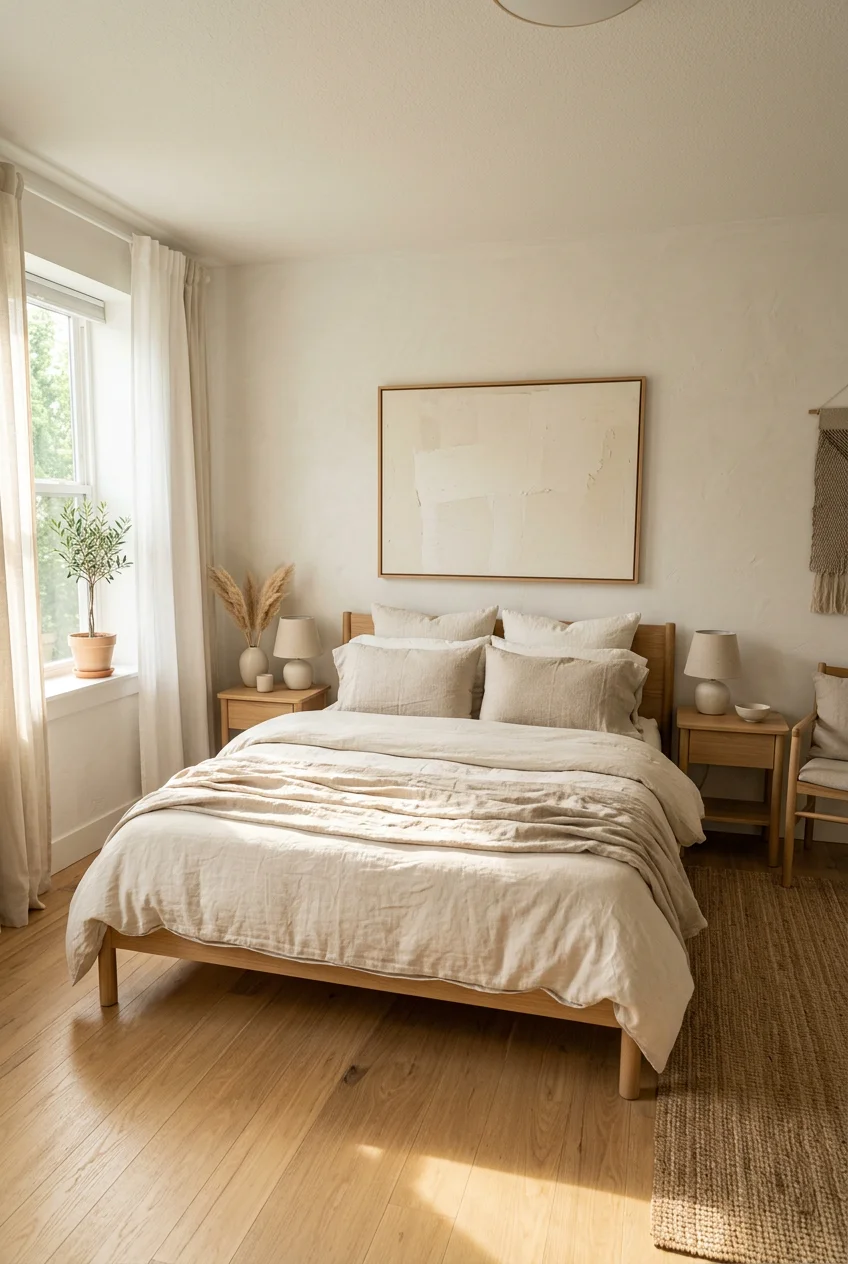
What’s Inside
- Start With Textured Wall Treatments for Depth
- Pick a Warm, Trending Beige Paint Color
- Layer Diverse Natural Textiles
- Anchor the Space with Warm Wood Furniture
- Integrate Sculptural and Ambient Lighting
- Hang Neutral Abstract Art
- Add Greenery for a Biophilic Touch
- Install Heavy Blackout Curtains for a True Beige Bedroom Aesthetic
- Introduce Subtle Metallic Accents
- Avoid Overcrowding the Surfaces
- Use Pampas Grass for Soft Texture
- Play With Contrasting Sheens
- Introduce a Muted Jewel Tone Accent
- Embrace the Black and Beige Contrast
- Mix Three Distinct Textures Minimum
- Hide Clutter in Woven Jute Baskets
- Invest in a Low-Profile Bed Frame
- Complete the Beige Bedroom Aesthetic with Scent Scaping
I spent $400 repainting my guest room in 2021, and it ended up looking exactly like my dentist’s waiting room. Flat, lifeless, and smelling faintly of regret. Nailing the beige bedroom aesthetic requires more than just slapping a coat of tan paint on drywall and calling it a day. I learned this the hard way after living in that sterile box for a year before finally figuring out the mechanics of neutral layering—it took me years to figure out, no exaggeration. Now, my master bedroom is a textured, warm sanctuary that actually feels intentional. If you’re trying to build a space that feels calm without crossing into boring territory, you need a specific formula. It’s about mixing sheens, contrasting undertones, and relying on tactile materials rather than loud patterns. Let’s break down the exact pieces, paints, and textiles you need to get this look right without making the same expensive mistakes I did.
1. Start With Textured Wall Treatments for Depth

If you leave your walls completely flat, a beige palette quickly turns muddy. I tried standard matte paint first, and the room just felt dead. You need physical texture to catch the light. Paintable MDF wall panels are an excellent starting point. You can cut them to size and color-drench them in a creamy ivory for a modern finish. If you aren’t ready to use a saw, textured wallpaper is the next best option. I used Happywall’s Plain textured wall neutral beige wallpaper ($3.50 per square foot) on my focal wall behind the bed. It has this subtle, gritty texture that mimics raw plaster. Alternatively, Etsy sells a Beige Faux Linen Peel and Stick Wallpaper for about $45 per roll. The linen finish breaks up the monotony of smooth drywall. You won’t believe how much this single change impacts the room’s acoustics and light distribution. It makes the space feel instantly more expensive.
2. Pick a Warm, Trending Beige Paint Color

Choosing the wrong undertone will ruin your room faster than anything else. I originally picked a cool-toned beige that looked distinctly pink in the afternoon sun. Total disaster. In 2026, warm neutrals with yellow or green undertones are the standard. Sherwin-Williams Shoji White SW 7042 has an LRV (Light Reflectance Value) of 74, making it incredibly soft and restful for a sleeping space. I currently have this on my ceiling. Another reliable option is Benjamin Moore Muslin OC-12 with an LRV of 73. It brings a cozy warmth without feeling heavy or dated. If you want a deeper, moodier statement wall, test Sherwin-Williams Universal Khaki SW 6150. It carries a very subtle green-brown undertone. A gallon of their top-tier Emerald interior acrylic latex costs $85. Skip the cheap builder-grade paint. The coverage is terrible, and you’ll end up doing three coats anyway.
3. Layer Diverse Natural Textiles

A monochromatic room dies without texture. Interior designers always talk about layering, but practically, this means mixing fabrics that feel completely different to the touch. I keep a 100 percent European flax linen duvet cover from West Elm ($230 for a queen) on my bed year-round. Linen has a natural crumple that prevents the bed from looking too stiff. Over that, I throw a chunky knit cotton blanket from Target’s Threshold line ($35) at the foot of the bed. You also need a base layer for your floors, especially if you have hardwoods. I put a 5×7 foot woven jute rug from Rugs USA ($110) directly under the lower half of my bed frame. The rough, fibrous texture of the jute contrasts sharply with the soft linen and smooth cotton. I bought a cheap synthetic rug once, and it just looked shiny and cheap. Stick to natural fibers.

50×70 Inch Rust Throw Blanket – Soft & Fluffy Fleece
50×70 Inch Rust Throw Blanket – Soft & Fluffy Fleece has been one of the most consistently praised picks in this category. 11 reviewers averaged 4.5/5.
4. Anchor the Space with Warm Wood Furniture

If everything in your room is soft and upholstered, the space feels ungrounded. You need hard, warm materials to create friction. Introduce furniture pieces in walnut or white oak to add depth. I replaced my old painted white nightstands with the Ethnicraft Nordic II Bedside Table in Oak from Lumens. They cost $419 each, which stung at the time, but the raw timber grain completely changed the room’s energy. If that’s out of your budget, the Celine 3-Drawer Nightstand from Joss & Main runs about $250 and offers a similar warm wood tone. The key is choosing a low-profile design so the furniture doesn’t dominate the room. The wood provides a necessary visual break from the sea of cream and taupe textiles. Don’t match your wood tones perfectly, either. A slightly darker walnut dresser pairs beautifully with lighter oak nightstands.
5. Integrate Sculptural and Ambient Lighting

Overhead lighting is the enemy of a relaxing bedroom. I haven’t turned on my main ceiling fixture in three years. Instead, rely on layered ambient lighting to cast warm shadows against your beige walls. A statement pendant light acts as functional art. I installed a 20-inch airy feather pendant shade I found on Amazon for $45. It diffuses the light beautifully. For task lighting, I keep a sleek brass floor lamp from Target ($60) in the reading corner. The most critical detail here is your bulb temperature. You must use warm LED bulbs, specifically 2700K. Anything higher, like 3000K or 4000K, casts a blue, sterile light that makes beige look like a hospital corridor. I buy the Philips 60W equivalent warm glow dimmable LEDs in a 4-pack for $16 at Home Depot. They dim smoothly without flickering.
6. Hang Neutral Abstract Art

Bare walls make a minimalist room look unfinished rather than intentional. You need art, but it shouldn’t scream for attention. I look for pieces with earthy, natural tones and simple, balanced compositions. Last month, I bought a Large Framed Abstract Neutral Landscape Wall Art, specifically a Misty River Canvas Print, from an Etsy seller for $142.49. It measures 24×36 inches and sits in a thin, light oak floating frame. The muted browns and soft creams in the print pull the entire room’s palette together. Avoid art with stark white backgrounds, as it will clash with your warm beige walls. I made the mistake of hanging a bright white typography poster in my old room, and it just looked aggressive. Stick to canvases or textured watercolor paper that absorb light rather than reflecting it harshly.

HOMIDEC Closet Organizers and Storage
HOMIDEC Closet Organizers and Storage has been one of the most consistently praised picks in this category. 8 reviewers averaged 4.5/5.
7. Add Greenery for a Biophilic Touch

A neutral room needs a pulse. Plants introduce vitality and a splash of organic color that aligns perfectly with biophilic design trends. I have a 6-foot tall faux fiddle-leaf fig from Nearly Natural ($120) in the corner because I can’t keep a real tree alive to save my life. But on my dresser, I keep a real trailing golden pothos. It sits in a rustic, unglazed 6-inch ceramic planter I picked up at Walmart for $14. The vibrant green leaves break up the neutral tones and add a necessary organic shape to the room. If you’re buying real plants, pick up a $5 bag of organic potting soil from Sprouts while you’re grabbing groceries. Proper drainage is non-negotiable. I ruined a $40 wood tray because I watered a plant in a pot with no drainage tray. You might also like: 15 Brilliant Bedroom Light Fixtures You Haven’t Thought Of
8. Install Heavy Blackout Curtains for a True Beige Bedroom Aesthetic

Window treatments dictate the architectural feel of your bedroom. Flimsy, sheer curtains make a space look cheap. For a truly high-end beige bedroom aesthetic, you need heavy, textured drapes. I use the Deconovo 100 Percent Blackout with Liner Grommet Curtains. You can get two 52×84 inch panels for $43.99 on Amazon. I’ve used these for two years now. They have a faux linen texture that looks incredibly expensive for the price. Another solid option is their Faux Linen Total Blackout Grommet Curtains, starting around $50.14. Hang the curtain rod as close to the ceiling as possible and extend it 10 inches past the window frame on each side. This creates the illusion of massive windows and taller ceilings. I used to hang my curtains right on the window trim, and it made the room feel cramped and squat. The heavy fabric also dampens street noise. You might also like: 20 Charming Cozy Warm Bedroom You Need to See
9. Introduce Subtle Metallic Accents

Beige absorbs light, so you need a few reflective surfaces to bounce it back. Metallic elements act like jewelry for the room. I don’t mean massive mirrored dressers. Think small, deliberate touches. I have two 5×7 inch brushed brass picture frames from Target ($12 each) on my dresser. My nightstand lamps have antique bronze bases. These small metallic hits catch the morning light and add a layer of luxury without compromising the serene vibe. I tried using polished chrome hardware for a while, but it felt too cold and modern for a warm beige palette. Stick to warm metals like unlacquered brass, antique gold, or deep bronze. Even the drawer pulls on your nightstands can make a difference. I swapped the cheap plastic knobs on my IKEA dresser for heavy brass pulls I found on Etsy for $6 each.

AMADA HOMEFURNISHING Floating Shelves
If you want something that just works, AMADA HOMEFURNISHING Floating Shelves is a safe bet (114 reviews, 4.5 stars).
10. Avoid Overcrowding the Surfaces

The beauty of this aesthetic comes from negative space. If you cover every flat surface with knick-knacks, the room loses its calming effect. I used to keep my perfume collection, loose change, and half-read books scattered across my dresser. It gave me low-grade anxiety every time I walked in. Now, I use a strict tray system. I keep a 12-inch round woven rattan tray from Costco ($20 for a set of two) on my dresser. If an item doesn’t fit in the tray, it goes in a drawer. I limit my nightstand to a lamp, a coaster, and my current book. That’s it. When you have fewer items on display, the pieces you do choose to show off have more impact. Give your eyes a place to rest. Clutter completely destroys the peaceful atmosphere of a neutral room. You might also like: 15 Inspiring Master Bedroom Wall Decor to Transform Your Space
11. Use Pampas Grass for Soft Texture

If you want a bohemian or minimalist touch that doesn’t require watering, pampas grass is the answer. It adds a soft, airy texture that perfectly complements a beige palette. I bought a bundle of 15 natural dried stems from Etsy. They are about 24 inches long and sit in a tall, narrow glass vase on my floor. You can also find a pack of 40 pieces of natural dried boho artificial plant decor for around $29.20 online. When they first arrive, they look flat and sad. The trick is to take them outside and gently shake them, then use a hairdryer on a cool setting to fluff out the plumes. I skipped the hairdryer step the first time and wondered why my grass looked like wet dog hair. Just spray them lightly with cheap aerosol hairspray afterward to stop them from shedding everywhere.
12. Play With Contrasting Sheens

Texture isn’t just about how things feel; it’s about how they reflect light. Mixing materials with contrasting sheens adds subtle dynamism to the room. I pair a matte, unglazed clay vase from Crate & Barrel ($35) next to a glossy glazed ceramic catchall dish. On my bed, I mix a smooth, slightly shiny silk pillowcase with nubby, matte linen shams. This variation allows the natural light from the window to bounce differently across the room. As the sun moves, the room actually changes character. If everything in the room is matte, it looks dusty. If everything is glossy, it looks like a cheap catalog. You need the friction between the two. I learned this after buying an entirely matte bedding set that just looked flat and lifeless under my warm LED lamps.

QEEIG Floating Shelves for Wall Bathroom Shelf Bedroom
If you want something that just works, QEEIG Floating Shelves for Wall Bathroom Shelf Bedroom Kitchen Living is a safe bet (45 reviews, 4.5 stars).
13. Introduce a Muted Jewel Tone Accent

A completely monochromatic room often feels washed out. To anchor the space, interior designers recommend introducing a single accent color in a muted jewel tone. I use a deep olive green velvet lumbar pillow from CB2 ($45) on my bed. It provides a soft, sophisticated contrast that grounds the lighter beige tones without disrupting the overall neutral palette. Charcoal gray or a desaturated navy blue works just as well. I tried a bright terracotta cushion once, and it completely hijacked the room’s focal point. You want the accent color to be muddy and subdued. The velvet material is crucial here, too. The heavy, plush fabric absorbs light and makes the dark color feel rich and intentional rather than jarring. Keep the accent to just one or two small items, like a cushion or a small ceramic bowl.
14. Embrace the Black and Beige Contrast

One of the strongest trends right now is pairing black and beige. The stark contrast feels incredibly modern and prevents the beige from looking traditional or stuffy. I have a beige upholstered headboard from Wayfair ($280) paired with crisp white sheets and a black wool throw blanket draped at the foot. My nightstands are matte black wood. The black acts as an eyeliner for the room, defining the edges and making the beige tones appear warmer and richer by comparison. Don’t overdo it, though. You aren’t creating a checkerboard. Use black in thin, linear elements: a slim black picture frame, black metal curtain rods, or the base of a floor lamp. I bought a heavy black ceramic vase last Tuesday at Whole Foods for $15, and it looks stunning sitting against my textured beige wallpaper.
15. Mix Three Distinct Textures Minimum

The most common mistake people make with neutral rooms is ignoring tactile variety. If your walls, bedding, and rug all have the same smooth finish, the room fails. My rule is to combine at least three distinct textures in every sightline. Right now, looking at my bed, I see a nubby boucle accent chair ($150 from Target), a raw wood side table, and a soft wool blanket. Boucle, wood, and wool. The friction between these materials creates richness and dimension. I used to have a cotton duvet, cotton sheets, and a flat cotton rug. It was horribly boring. You have to force yourself to buy materials that feel rough, fluffy, smooth, and ridged. Even your window treatments count toward this texture quota. Faux linen curtains add a visible weave that smooth polyester panels simply lack.

Amaoot Floating Shelves Set of 3, Home Wood Wall Shelf
If you want something that just works, Amaoot Floating Shelves Set of 3 is a safe bet (893 reviews, 4.5 stars).
16. Hide Clutter in Woven Jute Baskets

Storage is usually ugly, but in a beige room, it’s an opportunity to add more texture. Plastic storage bins will ruin your aesthetic instantly. I use large woven jute and water hyacinth baskets to hide my extra blankets, out-of-season clothes, and random electronics. I found a nesting set of three heavy-duty water hyacinth baskets at Costco for $35. I keep the largest one at the foot of my full-length mirror. They blend perfectly with the warm wood tones and beige walls while hiding the things I don’t want to look at. I tried using fabric storage cubes from IKEA for a while, but they lost their shape and looked sloppy within a month. Rigid woven baskets maintain their structure and bring a natural, earthy element indoors. Plus, they smell faintly of dried grass, which I actually enjoy.
17. Invest in a Low-Profile Bed Frame

A massive, bulky bed frame can swallow a room whole. To maintain a light, airy feeling, you need a low-profile frame. I upgraded to the Thuma The Bed frame ($1,095 for a queen) in the walnut finish. It has clean lines, no visible hardware, and sits relatively low to the ground. If that’s out of the budget, the IKEA Malm bed frame in white stained oak veneer ($249) offers a similar minimalist silhouette. A lower bed makes your ceilings feel taller and gives the room a relaxed, grounded energy. I used to have a tall, dark cherry sleigh bed that I bought on Craigslist, and it made my standard 8-foot ceilings feel incredibly oppressive. Stick to simple, platform-style beds with clean lines. It lets your textured bedding and wall treatments remain the focal point.
18. Complete the Beige Bedroom Aesthetic with Scent Scaping

The final layer of a true beige bedroom aesthetic isn’t visual; it’s olfactory. You can’t have a serene, visually calming room that smells like stale laundry or harsh chemical cleaners. I use scent scaping to make the room feel like a high-end hotel. I burn a Voluspa Baltic Amber glass jar candle ($32 at Nordstrom) on my dresser every evening. The scent is warm, woody, and slightly sweet, which perfectly matches the visual warmth of the room. Avoid overly fruity or artificial scents. I bought a cheap tropical breeze plug-in from Kroger once, and the synthetic smell gave me a massive headache and completely ruined the relaxing vibe. Stick to natural, earthy scents like amber, sandalwood, cedar, or vanilla. The amber glass jar also looks beautiful when the candle is unlit, doubling as a small decorative accent.
Building a cohesive neutral space takes patience, but the payoff is a room that actually helps you decompress at the end of the day. Don’t rush out and buy everything at once. I’d suggest starting with your paint and lighting, then slowly layer in the textures and wood tones. I promise, once you get the lighting and textures right, you won’t ever want to leave your bed. If you found this breakdown helpful, save this post or pin it to your bedroom mood board so you have the exact paint colors and product names ready when you start decorating.
Frequently Asked Questions
How do I make a beige bedroom not look boring?
Prevent a boring beige room by mixing at least three distinct textures, like linen, boucle, and raw wood. Add contrasting sheens, such as matte clay vases next to glossy ceramics, and introduce a single muted jewel-tone accent pillow to anchor the space.
What is the best beige paint color for a bedroom?
Warm neutrals are ideal for bedrooms. Sherwin-Williams Shoji White SW 7042 and Benjamin Moore Muslin OC-12 both offer soft, restful warmth without heavy yellow undertones. Always test swatches on your walls to see how they react to your specific natural light.
What colors pair best with a beige bedroom aesthetic?
Black and beige is a highly trending combination that adds modern contrast. You can also pair beige with warm wood tones like walnut or white oak, subtle metallic brass, and muted jewel tones like deep olive green or charcoal gray.
How do I light a beige bedroom properly?
Avoid harsh overhead lighting. Instead, layer ambient light using floor lamps, table lamps, and pendant fixtures. It is crucial to use warm LED bulbs with a color temperature of 2700K to prevent the beige walls from looking blue and sterile.
