What’s Inside
- Select the Perfect Deep Blue Paint with the Right Sheen
- Layering Textures with Heavyweight Linen
- Warm Brass Lighting to Cut the Cool Tones
- Incorporating Natural Wood Furniture
- The Dark Blue Bedroom Aesthetic Needs Strategic Rug Placement
- Adding Greenery for Contrast
- Velvet Blackout Curtains for Depth
- Creating a Focal Point with Oversized Art
- Low-Profile Bed Frames to Balance Dark Walls
- Scentscaping the Dark Blue Bedroom Aesthetic
- Swapping to Matte Black Hardware
- Utilizing Mirrors to Bounce Light
- Layering Ambient and Task Lighting
- Integrating Woven Baskets for Soft Storage
- Keeping Ceilings Crisp White or Tonal
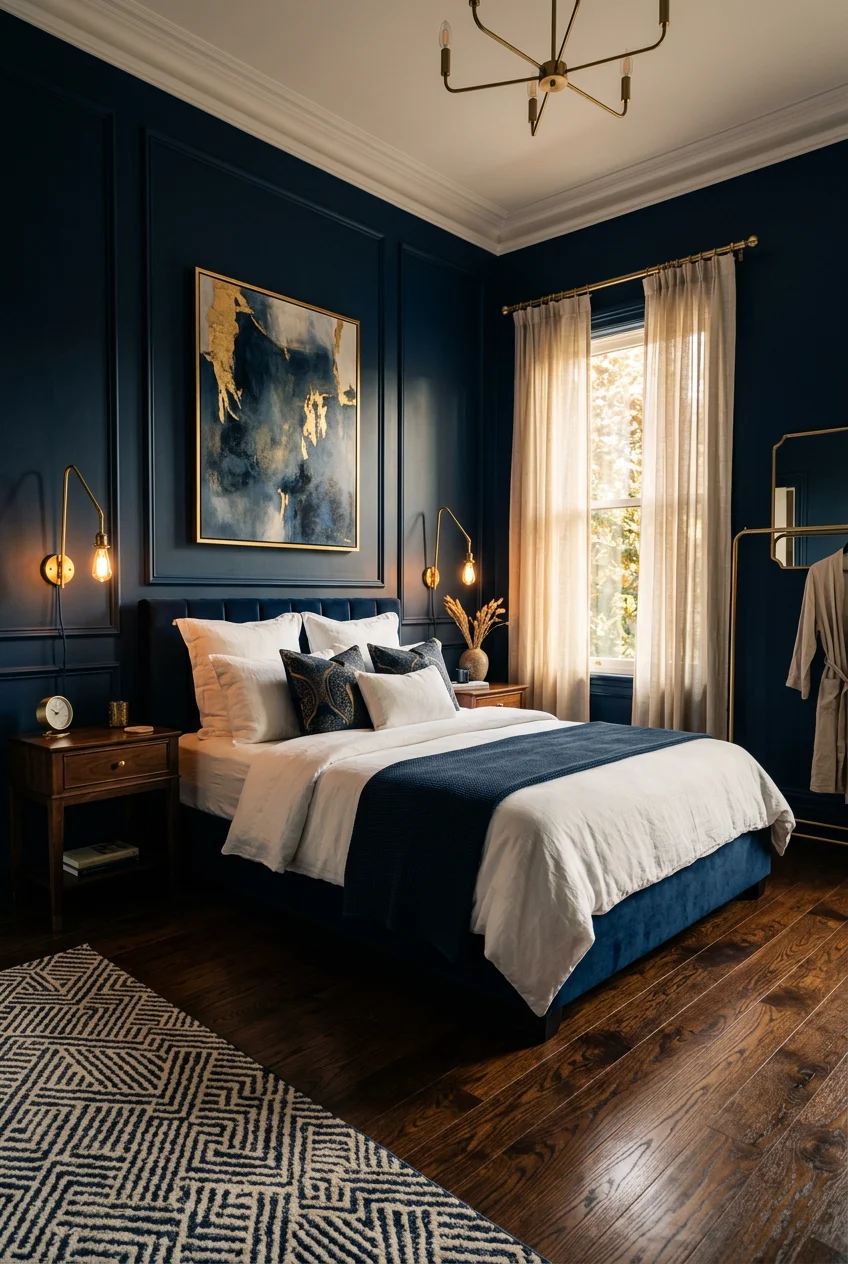
Two years ago, I painted my 12×14 guest room navy blue without priming. It looked like a damp, bruised plum. That disaster forced me to study how light interacts with cool tones before I tried a dark blue bedroom again. If you’re putting dark paint on your walls, you’ve got to be methodical about lighting, undertones, and fabric weights. A dark blue bedroom shouldn’t feel like a cave. Let’s break down how to build a space that feels deliberate. Trust me on this.
1. Select the Perfect Deep Blue Paint with the Right Sheen

The foundation of this look is getting the undertone right. I tried three cheap navy paints before realizing they all turned purple under LED bulbs. I finally bought a gallon of Benjamin Moore Hale Navy (HC-154) for $74.99. It’s got a gray undertone that stays true blue even at night. Sheen matters too. I used a flat finish to absorb light and create a velvet effect. Eggshell reflects too much glare from bedside lamps and highlights drywall bumps. Last Tuesday at Home Depot, I watched a couple buy high-gloss navy for a bedroom. It’s going to look like a wet plastic bag. Stick to flat or matte. You’ll need two coats minimum, and a tinted primer saves you a third. I spent four hours taping the baseboards with $8.98 FrogTape; it’s worth it because dark paint bleeds terribly on white trim. The $22.98 Zinsser Bulls Eye 1-2-3 dark tinted primer works perfectly.
2. Layering Textures with Heavyweight Linen

Dark blue walls swallow light. If you use flat cotton sheets, the room feels one-dimensional. You need heavy, visible textures on the bed. I bought the Target Casaluna Heavyweight Linen Blend Comforter Set for $99 in ‘Natural’. The wrinkled texture of the linen contrasts against the smooth, dark walls. I’ve washed it every two weeks for eight months with 1/2 cup of mild detergent, and it just gets softer. One early mistake was buying a matching navy microfiber duvet. It turned the bed into a black hole. You need bedding to break up the visual weight. The cream linen reflects light back toward the ceiling. I also add a $34.99 chunky knit throw from Walmart’s Better Homes and Gardens line at the foot of the bed. It anchors the mattress. When you’re dealing with dark walls, the bed needs to look like a cloud.
3. Warm Brass Lighting to Cut the Cool Tones

Blue is inherently cold. If you use silver or brushed nickel in a dark blue room, it feels like a hospital waiting room. Warm brass is non-negotiable. I use two West Elm Staggered Glass Sconces in Antique Brass, which cost $129 each. They sit exactly 24 inches above the mattress. The brass provides a sharp contrast to the matte walls, and the warm 2700K LED bulbs mimic candlelight. Don’t use daylight bulbs (5000K). I did this in my old apartment and it made the space feel like a sterile aquarium. The warm yellow light bouncing off the brass softens the navy paint and creates actual shadows. You can find cheaper alternatives, like the $45.99 Globe Electric brass sconces on Amazon, but make sure the finish leans brown, not bright yellow gold. Bright fake gold looks incredibly cheap against navy.

Govee RGBIC LED Strip Lights
If you want something that just works, Govee RGBIC LED Strip Lights is a safe bet (243 reviews, 4.5 stars).
4. Incorporating Natural Wood Furniture

You can’t put white MDF furniture against dark blue walls unless you want a nautical children’s room vibe. Natural wood brings necessary organic warmth. Last month, I picked up a solid acacia wood six-drawer dresser from Costco for $499. The medium walnut stain bridges the gap between the dark walls and the light bedding. The wood grain provides a natural pattern that breaks up the solid blocks of color. I tried a black painted dresser here last year, but it got lost against the deep walls. The contrast was too low, making the room look like a showroom instead of a bedroom. Wood tones act as a neutralizer. If your budget is tight, sand down an old Facebook Marketplace dresser and apply a $9.48 half-pint of Minwax Wood Finish in Special Walnut. Just let it cure for 72 hours outside, or your bedroom will smell like a chemical plant for weeks. Learned that the hard way.
5. The Dark Blue Bedroom Aesthetic Needs Strategic Rug Placement

A dark blue bedroom needs a rug that covers at least two-thirds of the floor space under the bed. Dark walls make a room feel smaller, and a tiny rug floating at the foot of the bed shrinks the floor plan further. I use an 8×10 foot Loloi II Layla Collection rug in Olive/Charcoal, which I bought for $185 from Rugs USA. The distressed pattern includes tiny flecks of rust and beige that pull the room together. The key is placing the rug exactly 24 inches down from the nightstands. I laid it crooked the first time and tripped over the corner for a week. A rug pad is mandatory. The $39.99 Mohawk Home 1/4-inch dual surface pad keeps the rug from sliding and adds cushioning. Skip the fluffy shag. They trap dust and look matted after three months. A low-pile rug is much easier to vacuum.
6. Adding Greenery for Contrast

Dark rooms need life, or they start feeling stagnant. Plants provide a pop of bright green that cuts through the heavy blue tones. I bought a 6-inch potted Monstera Deliciosa at Trader Joe’s last Tuesday for $14.99. I dropped it into a $22 white ceramic planter from Target and placed it on a small wooden stand. The glossy leaves catch the light from the window. Just be realistic about your natural light. If your room only has one north-facing window, a Monstera won’t survive. I killed a $40 Fiddle Leaf Fig by sticking it in a dark corner. Now, I use a $19.99 Fejka artificial potted plant from IKEA for the darkest corner. Nobody inspects bedroom plants closely enough to notice it’s plastic, and it serves the same visual purpose without dropping dead leaves. You might also like: 20 Creative Cozy Small Bedroom for Any Style

Govee RGBIC LED Strip Lights
A dependable everyday pick — Govee RGBIC LED Strip Lights pulls in 243 ratings at 4.5 stars. Not flashy, just solid.
7. Velvet Blackout Curtains for Depth

Thin cotton curtains look cheap against saturated wall colors. You need fabric with physical weight. I use the Signature Velvet Blackout Curtains from Half Price Drapes in ‘Amber’. They cost $64 per 50×96 inch panel. The heavy velvet absorbs sound, and the amber color provides a complementary contrast to the blue. I hang them half an inch below the ceiling line to make the walls look taller. I used to hang curtains right above the window frame, and it stunted the room’s height. You also need a heavy-duty rod. I use a $32.98 1-inch diameter matte black rod from Walmart. The cheap 5/8-inch rods will bow under the weight of real velvet. Make sure to steam the curtains after hanging them. Wrinkled velvet just looks messy. You might also like: 20 Inspiring Bedroom Wall Lights That Are Totally Worth It
8. Creating a Focal Point with Oversized Art

A solid dark wall is an imposing block of color. You have to break it up, but a gallery wall of 5×7 frames looks cluttered against a dark background. You need one oversized piece. I ordered a 30×40 inch canvas print from Minted called ‘Mist on the Mountains’ for $248. It features muted grays and whites that pop against the Hale Navy paint. I centered it exactly 8 inches above the headboard using a laser level. When I first hung it, I put it 15 inches high, and it looked like it was floating away. Always anchor your art to the furniture below it. I chose a thin, natural maple frame to tie in with the wood dresser. Avoid heavy, dark frames on dark walls. They blend in and defeat the purpose. You want the art to act as a window. You might also like: 15 Inspiring Master Bedroom Wall Decor to Transform Your Space
9. Low-Profile Bed Frames to Balance Dark Walls

When walls are visually heavy, furniture needs to be visually light. A massive, tall headboard makes a dark room feel claustrophobic. I switched to the Thuma The Bed frame in Walnut, which costs $1,095 for a queen. It has a low 35-inch clearance and clean, horizontal lines. The Japanese joinery means there are no screws to squeak. I had a tall, tufted grey headboard before this. It absorbed so much light that the corner of the room looked like a cave. The low-profile frame leaves more negative space on the wall, which gives the eye a place to rest. If you’re on a budget, the Zinus Suzanne 37-inch metal and wood platform bed is a solid alternative for $189 on Amazon. Just make sure the mattress sits low enough to expose the wall behind it. A 10-inch mattress works perfectly.

Leeleberd Led Lights for Bedroom 100 ft (2 Rolls of 50ft)
Leeleberd Led Lights for Bedroom 100 ft (2 Rolls of 50ft) Music Sync C has been one of the most consistently praised picks in this category. 199 reviewers averaged 4.5/5.
10. Scentscaping the Dark Blue Bedroom Aesthetic

The dark blue bedroom isn’t just visual. It’s sensory. A room that looks moody shouldn’t smell like cheap vanilla frosting. I prefer earthy scents. I buy the 0.5 oz Aura Cacia Cedarwood Essential Oil for $12.99 at Whole Foods. I put five drops into a $29.99 ceramic diffuser on my nightstand before bed. The woody scent matches the visual weight of the room. I used to burn $5 generic lavender candles, but they left soot marks on the dark paint. If you prefer candles, stick to soy wax with cotton wicks, like the P.F. Candle Co. Teakwood & Tobacco 7.2 oz jar for $24. The amber glass jar looks great against the blue walls. Scent anchors the aesthetic and signals to your brain that it’s time to sleep. Don’t skip this step.
11. Swapping to Matte Black Hardware

Builder-grade chrome doorknobs and hinges ruin the illusion of a custom bedroom. They reflect too much light and look cheap against dark paint. I replaced all the hardware with matte black. I used the Kwikset Halifax Square Door Lever, which costs $34.97 at Home Depot. I also swapped the closet door hinges for $4.98 matte black ones. It took 45 minutes with a power drill. I tried spray-painting the old chrome hinges black last year. The paint chipped off within a week, leaving silver scratches everywhere. Don’t waste your time painting high-friction hardware. Just buy the solid metal replacements. Matte black absorbs light and blends into the shadows, keeping the focus on the brass lighting and wood furniture. It’s a small detail that makes the room look expensive.
12. Utilizing Mirrors to Bounce Light

You have to manipulate natural light carefully in a dark room. A large mirror placed opposite the window doubles the amount of sunlight bouncing around. I use the 31×74 inch IKEA HOVET aluminum mirror, priced at $129. I lean it against the wall across from my south-facing window. The thin silver frame is minimal enough that it doesn’t clash with the brass sconces. I made the mistake of putting a mirror directly next to the window once. It reflected the dark wall and made the room feel darker. Placement dictates function. I secure the top of the mirror to the wall with a $6.48 heavy-duty drywall anchor kit from Lowe’s. Leaning a 40-pound sheet of glass against a wall without anchoring it is a disaster waiting to happen.

Govee RGBIC LED Strip Lights, Smart LED Lights for Bedroom
Govee RGBIC LED Strip Lights has been one of the most consistently praised picks in this category. 243 reviewers averaged 4.5/5.
13. Layering Ambient and Task Lighting

A single overhead light is the enemy of any bedroom, but it’s brutal in a dark blue room. It casts harsh shadows and flattens the paint color. You need multiple light sources at different heights. Besides the brass wall sconces, I keep a small task lamp on the dresser. I bought a $15 Room Essentials metal desk lamp from Target and fitted it with a 4-watt LED Edison bulb. It provides just enough light to see inside the drawers without illuminating the whole room. I also installed a $24.99 Govee LED light strip behind the headboard. I set it to a warm amber color at 10% brightness. It creates a soft halo effect against the navy wall. I tried using the cool white setting once, and it completely washed out the blue paint. Stick to warm ambient lighting to maintain the cozy atmosphere.
14. Integrating Woven Baskets for Soft Storage

Hard surfaces like dressers need to be balanced with soft, woven materials. I use large seagrass baskets to store extra blankets. I found a 16-inch woven water hyacinth basket at my local Kroger for $24.99. The natural tan color pops against the dark blue walls, and the braided texture adds necessary roughness. I used to keep a plastic laundry hamper in the corner. It looked terrible and ruined the moody aesthetic. Woven baskets hide the mess while contributing to the design. I line the inside of the basket with a $9 plain canvas laundry bag from Amazon so the seagrass doesn’t snag my clothes. It’s a cheap fix that makes the basket functional. You can also use smaller 8-inch baskets on the dresser to corral loose cables.
15. Keeping Ceilings Crisp White or Tonal

The ceiling is the final variable. You have two choices: paint it crisp white to reflect light, or paint it a lighter shade of blue for a cocoon effect. I chose white. I used a gallon of Sherwin-Williams ProMar 400 Flat Ceiling Paint in High Reflective White, which cost $45. The contrast between the navy walls and the white ceiling draws the eye upward, making the 8-foot ceiling feel higher. I tried painting the ceiling the same Hale Navy as the walls in a previous house. It felt like sleeping inside a shoebox. Unless you have 10-foot ceilings and massive windows, color-drenching the ceiling is a huge risk. If the sharp contrast of white bothers you, ask the paint counter to mix the ceiling paint with 10% of your wall color. It softens the transition. Use a roller with a 3/8-inch nap to avoid leaving heavy texture marks.
Building a room around dark walls requires intention. You can’t just slap up the paint and use your old furniture. You have to balance light absorption with warm metals, natural woods, and heavy textures. I’ve spent years tweaking these details, and getting the lighting right is always the hardest part. No exaggeration. Pin this guide for your next hardware store run, and focus on the undertones before you commit to a gallon of paint.

HYMOKEGE Queen Comforter Set Seersucker 7 Pieces
HYMOKEGE Queen Comforter Set Seersucker 7 Pieces has been one of the most consistently praised picks in this category. 92 reviewers averaged 4.5/5.
Frequently Asked Questions
What is the best paint finish for a dark blue bedroom?
Always use a flat or matte finish for dark blue walls. Glossy finishes reflect too much light, highlighting drywall flaws and creating a cheap, plastic-like glare. Flat paint absorbs light, giving the dark blue a soft, velvet-like texture.
How do you keep a dark blue bedroom from looking too small?
Balance the dark walls by painting the ceiling crisp white, placing a large mirror opposite your window to bounce natural light, and keeping large furniture like the bed frame low to the ground to maximize visible wall space.
What colors go best with a dark blue bedroom aesthetic?
Warm tones are essential. Pair dark blue with natural walnut or acacia wood, warm brass lighting, cream or oatmeal textured linens, and amber accents. Avoid cool silvers and stark blacks, which make the room feel cold and sterile.
Do I need special lighting for a dark blue bedroom?
Yes. Dark walls absorb light, so a single overhead fixture isn’t enough. Layer warm 2700K LED bulbs in brass wall sconces, add task lamps on dressers, and use ambient LED strips behind the headboard to create soft shadows.
