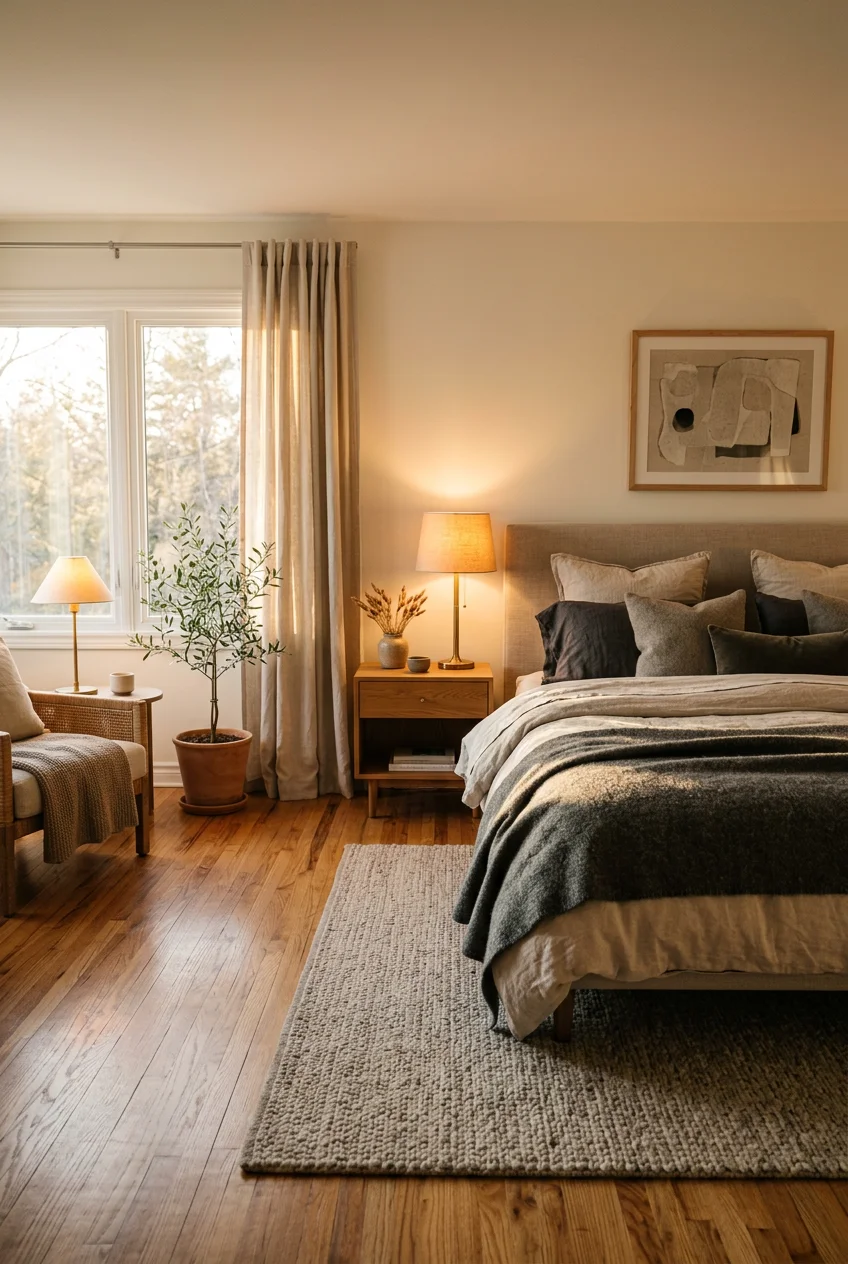
What’s Inside
- Layer Your Cozy Lighting Bedroom Setup Like A Pro
- Stick Strictly To 2700K-3000K Warm White Bulbs
- Install Dimmer Switches On Every Single Wall Plate
- Measure Bedside Task Lighting Exactly At Eye Level
- Use Battery-Operated Sconces When You Can’t Hardwire
- Add A Heavy Himalayan Salt Lamp For Amber Ambience
- Conceal Your LED Strips Behind The Headboard
- Never Mix Color Temperatures In The Same Space
- Keep A Philips Hue Go On Your Nightstand
- Swap Harsh Glass For Fabric Drum Shades
- Drape Warm White Fairy Lights Over Your Mirror
- Bounce Light Around With Floor Mirrors
- Cap Your Evening Bulbs At 25 Watts Maximum
- Mount Sculptural Fixtures To Act As Wall Art
- Hide A Small Lamp Inside Your Closet
- Use Smart Plugs For Automated Evening Wind-Downs
- Place Floor Lamps In Empty Dark Corners
- Choose Matte Black Fixtures To Ground The Space
- Finalize Your Cozy Lighting Bedroom Routine
I spent three years wondering why my bedroom felt like a sterile dentist office before realizing my overhead fixture was blasting 5000K daylight bulbs. Getting a cozy bedroom lighting setup right isn’t about buying expensive fixtures. It’s about math, placement, and knowing which bulbs won’t ruin your sleep. Last Tuesday at Costco, I saw a woman loading up on “cool white” LEDs for her nightstands. I had to bite my tongue. Let’s fix these basic mistakes.
1. Layer Your Cozy Lighting Bedroom Setup Like A Pro

Layering isn’t just a design buzzword. It’s how you make a room actually work. You can’t rely on one overhead light. You need ambient light for brightness, task lighting for reading, and accent lighting for mood. I did this wrong for months. I used one harsh ceiling fan light, and my room felt flat and depressing. Now, I use a three-point system. My main source is a frosted flush mount, my task lights are bedside lamps, and my accent light is a small floor can. I bought the GE Relax LED 60W replacement bulbs ($8.99 for a 4-pack) at Walmart to keep the base layer soft. When you split your light sources across different heights, you break up the shadows. You aren’t just lighting the floor. You’re hitting the walls and ceiling too. It creates a dimensional space instead of a flat box. It makes a huge difference.
2. Stick Strictly To 2700K-3000K Warm White Bulbs

The color temperature dictates everything. You want “warm white” LEDs between 2700K and 3000K. This range emits a soft, yellowish glow that mimics traditional incandescent bulbs. Anything over 4000K looks blue, harsh, and sterile. Interior expert WG Hickman at Tri-County Air Service suggests sticking to 2700K to help you relax. I learned this the hard way when I grabbed the wrong box at Target. I installed 4000K bulbs and couldn’t figure out why my brain felt wired at 11 PM. The light looked like a hospital corridor. Now, I buy the Philips Warm Glow Dimmable LEDs ($12.49 for a 3-pack) at Home Depot. They stay in that perfect 2700K range. The warm light signals to your brain that the sun is setting. It’s a biological hack for better rest.
3. Install Dimmer Switches On Every Single Wall Plate

Installing dimmers is non-negotiable. It’s the most effective hardware change you can make. The average cost for installation ranges from $80 to $200, but you can do it yourself with a flathead screwdriver if you’re careful. Putting dimmers on your overhead lights and sconces lets you adjust brightness for whatever you’re doing. I use the Lutron Diva LED+ Dimmer switch ($29.97 at Lowe’s). I bought a cheaper off-brand switch first, and it made my LEDs buzz. That was a $15 mistake. The Lutron switch doesn’t buzz at all. You need bright light at 8 AM for laundry, but you only want a 10 percent glow at 9 PM. Dimmers give you that control without needing extra lamps. Trust me on this.

50×70 Inch Rust Throw Blanket – Soft & Fluffy Fleece
50×70 Inch Rust Throw Blanket – Soft & Fluffy Fleece has been one of the most consistently praised picks in this category. 14 reviewers averaged 4.5/5.
4. Measure Bedside Task Lighting Exactly At Eye Level

Bedside lamps are useless if they blind you while you read. For comfortable reading, position your lamps so the bottom of the shade sits exactly at eye level when you’re sitting up. This blocks the raw bulb from shining into your eyes while creating a focused pool of light on your book. I used to have tiny 12-inch lamps on low nightstands. I’d sit up to read and get a face full of glare. I replaced them with the Target Threshold Crosby Desk Lamp ($35.00 each). The adjustable arm means I can pull the shade down to 22 inches above the mattress, which is my eye level when propped on pillows. Measure your sitting height before buying. It’s a simple ergonomic rule most people ignore.
5. Use Battery-Operated Sconces When You Can’t Hardwire

Hardwiring sconces is expensive and messy. If you rent, it’s usually impossible. Battery-operated wall sconces solve this. Brands like Ouyulong offer sets of two rechargeable sconces with 3000K light and dimmable features. They usually cost between $71 and $119. I recently tested the KARTOOSH Battery-Operated Wall Sconces ($89.99 on Amazon) in my guest room. They attach to the wall using heavy-duty Command strips. You don’t drill a single hole. The tradeoff is that you have to charge the puck lights via the included 3-foot USB-C cable every two weeks. It’s a minor annoyance, but the result is worth it. You get hotel-style lighting without calling an electrician. I pop the bulbs out on Sunday mornings, charge them on my kitchen counter, and put them back before dinner.
6. Add A Heavy Himalayan Salt Lamp For Amber Ambience

I bought my first Himalayan salt lamp at Sprouts last year. I spilled water on it, and the salt started weeping onto my wood nightstand. Don’t do that. Keep them dry. Despite that disaster, I replaced it because the heavy amber glow is unmatched for late-night vibes. You can find a Levoit Natural Himalayan Salt Lamp in the 11 to 15-pound range for around $51. Look for one with a built-in touch dimmer and a sealed wooden base. While the scientific claims about negative ions are debatable, the visual warmth is a proven mood booster. The thick pink salt acts as a dense diffuser for the small bulb inside. I turn mine on an hour before bed. It casts a heavy, orange-tinted shadow that makes the whole room feel grounded. You might also like: 17 Country Teen Bedroom That Actually Work

Bedsure GentleSoft White Throw Blanket for Couch
A dependable everyday pick — Bedsure GentleSoft White Throw Blanket for Couch – Cozy Soft Fleece Su pulls in 24 ratings at 4.5 stars. Not flashy, just solid.
7. Conceal Your LED Strips Behind The Headboard

Exposed LED strip lights look like a college dorm. You have to conceal them for a sophisticated look. I run Govee 16.4ft LED Strip Lights ($14.99 at Best Buy) behind the back lip of my headboard using the adhesive tape. You want the light to bounce off the wall, creating a soft, indirect halo. You should never see the individual plastic diodes. I tried sticking them under my bed frame first, but my floors are glossy hardwood. The floor reflected every single dot of light like an airport runway. I peeled them off and moved them behind the headboard instead. The matte drywall diffuses the light perfectly. This adds massive depth. Just make sure you select the warm white setting on the app, not the neon blue or red. You might also like: 15 Charming Men’s Bedroom Wall Decor Ideas You Need to See
8. Never Mix Color Temperatures In The Same Space

Mixing color temperatures is the fastest way to make a room feel chaotic. Expert Meredith Owen notes that lighting temperatures are often overlooked, but you really want them to be consistent. If your ceiling fixture is 3000K and your bedside lamp is 4000K, your brain registers the clash. It creates subtle visual discomfort. I walked into a friend’s house last month, and her bedroom felt off. I realized she had a cool white bulb in her floor lamp and a warm white one in her fan. I stick to Cree Lighting 2700K A19 bulbs ($9.98 for a 2-pack at Home Depot) across every fixture. Cohesion is mandatory. Check the Kelvin rating on the box before you buy anything, and remember that a thick lampshade can slightly alter the output. You might also like: 16 Teen Boy Bedroom Ideas You Need to See
9. Keep A Philips Hue Go On Your Nightstand

Sometimes you need a light source in a spot with no outlet. Smart portable lamps are great for this. The Philips Hue Go is a bowl-shaped light that offers 16 million colors and runs on a battery. You control it via Bluetooth on your phone, or by pressing the button on the casing. Prices range from $53.99 to $180.99 depending on the generation and retailer. I bought mine for $89.99 at Best Buy in October. I keep it on my vanity, but I’ll carry it to the reading chair when I need extra light. The battery life on full brightness is only about two hours, which is a downside. However, if you dim it to 20 percent on a warm setting, it lasts all evening. It’s a versatile tool for dark corners.

Ultra Soft Cozy Faux Fur Throw Blanket
A dependable everyday pick — Ultra Soft Cozy Faux Fur Throw Blanket pulls in 11 ratings at 4.5 stars. Not flashy, just solid.
10. Swap Harsh Glass For Fabric Drum Shades

The material of your lampshade changes the physical texture of the light. Clear glass or exposed bulbs create harsh shadows and glare. You need fabric drum or linen shades to provide soft, diffused light. Light neutrals like white, ivory, or sand work best. They filter the raw bulb and push a gentle, warm tone outward. I bought a cheap plastic shade at Walmart a few years ago. It trapped heat and made the light look green. I threw it away and bought the Target Threshold 13-inch Linen Drum Shade ($15.00) instead. It has a sturdy metal harp inside that keeps its shape. The woven linen texture catches the light beautifully. The fabric acts as a barrier, softening the output before it hits your walls. This aligns with the shift toward softer, more organic bedroom textures.
11. Drape Warm White Fairy Lights Over Your Mirror

Fairy lights aren’t just for teenagers. They’re a budget-friendly way to add tiny points of light to a dark space. You just have to use them deliberately. I drape a strand of Twinkle Star 33ft 100 LED String Lights ($11.99 on Amazon) tightly around the frame of my floor mirror. You must buy the warm white version on a bendable copper wire. The green plastic wires look cheap. I tried hanging them across the ceiling once, and it looked messy. Keeping them constrained to a single architectural feature, like a mirror frame or headboard, makes them look intentional. They draw only 3 watts. I plug them into a smart timer so they turn on at dusk, providing a faint, welcoming glow when I walk in.
12. Bounce Light Around With Floor Mirrors

If your bedroom lacks natural light, you have to manufacture brightness. Strategically placed mirrors amplify sunlight and your artificial lamps. You want to position a large mirror opposite a window, or behind a table lamp. The glass bounces the light back into the center of the room. I use the IKEA HOVET mirror ($149.99). It’s massive, 30 by 77 inches, with a sleek aluminum frame. I leaned it against the wall next to my floor lamp. When I turn the lamp on, the mirror doubles the light output without needing a second bulb. I tried a cheap over-the-door mirror from Kroger first, but the glass was warped. The heavy IKEA glass is flat and reflects light cleanly. It makes my cramped 10×12 bedroom feel wider.

Bedsure GentleSoft Sage Green Throw Blanket for Couch
Bedsure GentleSoft Sage Green Throw Blanket for Couch – Checkered Cute has been one of the most consistently praised picks in this category. 98 reviewers averaged 4.5/5.
13. Cap Your Evening Bulbs At 25 Watts Maximum

Brightness is measured in lumens, but we usually shop by wattage equivalents. Interior designer Thea Bloch-Neal recommends capping evening bulbs at 25 watts. She points out that anything over that can lead to an uncomfortable squint. I agree. I used to keep 60-watt equivalent bulbs in my bedside lamps. Reading felt like staring into a car headlight. I swapped them out for Sylvania 25W equivalent LED bulbs ($5.99 for a 2-pack at Kroger). The difference is immediate. A 25-watt equivalent bulb puts out about 250 lumens. It’s just enough light to see the pages of a book, but dim enough that your eyes can relax. Save the 60-watt bulbs for your overhead fixture when you’re vacuuming.
14. Mount Sculptural Fixtures To Act As Wall Art

Your lighting fixtures should look good even when they’re off. Adjustable and sculptural fixtures act as practical art. I look for sconces with matte brass finishes and unusual shapes. The West Elm Miti Sconce ($129.00) is a great example. It has a sharp, angular arm that contrasts with a soft, round globe, and a heavy brass mounting plate. I installed one above my reading chair last month. Before that, I had a generic, builder-grade dome light that added zero personality. A sculptural fixture draws the eye upward and adds architectural interest. You aren’t just buying a light source; you’re buying a piece of hardware that dictates the style of the room. Don’t settle for boring white plastic when brass and steel options exist.
15. Hide A Small Lamp Inside Your Closet

A dark closet ruins the vibe of a calm bedroom. If you’re fumbling in the dark for clothes at 6 AM, you’re starting your day stressed. I fix this by hiding small, battery-operated lights inside the closet frame. I buy the GE Wireless Tap Lights ($10.50 for a 2-pack at Costco). They run on AA batteries and stick to the wall with adhesive pads. I placed two of them just inside the door frame, pointing inward at the clothes. I don’t use the motion-sensor versions because my cat kept triggering them at night. The manual tap lights are better. You just press the lens to click them on. It provides a clean, 3000K wash of light over my hangers without forcing me to turn on the main bedroom lights.

COOVA Faux Fur Throw Blanket for Couch
Honestly, COOVA Faux Fur Throw Blanket for Couch surprised me — sturdier than it looks in the photos, and over 12 buyers gave it 4.5 stars.
16. Use Smart Plugs For Automated Evening Wind-Downs

I automate my lamps so I don’t have to walk around flipping switches when I’m tired. Smart plugs are the easiest way to do this. I use the Kasa Smart Plug Mini ($19.99 for a 4-pack at Target). You plug the lamp into the smart plug, and that into the wall. Then, you set a schedule on the Kasa app. I have my bedside lamps set to turn on at 10 percent brightness at 8:00 PM, and turn off completely at 11:00 PM. I struggled with the Wi-Fi setup initially because my router broadcasts a 5GHz signal, and these plugs require a 2.4GHz network. Once I split my Wi-Fi bands, it worked perfectly. Walking into a room that has already lit itself with a warm, dim glow feels luxurious.
17. Place Floor Lamps In Empty Dark Corners

Empty, dark corners make a bedroom feel smaller because shadows swallow the space. You need to push light into those dead zones. A slim floor lamp is the best tool for this. I bought the Brightech Maxwell Floor Lamp ($49.99 on Amazon) for the corner next to my dresser. It has open wooden shelves, a tall, rectangular fabric shade, and a convenient foot pedal switch. I put a 40-watt equivalent bulb in it. Before I added the lamp, that corner looked like a black hole at night. Now, the soft vertical column of light highlights the wood grain of the dresser and makes the ceiling feel taller. Don’t leave your corners dark. Even a tiny wash of light in the perimeter expands the perceived square footage.
18. Choose Matte Black Fixtures To Ground The Space

Warm light needs a visual anchor, or the room feels floaty. Matte black metal fixtures provide the necessary contrast. The sharp, dark metal grounds the soft, yellow light. I swapped out my shiny chrome bedside lamps for the Globe Electric Holden Sconces in matte black ($24.99 each at Home Depot). The chrome reflected too much glare and looked cheap. The matte black absorbs the light and looks heavy and intentional. If you have light-colored walls and soft linen shades, a black metal lamp base acts like punctuation in a sentence. It stops the eye. I tried painting my old lamps with black spray paint from Walmart, but it chipped off within a week. Just buy the actual black fixtures. The factory finish holds up to daily touching and dusting.
19. Finalize Your Cozy Lighting Bedroom Routine

Every cozy bedroom routine needs a focal point for the transition to sleep. I use a sunrise alarm clock to manage my wind-down. The Hatch Restore 2 ($199.99 at Target) sits on my nightstand. It’s expensive, but the light gradients and the braided cord are flawless. At 9:30 PM, it starts a 30-minute sunset routine. The light shifts from a bright peach to a deep, dark red before turning off. Red light doesn’t inhibit melatonin production like blue light does. I tried using my phone on “night shift” mode for years, but it still kept me awake. The fabric dome of the Hatch diffuses the red light across my wall. It forces my eyes to get heavy. By the time the light fades to black, I’m asleep. It’s the ultimate functional lighting tool.
I’ve spent too much time testing bulbs and returning ugly lamps, but getting your lighting right changes how you sleep. Skip the harsh daylight bulbs. Stick to warm, layered sources on dimmers, and your room will feel better. I’d love to hear what fixtures you choose. Pin this guide for your next Target run so you don’t buy the wrong Kelvin rating again!
Frequently Asked Questions
What is the best color temperature for a cozy lighting bedroom?
You should use warm white LED bulbs with a color temperature between 2700K and 3000K. This range emits a soft, yellowish glow that mimics traditional incandescent lighting, helping your brain relax before sleep.
How many light sources should a bedroom have?
You need at least three light sources to create depth. Use an overhead fixture for ambient light, bedside lamps for task lighting, and small floor lamps or sconces for accent lighting to eliminate harsh shadows.
How high should bedside lamps be positioned?
Position your bedside lamps so the bottom of the lampshade sits exactly at your eye level when you’re sitting up in bed. This prevents the raw bulb from glaring directly into your eyes while you read.
Can I mix different color temperature bulbs in my bedroom?
No, mixing color temperatures causes visual discomfort. Ensure every bulb in your room, from the ceiling fan to the bedside lamp, stays within the exact same 2700K to 3000K range for a cohesive look.
