What’s Inside
- Embrace the “New Neutral” Wall Colors
- Strategic Use of Dark Wall Colors for a “Cocooning” Effect
- Layer with Light-Reflecting Bedding
- Incorporate Bold Jewel Tones
- Master Layered Lighting with Dimmers
- Introduce Reflective Surfaces with Mirrors and Metallics
- Anchor the Room with a Light-Colored Area Rug
- Mix Textures Extensively
- Incorporate Greenery with Live Plants
- Avoid “Matchy-Matchy” Furniture Sets
- Utilize the 60-30-10 Rule
- Consider Light Wood Flooring
- Don’t Forget the Ceiling
- Mix Dark and Light Wood Finishes
- Integrate Art with Warm Frames
Most people push their heavy wood dressers against stark white walls, throw on a gray comforter, and wonder why the room feels like a cheap 1990s motel. Decorating around dark brown bedroom furniture isn’t about ignoring the visual weight of the wood. It’s about leaning into it. Heavy furniture absorbs light and demands attention. This means your paint, textiles, and lighting need to work twice as hard to keep the space from feeling like a cave. If you only try one idea from this list, make it #10. Breaking up those matching catalog sets is the only way to make a room look styled, not just purchased. Trust me on this.
Skip this if your landlord strictly forbids painting walls or changing light fixtures, and you’re working with a tiny, windowless room. Dark wood needs layered light and intentional wall colors to shine. If you’re stuck with landlord-special beige and can’t add rugs or lamps, these strategies won’t save the space.
1. Embrace the “New Neutral” Wall Colors

Stark white walls against dark brown furniture create a harsh, high-contrast look that feels sterile. Instead, the design world is moving toward warm, sophisticated neutrals. Brown-based neutrals like soft cinnamon, pale caramel, or creamy off-whites are the new classics. They offer depth and bridge the gap between heavy wood and lighter textiles. If you want a lighter, airy feel without the starkness, look at Benjamin Moore White Dove OC-17 (typically $50 to $70 per gallon). It has a slight gray undertone that balances the yellow or red reflections that often bounce off dark wood finishes. Another excellent option is Sherwin Williams Alabaster SW 7008. It provides a warm white base with subtle beige undertones that make dark furniture feel grounded rather than floating.
Best for: north-facing rooms that need artificial warmth.
The catch: White Dove can look slightly dingy in rooms that don’t get warm afternoon sun. You’ll have to rely heavily on warm artificial lighting.
2. Strategic Use of Dark Wall Colors for a “Cocooning” Effect

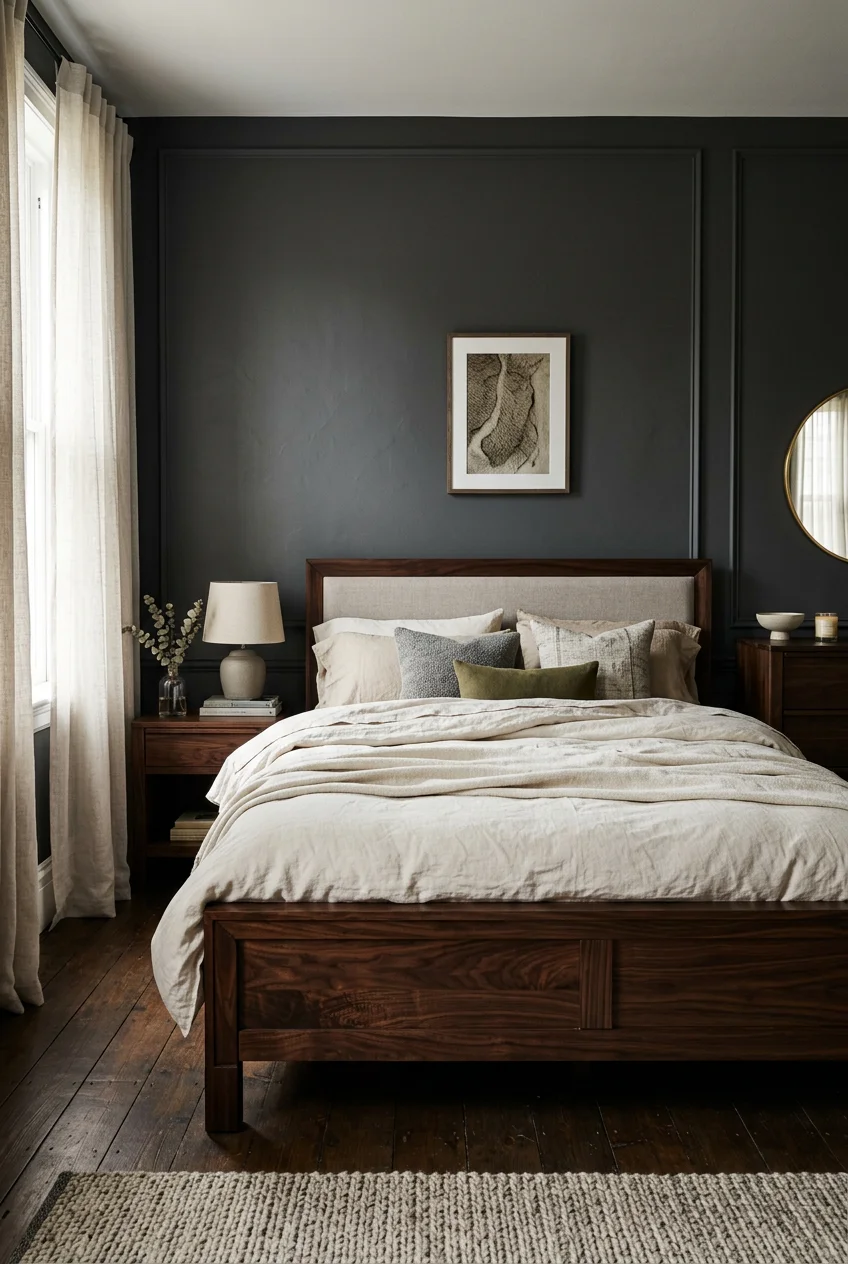
People panic when they hear the suggestion to paint walls dark in a room that already has dark furniture. The common mistake is assuming dark walls shrink a room. In reality, dark walls blur the edges of the space, creating a sophisticated, cocooning effect. For a dramatic and cohesive look, paint an accent wall or the whole room if you’re brave with Sherwin Williams Black Fox SW 7020 (around $50 to $70 per gallon). This deep, saturated brown-black absorbs shadows. When you place a dark brown headboard against it, the furniture blends in. It appears less imposing and more integrated into a moody, sophisticated space. It tricks the eye into ignoring the bulk of the furniture.
The catch: You’ll need at least three distinct, bright light sources—overhead, task, and ambient—or the room will feel like the inside of a closet once the sun goes down.
3. Layer with Light-Reflecting Bedding

To counteract the immense visual weight of a dark brown sleigh bed or platform frame, you need bedding that reflects light. Dark sheets on a dark bed just look like a black hole. Trending bedding colors include warm taupes, clay neutrals, and soft blues, but nothing beats the crisp contrast of pure white. A white duvet cover, like the Parachute Percale Duvet Cover Set (starting around $200 for a Queen), paired with ivory or light gray sheets, creates a refreshing break for the eyes. The crisp, cooling cotton against the heavy, rigid wood grain makes the bed feel incredibly inviting. The contrast highlights the wood’s richness rather than competing with it.
The catch: Pure white percale shows every single pet hair, sweat stain, and wrinkle. It’s a chore. I learned that the hard way.

QEEIG Floating Shelves for Wall Bathroom Shelf Bedroom
If you want something that just works, QEEIG Floating Shelves for Wall Bathroom Shelf Bedroom Kitchen Living is a safe bet (46 reviews, 4.5 stars).
4. Incorporate Bold Jewel Tones

Dark brown wood acts as a fantastic anchor for deep, saturated jewel tones. Introduce accents in sapphire blue, emerald green, or ruby red. These colors share the same visual weight as the dark wood, so they won’t get washed out. Introduce these tones through throw pillows, a velvet bench at the foot of the bed, or a statement armchair in the corner. For example, a pair of 20×20 inch velvet throw pillows in emerald green from West Elm (budget roughly $30 to $50 each) adds a vibrant punch of color. The lush texture of the velvet plays beautifully against the smooth, hard surface of a dark mahogany or walnut headboard.
Best for: adding personality to boring builder-grade rooms.
The catch: Jewel tones can quickly look tacky and overwhelming if you use more than two competing colors in the same room. Stick to one dominant jewel accent color.
5. Master Layered Lighting with Dimmers

Adequate and layered lighting is the only thing standing between your dark brown bedroom furniture and a gloomy, depressing atmosphere. Relying on a single flush-mount ceiling fixture is a massive mistake. You need to install a central overhead fixture, such as a modern brass chandelier (Pottery Barn’s Hayes Chandelier runs $300 to $500), and complement it with bedside task lamps. Ensure your bulbs are 2700K warm white with a high CRI of 90+ so the wood tones look rich, not muddy. Add dimmer switches (around $15 to $30 per switch) to control the ambiance. This lets you shift the room from bright daytime functionality to a calm, cocooned evening vibe.
The catch: Hardwiring a new chandelier requires an electrician if you aren’t comfortable shutting off breakers and handling wiring. That adds significantly to the total project budget. You might also like: 18 Bedroom Decor Inspiration Ideas That Will Transform Your Space
6. Introduce Reflective Surfaces with Mirrors and Metallics

Mirrors are functional, but their real job in a room with heavy dark furniture is bouncing light and making the space feel larger. Position a large mirror opposite your biggest window to maximize natural light. A 36×48 inch ornate gold-framed mirror (like Anthropologie’s Primrose Mirror for a splurge, or a similar arched style from Target for under $150) breaks up the heavy wood tones. Incorporate metallic accents like brushed gold or brass hardware on your dark dressers. Swapping out the cheap wooden knobs for heavy brass pulls adds instant sparkle and contemporary contrast to dated furniture. You might also like: 19 Grey Bedroom Decor for Every Budget
The catch: Heavy floor mirrors require proper, heavy-duty wall anchors. Don’t just lean a 60-pound mirror on a slippery hardwood floor without securing it, especially if you have pets or kids. You might also like: 15 Charming Men’s Bedroom Wall Decor Ideas You Need to See

upsimples 6 Pack Wooden Floating Shelves
A dependable everyday pick — upsimples 6 Pack Wooden Floating Shelves pulls in 47 ratings at 4.5 stars. Not flashy, just solid.
7. Anchor the Room with a Light-Colored Area Rug

A common mistake is placing dark brown furniture directly on dark wood floors or dark carpets. The pieces just bleed into the floor. The room feels bottom-heavy. Choose a large, light-colored area rug to anchor the furniture and visually separate it from the floor. An 8×10 foot ivory or light gray shag rug from Rugs USA (typically $200 to $400) visually lightens the entire bottom half of the space. For a surprising twist in smaller rooms, layer a thinner, patterned 5×7 foot Moroccan-inspired rug atop a neutral base rug to add depth without overwhelming the floor plan.
Best for: renters trying to hide ugly, dark apartment carpeting.
The catch: High-pile shag rugs are notoriously difficult to vacuum and tend to flatten permanently in high-traffic areas right where you step out of bed.
8. Mix Textures Extensively

Dark wood furniture feels incredibly solid, rigid, and heavy. If you pair it with flat, boring textiles, the room feels stiff. You have to offset the hard lines by layering diverse, tactile textures. Think about tossing a chunky knit throw (Target’s Threshold Chunky Knit Throw is usually around $30) across the foot of the bed. Add velvet cushions. Hang heavily textured linen curtains (Pottery Barn Belgian Flax Linen Curtains start at $80 per panel) instead of flat cotton panels. Bring in woven rattan baskets for laundry or extra blankets. This creates visual interest and a tactile environment that softens the harshness of the dark wood.
The catch: Real linen curtains wrinkle instantly upon touching them and rarely block enough morning sunlight for light sleepers unless you pay a premium for blackout lining.
9. Incorporate Greenery with Live Plants

Wood is a natural material, and the easiest way to complement it is by bringing more of nature indoors. Live plants introduce vibrant green tones that sit perfectly opposite the warm brown undertones of your furniture on the color wheel. A large potted plant, like a Fiddle Leaf Fig (ranging from $50 to $150), breaks up the rigid, boxy lines of dressers and nightstands. If floor space is tight, place several smaller snake plants on floating shelves. The organic shapes breathe actual life into a room that might otherwise feel heavy and static.
The catch: Fiddle Leaf Figs are incredibly dramatic, finicky plants. They’ll drop half their leaves if you expose them to a slight draft or move them two inches from their preferred sunlight spot.

Fixwal Floating Shelves for Wall
Fixwal Floating Shelves for Wall has been one of the most consistently praised picks in this category. 459 reviewers averaged 4.5/5.
10. Avoid “Matchy-Matchy” Furniture Sets

The absolute fastest way to make a bedroom look dated is buying a five-piece matching bedroom set where the bed, nightstands, dresser, and mirror are all the exact same dark brown wood. It creates a “sea of dark brown” effect that swallows the room. Instead, mix and match. Keep your dark brown bed frame, but pair it with nightstands in a different material or finish. A white lacquered nightstand or a light wood option (the IKEA HEMNES Nightstand in white is around $90) creates immediate visual interest. It makes the room look intentionally styled over time rather than bought straight from a catalog page.
Best for: anyone trying to modernize inherited antique furniture.
The catch: Mixing furniture styles requires a strict eye for scale. A delicate, spindly metal nightstand will look completely ridiculous next to a massive, chunky dark wood sleigh bed.
11. Utilize the 60-30-10 Rule

If you struggle with balancing colors, use the 60-30-10 rule. This strategy dictates that 60% of the room should be a dominant light color (your walls and main bedding), 30% should be a medium-tone secondary color (your curtains, rug, and an accent chair), and 10% should be your accent color. When working with dark brown bedroom furniture, treat the dark wood as your 10% accent. This ensures the heavy wood doesn’t overpower the space. For example, use light greige walls (60%), medium-toned sage green textiles (30%), and let your dark brown furniture act as the grounding 10%.
Best for: beginners who feel completely overwhelmed by color theory and need a mathematical formula.
The catch: Calculating strict visual percentages is frustrating in asymmetrical rooms or spaces with massive windows that eat up all your wall space.
12. Consider Light Wood Flooring

If you’re in the middle of a renovation or choosing new flooring, lighter wood flooring provides the absolute best stage for dark furniture. Light oak, maple, or even whitewashed luxury vinyl planks make the space feel brighter and more open. The light floors create a natural, organic contrast that highlights the rich grain of the dark brown pieces without making the room feel like a dungeon. It bounces light back up toward the ceiling, counteracting the light-absorbing qualities of the dark dressers sitting on top of it.
The catch: Refinishing hardwood floors or installing new flooring is the most expensive, dusty, and disruptive project on this entire list, often costing thousands of dollars.

WOPITUES Wood Floating Shelves Set of 6
A dependable everyday pick — WOPITUES Wood Floating Shelves Set of 6 pulls in 68 ratings at 4.5 stars. Not flashy, just solid.
13. Don’t Forget the Ceiling

Most people leave their ceiling painted flat builder-grade white and completely ignore it. A surprising trick to brighten a room dominated by dark brown furniture is to paint the ceiling a different, lighter color with a slight sheen. Consider a very pale haint blue or a soft off-white with a satin finish. The satin finish reflects significantly more light from your lamps and windows than flat paint does. It draws the eye upward, making the room feel taller, more expansive, and less weighed down by the heavy furniture on the floor.
The catch: Painting a ceiling is literal neck torture. A satin finish will highlight every single drywall imperfection, tape seam, or roller mark if you aren’t careful.
14. Mix Dark and Light Wood Finishes

Gone are the days when all the wood in a room had to match perfectly. Create a layered, lived-in, and modern look by mixing your dark brown furniture with lighter wood accents. Pair a dark walnut dresser with a blonde white-oak media console, or place a light-stained ash wooden bench at the foot of your dark mahogany bed. The trick is ensuring the undertones of the different woods complement each other. Mix cooler, ashy dark browns with cooler light woods, and warm, red-toned browns with warm, honey-toned light woods.
The catch: If you mix a warm, red-toned cherry wood with an ashy, cool-toned gray oak, the undertones will clash horribly and make the room feel chaotic.
15. Integrate Art with Warm Frames

Bare walls make heavy furniture look even heavier because there’s nothing else for the eye to focus on. Use artwork to draw attention upward and add visual interest. Choose pieces with vibrant colors that complement your jewel tones or neutral bedding. Sepia photography, charcoal sketches, or botanical prints in warm-toned frames tie the decor together. Look for frames in aged brass, burl wood, or natural light oak. These materials add personality and warmth without competing directly with the dark furniture.
The catch: Custom framing is shockingly expensive. It often costs more than the art itself unless you stick strictly to standard sizes from craft stores like Michaels.
How we chose these ideas: We prioritized styling methods that offer high visual impact without requiring a total room gut. The focus was on renter-friendly adjustments, balancing heavy wood tones through accessible lighting and textile changes, and providing solutions that work across various budgets.
Decorating around dark wood doesn’t have to feel like a chore. Embrace the depth it brings to a room, layer your lighting, and don’t be afraid to mix your finishes. It took me years to figure out that contrast is everything—no exaggeration. If you found these tips helpful, pin this article to your bedroom decor board so you have it handy the next time you’re staring blankly at a paint swatch.

ANROYE 2 Tier Macrame Boho Wall Hanging Shelf
Honestly, ANROYE 2 Tier Macrame Boho Wall Hanging Shelf surprised me — sturdier than it looks in the photos, and over 351 buyers gave it 4.5 stars.
Frequently Asked Questions
What wall color goes best with dark brown bedroom furniture?
Warm neutrals like creamy off-whites, soft beige, or greige work beautifully to contrast heavy wood. For a moody look, deep jewel tones or a saturated brown-black accent wall can make dark furniture blend seamlessly.
How do you brighten a bedroom with dark wood furniture?
Maximize light by using large mirrors opposite windows, installing layered lighting with dimmers, and incorporating crisp white or light-colored bedding. A large, light-colored area rug also helps anchor the space and bounce light upward.
Can I mix light and dark wood furniture in a bedroom?
Yes. Mixing wood tones creates a modern, collected look. Pair dark walnut or espresso pieces with blonde oak or light ash accents, ensuring the warm or cool undertones of the woods complement each other.
What colors make dark brown look modern?
Emerald green, sapphire blue, and crisp white instantly modernize dark brown furniture. Avoid matching dark brown sets entirely; instead, break up the visual weight with metallic brass accents and heavily textured fabrics like linen and velvet.
