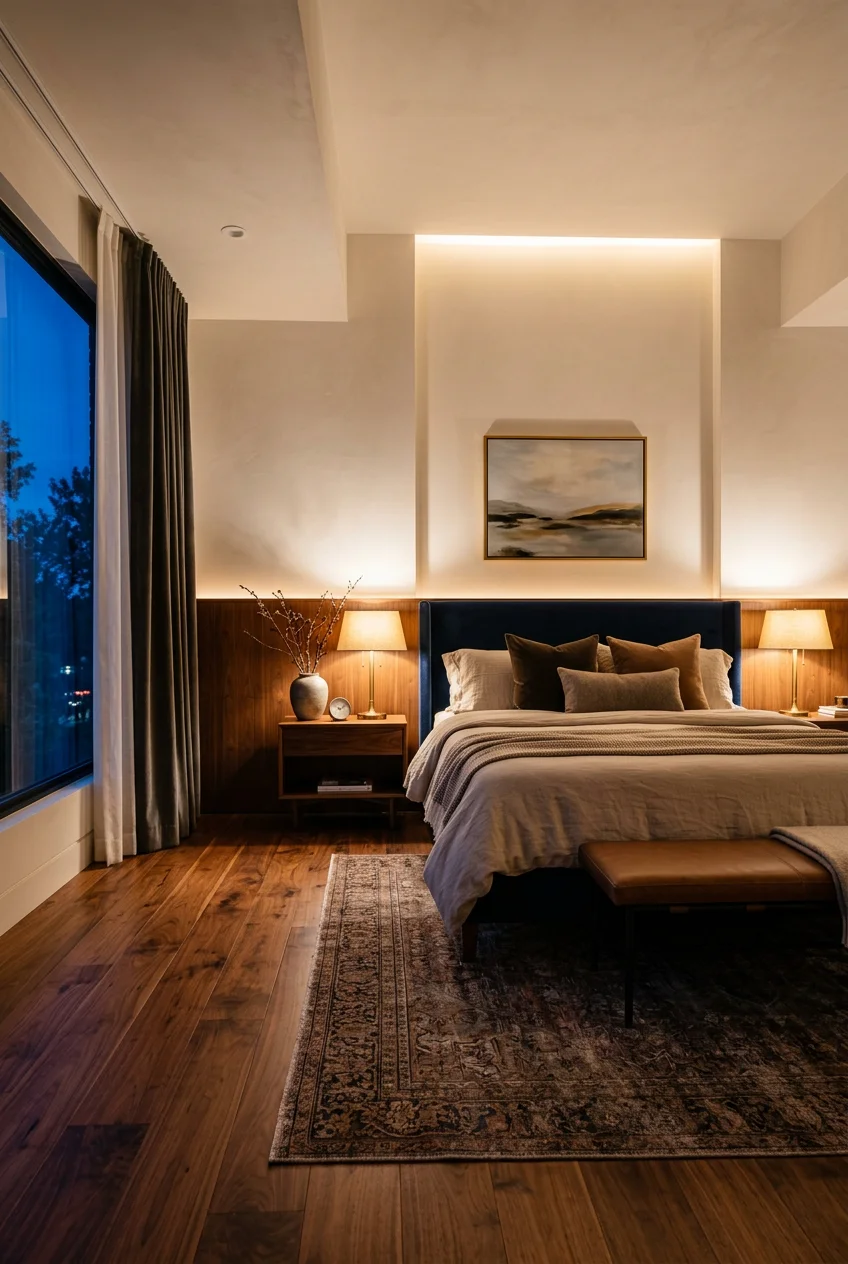
What’s Inside
- Embrace Layered Lighting for Versatility
- Prioritize Warm White Color Temperatures
- Install Dimmers on All Light Sources
- Lock In the Optimal Bedside Lamp Height
- Hang Pendant Lights Over Nightstands
- Integrate Smart Lighting Systems
- Utilize LED Strip Lighting for Accent Moods
- Aim for Appropriate Lumens Per Square Foot
- Avoid a Single Overly Bright Overhead Fixture
- Position Wall Sconces Strategically
- Deliberate Mismatches for Natural Warmth
- Incorporate Alabaster or Natural Stone Fixtures
- Consider Cordless Rechargeable Lamps
- Diffuse Lighting to Avoid Harsh Glare
- Ensure Bedside Lighting is Highly Targeted
- Utilize Floor Lamps in Dark Corners
- Install Cove Lighting for Soft Ambience
- Optimize Mirrored Vanity Lighting
Most folks flip a single overhead switch and wonder why their room feels like a dentist’s office. Poor lighting ruins even the best design. Getting bedroom light right takes a bit of strategy, not just a higher-wattage bulb. If you only try one thing from this list, make it #3. Why? Dimmers fix even the worst builder-grade fixtures.
Skip this if: You’re setting up a strictly utilitarian space, like a medical room or a dorm, where you need clinical visibility above all else. These tips focus on warmth and mood rather than sterile, maximum brightness.
1. Embrace Layered Lighting for Versatility

One ceiling fixture just washes out the room. A proper bedroom setup needs layers: ambient, task, and accent. Mix a central light with bedside lamps and maybe a floor lamp in the corner. Target has great ceramic table lamps for $30 to $50 that handle task lighting well. Pair those with cheap LED strips from IKEA (usually under $25) tucked behind your headboard for depth. You want the room to be bright enough for folding laundry but soft for winding down. Pro tip: don’t put all three layers on one switch. You might need heavy-duty extension cords hidden under the bed to make this work. Best for: rooms that double as workspaces. The catch: you need plenty of outlets, which older homes rarely have. I learned that the hard way.
2. Prioritize Warm White Color Temperatures

Color temperature sets the entire mood. Bulbs labeled 5000K to 6500K give off a harsh, blue light. That cool spectrum belongs in a warehouse, not your bedroom. Stick to the 2700K to 3000K range. GE Relax LEDs (usually under $15 for a four-pack) hit the mark. This warm white mimics candlelight and avoids the blue light that keeps you awake. Most people just grab whatever is on sale and accidentally turn their bedroom into a surgical suite. Check the Kelvin rating on the box first. Ignoring this ruins the vibe. If your walls are a cool gray, a 2700K bulb might look a bit muddy, so try a 3000K bulb instead. The catch: warm light changes how paint looks, making crisp whites appear a bit yellow at night.
3. Install Dimmers on All Light Sources

Dimmers are non-negotiable for a calm space. A Lutron Caseta Wireless Smart Dimmer gives you total control. You need bright light on dark winter mornings and a dim glow at 10 PM. Professional installation usually runs $80 to $200, plus $50 to $100 for the hardware. It’s an upfront cost that pays off every night. If you’re renting, plug-in dimmers from brands like Leviton cost about $15 and need no wiring. Just plug your lamp in and slide the switch. Dimming lights an hour before bed tells your brain it’s time to sleep. It’s a functional upgrade that helps your routine. The catch: older homes with bad wiring might need an expensive electrical panel upgrade before smart dimmers work right.

KSIPZE 100ft Led Strip Lights RGB Music Sync Color Changing
KSIPZE 100ft Led Strip Lights RGB Music Sync Color Changing Led Lights punches above its price — 394 buyers rated it 4.5 stars. The kind of pick people reorder.
4. Lock In the Optimal Bedside Lamp Height

Scale matters. The best height for bedside lamps is 24 to 30 inches. This puts the bottom of the shade at or just below eye level while you’re propped up in bed. Crate & Barrel sells heavy-based lamps in this size (usually $150 to $250). If your nightstand is 24 inches tall, a 24-inch lamp creates good balance. Anything shorter looks stunted and won’t light your book; anything taller just blasts glare into your eyes. Look for solid brass or ceramic bases so they don’t tip over. Take a tape measure to the store. Best for: traditional bedrooms with matching nightstands. The catch: tall, top-heavy lamps are easily knocked over by cats or clumsy hands. Trust me.
5. Hang Pendant Lights Over Nightstands

Pendants save space on small nightstands. Hang them 24 to 36 inches above the tabletop. This gives you light for reading without blocking your view across the room. Brands like Flos offer the stunning IC Lights S Pendant (budget $500 to $700) for a modern look. LZF also makes nice wood-veneer options that cast a warm glow. You have to measure carefully. Hang them too high, and the light disappears before it hits your book. If you like moving your bed around, this rigid layout won’t work. Best for: tiny bedrooms where every inch counts. The catch: hardwired lights mean you can’t rearrange furniture later without leaving a hole in your ceiling. You might also like: 20 Dreamy Bedroom Ideas Girl (2026) – Create Your Perfect Sanctuary
6. Integrate Smart Lighting Systems

Automation takes the friction out of your day. The Philips Hue system lets you program colors and brightness on a schedule. You can set bulbs to be bright at 7 AM and dim amber by 9 PM. A starter kit costs $100 to $130. Being able to kill every light in the house from your phone while in bed is incredibly practical. You won’t have to crawl out from the covers because you forgot the hallway light. But if the router goes down, your smart bulbs become very dumb. It’s a modern convenience with a learning curve. The catch: these systems need a stable Wi-Fi connection and a hub, which frustrates people who just want a simple switch. You might also like: 19 Bedroom Organization Ideas Worth Trying

Govee RGBIC LED Strip Lights
If you want something that just works, Govee RGBIC LED Strip Lights is a safe bet (252 reviews, 4.5 stars).
7. Utilize LED Strip Lighting for Accent Moods

LED strips provide architectural lighting without the custom price tag. Running a strip under the bed frame creates a subtle floating effect. Govee makes reliable, color-changing strips (usually under $40) that stick right to furniture. You can run them behind a headboard or along a wardrobe. It adds massive depth to a boring room. Use strips with a diffuser channel so you don’t see the individual dots. To avoid damage, I suggest using command hooks or masking tape instead of the factory adhesive. It takes ten extra minutes but saves your furniture. Best for: renters who want ambiance without drilling holes. The catch: cheap adhesive eventually ruins paint or veneer when you peel it off. You might also like: 19 Grey Bedroom Decor for Every Budget
8. Aim for Appropriate Lumens Per Square Foot

Guessing bulb wattage is a rookie mistake. For ambient light, aim for 10 to 20 lumens per square foot. A 100-square-foot room needs about 1,000 to 2,000 lumens total. For reading, a bedside lamp needs about 400 lumens. Home Depot carries bulbs clearly marked with lumen output ($10 to $20 a pack). Doing the math keeps the room from feeling like a cave or a stadium. Most people just grab a 60-watt equivalent and hope for the best. If you have dark walls, aim for the higher end of the scale because dark colors absorb light. The catch: calculating this requires measuring your room, a step most people skip because they’re lazy.
9. Avoid a Single Overly Bright Overhead Fixture

Relying on one dome light guarantees harsh shadows and a clinical feel. It’s the most common mistake in bedroom design. You need to pull light down from the ceiling and spread it around the perimeter. West Elm has beautiful flush mounts ($150 to $300) that diffuse light well, but they still need backup from lamps. Even lighting creates an inviting atmosphere. A bright overhead light highlights dust and casts bad shadows on your face. You can fix this by plugging your main lamps into smart plugs, letting you turn them on via an app or a wireless switch by the door. The catch: relying on lamps means fumbling for individual switches if they aren’t wired to a wall outlet.

Govee RGBIC LED Strip Lights, Smart LED Lights for Bedroom
If you want something that just works, Govee RGBIC LED Strip Lights is a safe bet (252 reviews, 4.5 stars).
10. Position Wall Sconces Strategically

Wall sconces add interest, but placement is everything. Mount them 60 to 66 inches from the floor to the center of the fixture. Or, measure 30 to 36 inches up from the top of your mattress. Keep them 6 to 12 inches out from the edge of the bed. CB2 sells great plug-in and hardwired sconces ($80 to $200). This spacing ensures you can reach them and the light hits your book, not your partner’s face. If you mount them too high, they act like floodlights. If you’re not ready for hardwiring, use plug-in versions with decorative cord covers. It’s a smart compromise. The catch: hardwiring means cutting into drywall, which means patching and painting if you ever get a bigger bed.
11. Deliberate Mismatches for Natural Warmth

Matching bedside lamps look classic, but mismatching feels more organic. Try different bases with the same shade color, or identical bases with varied shades. Anthropologie has quirky, sculptural bases ($150 to $350) that pair well with simpler fixtures on the other side. This breaks up the catalog-perfect rigidity and makes the room feel collected. You want it to look curated, not bought all at once from a showroom. To make it work, ensure the lamps are roughly the same height. If one is 20 inches and the other 30, the bed will look lopsided. Balance is key. The catch: pulling this off requires a good eye. Get it wrong, and the room just looks cluttered.
12. Incorporate Alabaster or Natural Stone Fixtures

Natural stone brings an organic texture that metal and glass can’t match. Alabaster gives off a soft, honeyed glow. Restoration Hardware and Arhaus carry stone sconces and lamps (usually $300 to over $800). These pieces act as art during the day and provide great warmth at night. The veining in the stone means no two pieces are the same, giving your room a custom feel. It’s a high-end look that upgrades basic furniture. If you’re mounting these above your head, don’t cut corners on hardware. Use toggle bolts, not cheap plastic anchors. Safety comes before looks with solid rock. The catch: real stone is heavy, requiring sturdy anchors and sometimes professional installation.

Leeleberd Led Lights for Bedroom 100 ft (2 Rolls of 50ft)
Leeleberd Led Lights for Bedroom 100 ft (2 Rolls of 50ft) Music Sync C has been one of the most consistently praised picks in this category. 205 reviewers averaged 4.5/5.
13. Consider Cordless Rechargeable Lamps

Cords ruin the look of a styled nightstand. Cordless rechargeable lamps solve this. Brands like Pooky and Zafferano offer heavy, well-designed portable lamps ($100 to $200) that hold a charge for 10 to 12 hours. You can put them on a shelf, a windowsill, or a nightstand without needing an outlet. They also work as emergency lights during power outages. If you forget to charge them, you’ll be left in the dark. Keep the cables in a drawer so you aren’t hunting for them. It’s a small hassle for a wire-free look. Best for: older apartments with few outlets. The catch: you have to actually remember to charge them, which adds another chore to your routine.
14. Diffuse Lighting to Avoid Harsh Glare

Exposed bulbs belong in industrial lofts, not bedrooms. Soft, indirect light is always better. Look for fixtures with fabric drum shades, vellum, or frosted glass. Wayfair has thousands of linen-shaded options ($50 to $100). These materials hide the bulb and scatter light, preventing glare when you wake up at night. A bare Edison bulb might be trendy, but staring at a filament will give you a headache. You’ll need a lint roller to clean linen shades; don’t use a damp rag, or you’ll just push dirt into the fibers. Maintenance is the hidden cost here. The catch: fabric shades attract dust like magnets and are hard to clean without leaving spots.
15. Ensure Bedside Lighting is Highly Targeted

A good reading light shouldn’t illuminate the whole room. Invest in directional fixtures. Astro Lighting makes adjustable LED reading lights ($150 to $250) with a narrow, focused beam. This lets one person read while the other sleeps in the dark. Precision matters. A wide-cast shade fails at this because the light spills everywhere. The best bedroom setups respect that people have different sleep schedules. Many hotels use this: a soft ambient sconce paired with a tiny, flexible gooseneck reading light. It’s the ultimate compromise for couples. You get task visibility without starting a fight. The catch: the narrow beam is useless for general lighting, so you still need other sources.

HOMIDEC Closet Organizers and Storage
A dependable everyday pick — HOMIDEC Closet Organizers and Storage pulls in 81 ratings at 4.5 stars. Not flashy, just solid.
16. Utilize Floor Lamps in Dark Corners

Corners trap shadows, making a room feel smaller. A slim floor lamp pushes light up the walls and makes the room feel larger. Target’s Threshold line has simple, brass-finished floor lamps ($60 to $90) that tuck behind dressers. Bouncing light off the ceiling from a corner creates a soft glow that overhead fixtures can’t touch. It fills the voids that table lamps miss. If your room is packed, tripping over a lamp base gets old fast. Look for designs with flat, low-profile bases that slide under a chair or nightstand. It’s all about placement. The catch: floor lamps with heavy bases take up floor space, which is a problem in cramped rooms.
17. Install Cove Lighting for Soft Ambience

Cove lighting directs light toward the ceiling, creating a gentle wash of light that feels luxurious. You can do this by installing crown molding a few inches below the ceiling and hiding LED strips in the gap. Lowe’s sells the trim and molding ($100 to $200 for a room). This removes the need for harsh central fixtures and makes the ceiling feel higher. If you cut the angles wrong, the corners will look bad and light will leak out. You can’t fake good carpentry, so hire a pro if you aren’t confident with tools. It’s a permanent upgrade. Best for: low ceilings, as the upward light adds height. The catch: installing molding perfectly level requires real skill.
18. Optimize Mirrored Vanity Lighting

If you get ready in your bedroom, good vanity lighting is critical. Shadows from overhead lights make makeup application a guessing game. You need light hitting your face directly. Costco often sells large mirrors with built-in LED borders ($150 to $250). Or, mount vertical sconces on either side of a mirror. This erases under-eye shadows and gives a true reflection. Don’t rely on ambient room light for color-matching foundation. Because integrated LEDs aren’t replaceable, they’re a waste of money in the long run. Traditional hardwired sconces with replaceable bulbs are the smarter, more sustainable choice. It takes more planning but pays off. The catch: integrated LED mirrors look sleek, but when the lights burn out, you often have to throw away the whole expensive unit.
How we chose these ideas: We looked at these strategies based on how renter-friendly they are, how easy they are to install, and their visual impact without needing a massive remodel. These recommendations focus on good prices and proven design principles rather than passing trends.
Getting the lighting right changes how a room feels at night. I recommend picking two or three of these strategies to layer together. I’ve included the measurements, so save this guide or pin it to your decor board so you have the numbers handy when you’re ready to start drilling or buying bulbs.
Frequently Asked Questions
What is the best color temperature for bedroom lighting?
Always aim for 2700K to 3000K, often labeled as warm white. This range mimics candlelight and promotes relaxation by limiting harsh blue light exposure before sleep. Anything above 4000K looks too clinical for a restful space.
How high should bedside wall sconces be mounted?
Mount bedside sconces 60 to 66 inches from the floor to the center of the fixture, or roughly 30 to 36 inches above the top of your mattress. This prevents glare and positions the light perfectly for reading.
How many lumens do I need for a bedroom?
Target 10 to 20 lumens per square foot for general ambient light. A standard 100-square-foot room needs about 1,000 to 2,000 lumens total. For bedside reading lamps, look for bulbs outputting around 400 lumens each.
Can I use LED strip lights in my bedroom?
Yes, LED strips are excellent for indirect accent lighting. Install them under the bed frame, behind the headboard, or along crown molding. Choose strips with a warm white setting and use a diffuser channel to hide the individual LED dots.
