What’s Inside
- Stop Guessing and Involve the Teen in the Swatch Process
- Ditch Flat Finishes for a Highly Durable Satin
- Invest in Scuff-Resistant Chemical Formulations
- Ground the Space with Warm Eucalyptus Green
- Try Universal Khaki for a Sophisticated Earth Tone
- Use Pure White as a Versatile Foundation
- Master the Bleed Seal Coat for Crisp Geometric Lines
- Use Urbane Bronze as Your Teen Boy Bedroom Paint Accent
- Test Your Paint Samples in Artificial Evening Light
- Never Skip the Heavy-Duty Surface Preparation
- Commit to the Two-Coat Minimum Rule
- Add a Functional Chalk Paint Zone
- Calculate Your Square Footage Accurately
- Upgrade to Premium Angled Brushes
- Choose Paint-and-Primer Combos for Simple Swaps
- Budget Realistically for Your Teen Boy Bedroom Paint Project
Most parents grab a gallon of flat navy blue teen boy bedroom paint, slap it on the walls, and wonder why the room looks like a dark, scuffed cave within a week. Truth is, teenage boys are tough on their rooms. Scuffs, mystery stains, and changing tastes mean standard builder-grade matte finish won’t survive the semester. You need a real plan for color and finish if you want this to last, rather than just picking a color off a tiny paper square and hoping for the best. Proper wall prep and the right chemical makeup matter just as much as the hue. If you only try one idea here, make it #7. It works: mastering the bleed seal technique for crisp lines takes a room from amateur hour to architectural, without spending an extra dime on fancy supplies. Trust me.
Skip this list if you’re outfitting a temporary dorm room or a strict rental where you can’t paint. These strategies require actual paint application, wall prep, and drying time. If your landlord forbids color changes and you’re relying on peel-and-stick wallpaper or hanging fabric, these specific paint techniques won’t help.
1. Stop Guessing and Involve the Teen in the Swatch Process

Selecting a paint color without consulting the person who sleeps there is a fast track to wasted money and arguments. A teen’s bedroom is often their only personal space, so their input is crucial for a color they’ll actually tolerate. Instead of staring at a screen, go to The Home Depot and grab three to four 8 oz sample pots. Paint large, 2-foot by 2-foot squares right on the walls. You need to see the texture drying and watch how the undertones shift as the sun moves. A gray that looks neutral under harsh hardware store lights often turns a sickly purple under bedroom bulbs. Let’s make sure the color works before buying a full gallon. The catch: teens often pick jarring, neon colors, requiring some negotiation to steer them toward a more muted, livable version. Learned that the hard way.
Best for: Homes with kids or pets who have strong opinions on their personal spaces.
2. Ditch Flat Finishes for a Highly Durable Satin

Teen rooms are high-traffic zones prone to flying sports gear, dirty shoes, and general chaos. Using a flat or eggshell finish here is a mistake because matte paints hold onto dirt and burnish—those shiny spots—the second you scrub them. Opt for a satin or semi-gloss finish. These create a harder shell that resists oils and dirt. A widely recommended option is Benjamin Moore’s Regal Select in Pearl, which works like a traditional satin. It offers a soft sheen that reflects just enough light to brighten the space while remaining easy to wipe down. Expect to pay $56 to $100 per gallon for premium lines like this. The catch: satin finishes highlight wall imperfections, meaning every bad drywall seam or patched hole will be far more visible than it would be with flat paint.
3. Invest in Scuff-Resistant Chemical Formulations

Not all interior acrylic paints are equal; cheaper brands often lack the binders needed to withstand daily abuse. If you’re painting a high-use room, investing in premium brands known for durability is the smarter move. Formulations like Sherwin-Williams Emerald or Duration Home Interior Acrylic Latex are excellent. These are engineered with specialized cross-linking polymers. Simply put, as the paint cures, the molecules bind tighter than standard paint, creating a stain-blocking barrier that makes cleaning easier. You won’t have to repaint just because a desk chair rubbed against the wall for a month. These 1-gallon cans typically run $83 to $106, though holiday sales can drop that price. The catch: these fast-drying formulas set incredibly quickly, making it harder to keep a wet edge while rolling, which can lead to visible roller marks if you’re too slow.

Acovy 30in Long Floating Shelves for Wall Set of 2
Acovy 30in Long Floating Shelves for Wall Set of 2 is sturdier in person than the photos suggest — over 8 buyers gave it 4.5 stars.
4. Ground the Space with Warm Eucalyptus Green

Trending palettes for 2026 are moving away from sterile, cool grays and into earthy schemes that evoke nature. A top contender for a teen boy’s room is a muted, organic green. Consider shades like Valspar’s “Warm Eucalyptus,” their 2026 Color of the Year. You can find Valspar at Lowe’s in the $28 to $55 per gallon range. This shade provides a grounded, sophisticated feel that’s mature without being dark. It pairs well with natural wood, leather, and matte black hardware for a rugged, clean look. The catch: earthy greens with warm undertones can look muddy in rooms that rely heavily on yellow, incandescent lighting instead of natural sunlight.
5. Try Universal Khaki for a Sophisticated Earth Tone

If green feels too specific, another major 2026 trend involves warm, sand-inspired neutrals. A color like Sherwin-Williams “Universal Khaki” offers a rich base that’s warmer than standard builder gray. Khaki and beige are making a comeback because they feel cozy. When you pair a gallon of warm khaki with crisp white baseboards and dark charcoal bedding, the contrast looks intentional and high-end. It’s a color that transitions from middle school through college, preventing the need for a total room overhaul every few years. The pigment also hides dust and scuffs better than stark white. The catch: khaki tones can feel dated and reminiscent of early 2000s homes if paired with heavy cherry wood, so use modern black or light oak accents to keep it current. You might also like: 20 Aesthetic Dark Nature Bedroom for Every Budget
6. Use Pure White as a Versatile Foundation

Sometimes the smartest choice is no color at all. For a versatile foundation that adapts to changing tastes, a warm neutral base is effective. Colors like Sherwin-Williams “Pure White” or Benjamin Moore’s “White Wisp” create a blank canvas. This lets you introduce personality through swappable elements: bedding, posters, rugs, and curtains. When a teen swaps their fixation from skateboarding to vintage cars, you aren’t stuck repainting four walls. Pure White has enough warmth to avoid looking like a hospital, but it’s crisp enough to make artwork pop. You can grab basic supplies at Target while picking up room accessories. The catch: white walls are unforgiving with fingerprints, requiring constant spot-cleaning around switches and doors. You might also like: 17 Home Decor Ideas Bedroom You Need to See
Best for: Renters who want a clean, updated look without violating lease agreements that require neutral walls.

Govee 100ft RGBIC LED Strip Lights
Govee 100ft RGBIC LED Strip Lights is sturdier in person than the photos suggest — over 7 buyers gave it 4.5 stars.
7. Master the Bleed Seal Coat for Crisp Geometric Lines

If you’re trying a two-tone wall or a geometric mural, standard painter’s tape rarely stops paint from bleeding underneath. To get a crisp line, you must use a “bleed seal” coat. First, press your 1.41-inch high-quality tape (like Frog Tape from Walmart) firmly along your guideline. Then, use a small brush to paint a thin layer of the *existing base wall color* over the edge of the tape. This layer seeps into the microscopic gaps under the tape and seals them shut. Let it dry for about an hour. Once sealed, paint your new, contrasting color over the line. When you peel the tape while the final coat is still slightly damp, you get a razor-sharp, flawless line. The catch: this doubles your waiting time since the seal coat must dry completely before you apply the contrasting color. You might also like: 19 Grey Bedroom Decor for Every Budget
Best for: Beginners attempting DIY geometric patterns or color-blocked accent walls for the first time.
8. Use Urbane Bronze as Your Teen Boy Bedroom Paint Accent

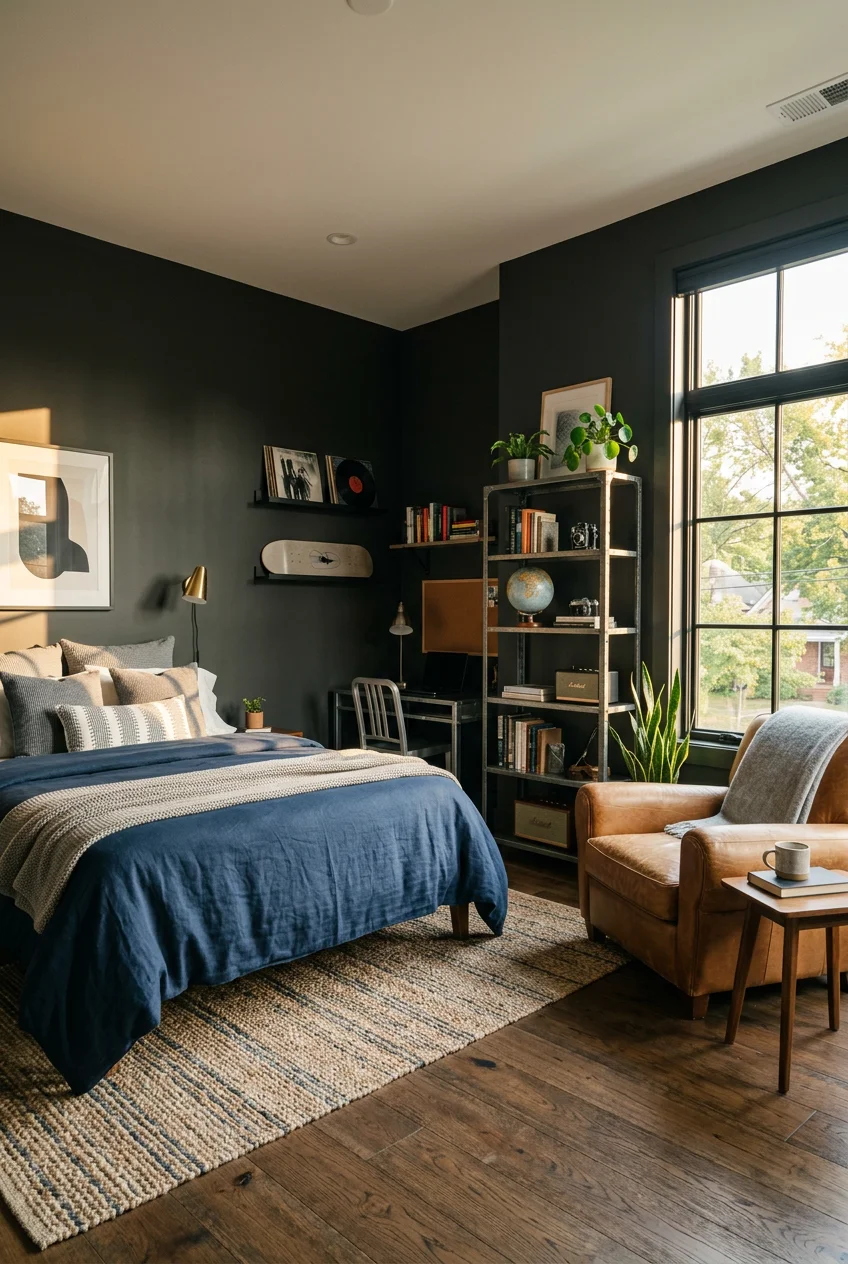
A dark accent wall is one of the most effective ways to add personality without making the room feel like a claustrophobic box. For 2026, bold yet balanced colors are winning, and Sherwin-Williams “Urbane Bronze” is a standout. It’s a complex, warm black with brown and subtle green undertones. Applying just 1 gallon behind the headboard anchors the room and creates a moody focal point. It pairs beautifully with LED strips, floating shelves, and metallic accents. Because it’s only one wall, the labor and material costs are lower than a full room repaint, making it a quick weekend project. The catch: a dark accent wall absorbs a lot of light, which can make small windows feel even smaller and require extra lamps to compensate.
9. Test Your Paint Samples in Artificial Evening Light

Too many people pick a color based on how it looks at noon on a Saturday. A common mistake is ignoring how artificial lighting changes paint pigments once the sun goes down. A blue that looks fresh in natural light might appear dull, gray, and depressing under a bedside lamp. Always test your samples under both natural and artificial light. Paint a large section and check it at 8:00 AM, 2:00 PM, and 9:00 PM with the lights on. The color temperature of your bulbs shifts how the eye perceives wall color. The catch: testing properly takes 24 to 48 hours, which derails anyone trying to rush through a spontaneous, one-day room makeover.

Tenmiro Led Lights for Bedroom 100ft (2 Rolls of 50ft)
A dependable everyday pick — Tenmiro Led Lights for Bedroom 100ft (2 Rolls of 50ft) Music Sync Colo pulls in 787 ratings at 4.5 stars. Not flashy, just solid.
10. Never Skip the Heavy-Duty Surface Preparation

Prep is the foundation of a lasting job, yet it’s the step most people rush. You can’t slap expensive paint over dusty, greasy walls and expect it to hold. Before opening a can, the walls must be cleaned to remove dust, skin oils, and debris. Mix 1/2 cup of a TSP substitute with warm water—you can find this at any Ace Hardware for under $15. Wipe down every inch of the wall, especially around door handles and light switches. After washing, sand rough spots and fill holes with spackle. Skipping this guarantees an uneven finish and paint that peels in sheets later. The catch: washing and sanding walls is exhausting, messy work that adds an entire day to your project before you touch a roller.
11. Commit to the Two-Coat Minimum Rule

Hardware store aisles are filled with cans boasting “one-coat coverage.” Let’s be clear: while some premium paints are thick, you almost always need two coats for an even, saturated finish. This is especially true for DIYers where roller pressure isn’t perfectly consistent. The first coat acts like a primer, binding to the wall. The second coat is where the true color and the intended sheen finally develop. Ensure the first coat is dry to the touch—usually 2 to 4 hours depending on humidity—before applying the second to prevent lifting the paint and creating splotchy textures. The catch: committing to two coats means buying enough paint to cover the room twice, doubling your material budget.
12. Add a Functional Chalk Paint Zone

If you want a functional, interactive element, consider a zone for chalk paint. Instead of a whole wall, tape off a rectangle over a desk or paint the panels of a wooden wardrobe. Brands like Rust-Oleum offer 30 oz cans of Chalkboard Paint that roll on smoothly and cure into a hard, writable surface. This creates a notice board for schedules, sports brackets, or creative sketches. It breaks up the monotony and gives the room an industrial, custom edge. The deep matte black also acts as a visual anchor in a lighter room. The catch: chalkboard paint creates a noticeable amount of fine, white chalk dust on the floor and baseboards once the teen starts using it.
Best for: Small dark rooms that don’t have enough floor space for standalone whiteboards or corkboards.

KSIPZE 100ft Led Strip Lights RGB Music Sync Color Changing
KSIPZE 100ft Led Strip Lights RGB Music Sync Color Changing Led Lights is sturdier in person than the photos suggest — over 394 buyers gave it 4.5 stars.
13. Calculate Your Square Footage Accurately

Running out of paint when you’re three-quarters of the way through the final wall is frustrating. Before heading to the store, understand the math. A standard gallon of interior acrylic paint covers between 350 to 400 square feet per coat. For a standard 10-foot by 10-foot bedroom with an 8-foot ceiling, you have roughly 320 square feet of wall space. Since you need two coats, you’re looking at 640 square feet of total coverage. You will generally need two 1-gallon buckets to finish properly without scraping the bottom of the tray. Use an online paint calculator to factor in large windows or closets. The catch: heavily textured walls have more surface area and absorb more paint, throwing off standard smooth-wall calculations.
14. Upgrade to Premium Angled Brushes

You can buy the most expensive paint on the market, but if you use a cheap, dollar-store brush, the room will look terrible. Low-quality brushes shed bristles into the wet paint, leave visible strokes in the corners, and result in uneven coverage. Investing in premium tools is mandatory. Grab a 2.5-inch angled Purdy brush for cutting in, and a high-quality 3/8-inch nap roller for the main walls. The 3/8-inch nap holds enough paint to cover smoothly without leaving a heavy, stippled texture. These tools are mid-range in price, but they make painting faster and less frustrating. The catch: premium brushes require meticulous cleaning with warm water and a wire comb immediately after use, or the bristles will harden and the brush will be ruined. Took me years to figure that out.
15. Choose Paint-and-Primer Combos for Simple Swaps

If you’re painting over a wall that’s already a light, neutral color, and the drywall is in good condition, you can save time by using a paint-and-primer in one. Products like Behr Marquee (at The Home Depot) or Valspar Ultra Paint & Primer offer convenience. These are thicker than standard paint and contain binding agents that help the color adhere without a separate layer of white primer. This is an efficient strategy when transitioning from light gray to warm khaki, potentially reducing labor time. Just wash the walls first. The catch: paint-and-primer combinations are heavy and thick in the tray, making them physically tiring to roll over large wall expanses compared to thinner, standard acrylics.

Govee RGBIC LED Strip Lights
If you want something that just works, Govee RGBIC LED Strip Lights is a safe bet (252 reviews, 4.5 stars).
16. Budget Realistically for Your Teen Boy Bedroom Paint Project

A “simple” paint job rarely costs what you assume. When budgeting, you have to factor in paint, prep materials, tape, and tools. Prices fluctuate by region, but expect to pay $56 to $100 per gallon for premium Benjamin Moore, and $83 to $106 for Sherwin-Williams top-tier lines. Budget-friendly options like Valspar range from $28 to $55. If you need two gallons of paint, plus $40 in tape, rollers, and drop cloths, a standard room refresh easily sits in the $150 to $250 range. Higher-quality paint offers better coverage and withstands scrubbing, saving you money by reducing how often you have to repaint. The catch: the sticker shock of buying premium paint and supplies at once often pushes what people think is a $50 project into a much larger commitment. No exaggeration.
Best for: Tight budgets where understanding the exact cost breakdown helps you know where to splurge (the paint) and where to compromise (reusing old drop cloths).
How we chose these ideas: These strategies were selected based on long-term wall durability, visual impact for 2026 trends, and realistic cost expectations. Priority was given to chemical finishes and prep techniques that withstand heavy daily use by teenagers while remaining accessible for a weekend DIY timeline.
Wrapping up a room refresh doesn’t have to be a nightmare of peeling tape and regretted color choices. I’m a firm believer that doing the tedious prep work and spending slightly more on a durable satin finish saves you from having to repaint the entire space a year later. Let’s be honest, nobody wants to move heavy teen bedroom furniture more than once. Pin this guide for your next weekend DIY project, and remember to actually wait for that first coat to dry before starting the second.
Frequently Asked Questions
What is the best finish for teen boy bedroom paint?
A satin or semi-gloss finish is highly recommended for teen bedrooms. These finishes create a slightly harder shell that resists absorbing dirt and oils, making it much easier to wipe away scuffs and marks with a damp sponge compared to flat or matte paints.
How much paint do I need for a standard bedroom?
A standard gallon of interior paint covers 350 to 400 square feet. For a typical 10×10 foot room with 8-foot ceilings, you will need exactly two gallons of paint to properly apply the recommended two coats for an even, durable finish.
What are the trending paint colors for teen boys?
Earthy, nature-inspired tones are dominating current trends. Warm eucalyptus greens, rich khakis, and moody urbane bronzes are incredibly popular. These sophisticated shades provide a grounded, mature aesthetic that transitions well as the teen grows, pairing perfectly with natural wood and dark metal accents.
Do I really need to wash the walls before painting?
Yes, thorough surface preparation is mandatory. You must wash the walls with a TSP substitute and warm water to remove dust, skin oils, and greasy fingerprints. Skipping this step prevents the new paint from adhering properly, leading to peeling and an uneven final texture.
