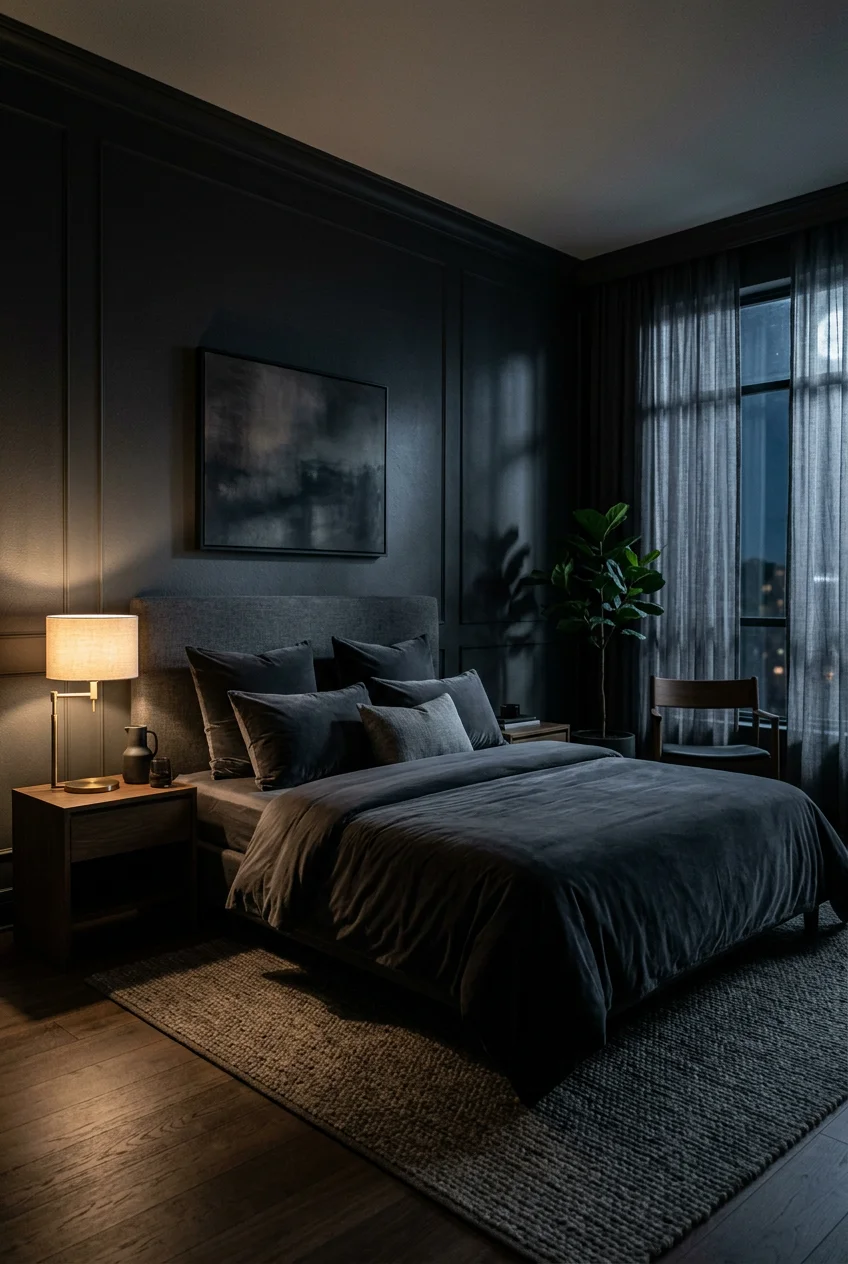
What’s Inside
- Embrace a Deep, Cocooning Color Palette
- Layer Dimmable Smart Lighting
- Introduce Celestial Projections
- Invest in Luxurious, Tactile Bedding
- Incorporate a Weighted Blanket for Deep Comfort
- Choose Curved and Sculptural Furniture
- Curate Moody Wall Art
- Strategically Dampen Sound with Textiles
- Diffuse Calming Essential Oils
- Incorporate a High-Fidelity White Noise Machine
- Celestial Accents Beyond Lighting
- Upholstered Wall Panels for Cocooning
- Ditching Bright Overhead Lighting
- Upgrading the Bedroom Door for Sound
- Low-Light, Dark Foliage Plants
- Nightstand Organization and Cord Management
- Layered Window Treatments for Complete Darkness
I tried to build a night-aesthetic bedroom last November, but the result felt more like a damp cave. I painted the walls black without testing the undertones, threw up some cheap hardware-store neon lights, and wondered why I couldn’t sleep. The truth is that a real night-aesthetic space needs deliberate layers of light, texture, and sound dampening. It’s about creating a quiet retreat for 10 PM, not just painting walls dark. I’ve shared the exact formulas I’ve used since that disaster to get it right. Let’s look at the mechanics of building a moody, restful space.
1. Embrace a Deep, Cocooning Color Palette

I painted my 12×14 foot guest room a harsh charcoal gray two years ago, and the room felt instantly smaller. The mistake was choosing a cool-toned gray with a semi-gloss finish. I learned that the hard way. For a proper night-aesthetic bedroom, you need rich, saturated hues with a matte finish. I switched to Benjamin Moore’s Hale Navy in their Aura matte finish ($98.99 per gallon). The matte finish absorbs light instead of reflecting it, creating that cocooning effect that designers love. If you’re nervous about dark walls, start with a smoky olive green or warm terracotta. The key is avoiding anything with a sheen. A dark ceiling drops the visual height, making it feel like a canopy. It’s a specific technique that requires good primer, but the result is a room that feels like nighttime even at 3 PM.
2. Layer Dimmable Smart Lighting

Most people get this wrong by relying on one overhead fixture. I lived with a harsh flush-mount ceiling light from IKEA for three years before I realized it was killing my sleep cycle. You need multiple light sources with dimming. I installed Philips Hue Play Gradient Lightstrips ($156.99 for the 65-inch version) behind my headboard, secured with the included 3M tape about two inches from the edge. They connect to an app, letting me shift from a bright amber at 7 PM to a deep, dim purple by 10 PM. I paired these with two basic $24.99 brass table lamps from Target, fitted with standard smart bulbs. You don’t need expensive fixtures if the bulbs do the heavy lifting. The gradient strip creates a halo effect on the dark paint, providing enough light to read without straining your eyes. It’s a functional setup that directly impacts how quickly I fall asleep.
3. Introduce Celestial Projections

I bought a cheap star projector off Amazon in 2021, and the motor ground so loudly I had to unplug it after ten minutes. If you want celestial projections, you have to prioritize build quality. I replaced that noisy plastic dome with the Gingko Smart Moon Lamp ($145.00). It’s a 3D-printed sphere measuring 5.5 inches across that levitates above a walnut base using magnets. The visual is striking, but more importantly, it emits a soft 2700K warm white glow without any mechanical humming. I keep mine on a floating shelf from West Elm across from the bed. If you aren’t ready for a levitating fixture, The Original Moon Lamp makes stationary versions starting around $39.99 for a 5.9-inch diameter. Just make sure you select one with a warm light setting. Cool blue light will ruin the moody atmosphere you’re trying to build.

Cologne Organizer for Men,Cologne Stand
Honestly, Cologne Organizer for Men surprised me — sturdier than it looks in the photos, and over 11 buyers gave it 4.5 stars.
4. Invest in Luxurious, Tactile Bedding

I used to buy standard cotton percale sheets and call it a day. That works for a minimalist summer setup, but a night aesthetic requires heavy, light-absorbing textures. Last October, I bought the West Elm Embroidered Washed Velvet Quilt on sale for $179.00 in the Full/Queen size. The velvet is crucial. Unlike smooth cotton, velvet catches the dim ambient light from your smart bulbs and creates deep shadows. It adds weight to the room. I layered this over a set of dark charcoal linen sheets I found at HomeGoods for $69.99. The mix of rough linen and plush velvet feels incredibly grounding. One downside is that velvet attracts pet hair like a magnet. I have to run a lint roller over the quilt every three days because my cat sleeps at the foot of the bed. Despite the maintenance, the tactile depth it adds is necessary for that cocooning atmosphere.
5. Incorporate a Weighted Blanket for Deep Comfort

A weighted blanket isn’t just a sleep aid; it’s a massive textural element that anchors the bed. I tried a cheap glass-bead weighted blanket from Walmart three years ago, and the beads pooled in the corners, making it useless. I eventually switched to the Bearaby Cotton Napper ($269.00 for the 20-pound version). It’s a chunky, hand-knit blanket made from thick organic cotton yarn, measuring 45 by 72 inches. Because the weight comes from the layered yarn rather than shifting beads, it drapes evenly. Visually, the thick loops add a rugged, complex texture that looks fantastic under dim lighting. I chose the Midnight Blue color to blend with my dark walls. The 20-pound weight provides a distinct physical pressure that genuinely helps me wind down after staring at a screen all day.
6. Choose Curved and Sculptural Furniture

Sharp angles and rigid lines create visual tension. When I started redesigning my space, I realized my harsh, rectangular metal bed frame was fighting the relaxing vibe. I sold it on Facebook Marketplace and bought a curved, fully upholstered bed frame from Wayfair for $415.99. The rounded headboard immediately softened the room. Curved and sculptural furniture is a major trend, specifically because it promotes a restful environment. I paired the bed with a small, rounded accent chair covered in dark gray boucle fabric ($189.00 at Target). The nubby texture of the boucle paired with the sweeping lines of the chair gives the corner an organic feel. You don’t need to replace all your furniture at once. Just swapping a harsh, square nightstand for a round pedestal table—like a 15-inch diameter metal drum table—can break up the rigid lines. The goal is to make the space feel like it’s wrapping around you. You might also like: 20 Creative Bedroom Wall Design You’ll Want to Bookmark

Yieach Bedside Shelf for Dorm Bed,Rv
If you want something that just works, Yieach Bedside Shelf for Dorm Bed is a safe bet (94 reviews, 4.5 stars).
7. Curate Moody Wall Art

Blank dark walls can quickly turn a cozy bedroom into a depressing box. You need art to break up the flat paint, but standard bright white matting will ruin the low-light atmosphere. I spent weeks looking for the right pieces before finding a seller on Etsy who prints dark, moody marine landscapes. I bought a 24 by 36 inch canvas print of a stormy ocean at night for $85.00. The trick is to avoid glass frames if possible. Glass reflects your smart lights and creates glare. I opted for a rolled canvas and stretched it over a wooden frame myself using a $14.99 staple gun from Home Depot. The matte canvas absorbs the ambient light perfectly. I hung this single large piece directly above the bed. If you prefer gallery walls, stick to dark academia themes with vintage star charts or deep abstract color blocks. Just ensure the frames are matte black or dark walnut rather than shiny brass or bright white. You might also like: 15 Stunning Painting Dresser Ideas You Can Try Today
8. Strategically Dampen Sound with Textiles

A room can’t feel like a sanctuary if you can hear every car driving past your house. I live on a busy street, and the road noise used to wake me up constantly. Sound dampening is a functional requirement here. I started by installing heavy, thermal-lined velvet blackout curtains from Amazon ($54.99 for a set of two 96-inch panels). The key is the installation. I mounted the curtain rod six inches above the window frame and let the fabric pool slightly on the floor. This creates a thick acoustic barrier. Next, I placed an 8 by 10 foot high-pile shag rug ($210.00 from Rugs USA) underneath my queen bed. It extends about three feet on either side and at the foot of the bed. Hardwood floors bounce sound, creating an echo. The thick curtains and the massive rug absorb those waves. The room physically sounds quieter the moment you walk through the door. You might also like: 15 Brilliant Small Bedroom Inspiration That Changed Everything
9. Diffuse Calming Essential Oils

Scent is the most overlooked element of bedroom design. I used to burn cheap vanilla candles until the synthetic soot started staining my ceiling. Now, I strictly use an ultrasonic essential oil diffuser. I bought the Vitruvi Stone Diffuser in black for $123.00. It’s a heavy, matte ceramic cylinder that looks like pottery rather than a plastic appliance. It holds 90ml of water and runs for about four hours on the continuous setting. For the actual oils, I rely on a specific blend to trigger my brain that it’s time to sleep. I use exactly 3 drops of doTERRA Balance and 3 drops of doTERRA Serenity. The Balance blend has spruce and frankincense, which gives the room a deep, grounding woodsy scent. The Serenity adds a sharp hit of lavender. I fill the diffuser with room-temperature tap water and turn it on 30 minutes before I plan to get into bed.

50×70 Inch Rust Throw Blanket – Soft & Fluffy Fleece
Honestly, 50×70 Inch Rust Throw Blanket – Soft & Fluffy Fleece surprised me — sturdier than it looks in the photos, and over 11 buyers gave it 4.5 stars.
10. Incorporate a High-Fidelity White Noise Machine

I tried using a white noise app on my phone for a year. The speaker quality was terrible, and receiving a late-night text notification would blast through the rain sounds and wake me up in a panic. You need a dedicated, high-fidelity machine. I purchased the Yogasleep Dohm Nova for $64.99 at Bed Bath & Beyond before they closed my local store. Unlike digital tracks that loop, the Dohm Nova uses an actual internal fan to generate mechanical white noise. You twist the outer plastic shell to adjust the tone and volume of the rushing air. It sits on my nightstand and completely masks the sound of my neighbor’s barking dog. If you prefer digital pink or brown noise, the LectroFan Evo ($59.95 on Amazon) is a solid alternative with precise volume control. I keep my Dohm Nova running at a medium-low volume every single night. The steady, analog hum is a critical layer in making the bedroom feel isolated from the rest of the noisy house.
11. Celestial Accents Beyond Lighting

It’s easy to go overboard and end up with a room that looks like a toddler’s space camp. I made this mistake by buying a massive, cheap tapestry of the solar system and tacking it to the ceiling. It looked terrible and gathered dust immediately. The right way to integrate celestial motifs into a night-aesthetic bedroom is through subtle, high-quality accents. I found a set of dark navy pillowcases with a delicate, silver-embroidered constellation pattern at Anthropologie for $48.00. You can also incorporate small metallic accents, like a heavy brass moon phase wall hanging. I bought a hammered brass garland measuring 36 inches long from a local boutique for $35.00 and draped it over a dark wooden mirror frame. These small metallic details catch the dim light from the smart bulbs, adding a hint of magic without looking juvenile or cheap.
12. Upholstered Wall Panels for Cocooning

I always hated the hollow sound my bedroom had, even with the heavy curtains and rug. Designer Zoë Feldman noted that the cocoon bedroom is a major upcoming trend, heavily relying on padded and upholstered elements. I decided to try upholstered wall panels instead of a traditional headboard. I ordered a set of 12 Vant Upholstered Wall Panels in a dark charcoal velvet ($219.00 for a box of four panels, measuring 39 by 11.5 inches each). The installation took me about three hours on a Saturday afternoon. You screw the track system directly into the drywall, and the padded panels snap onto the tracks. I ran them horizontally from the floor up to about five feet high behind my bed. The change was immediate. Not only does the velvet wall look incredibly luxurious under dim lighting, but the dense foam backing significantly deadens the sound. It feels like leaning against a quiet, padded bunker. It’s a commitment, but it completely alters the architecture of the space.

Wood Phone Docking Station for Men
Wood Phone Docking Station for Men – 360° Rotating Nightstand Organize punches above its price — 29 buyers rated it 4.5 stars. I would buy it again.
13. Ditching Bright Overhead Lighting

The fastest way to ruin a moody atmosphere is flipping on a standard 60-watt daylight bulb. I used to have a ceiling fan with three exposed glass shades, and turning it on felt like being interrogated. A massive mistake people make is trying to build a night-aesthetic bedroom while keeping their harsh overhead lighting intact. I completely disabled the light kit on my ceiling fan. Now, I only use ambient and task lighting. You must check the color temperature of every bulb you buy. You’re looking strictly for bulbs in the 2700K to 3000K range. Anything higher than 3000K starts looking blue and clinical. I bought a 4-pack of GE Relax LED dimmable bulbs (2700K, 800 lumens) from Lowe’s for $13.98. I put them in my floor lamp and my closet light. When you eliminate overhead glare and rely on warm, lower-level lighting, the shadows in the room stretch out and soften. It forces your eyes to relax long before you actually get into bed.
14. Upgrading the Bedroom Door for Sound

I spent hundreds of dollars on thick curtains and rugs, only to realize I could still hear my roommate watching TV in the living room perfectly. The culprit was my bedroom door. Most modern builder-grade homes use hollow-core interior doors, which are basically just two thin sheets of veneer over cardboard honeycombs. They block zero sound. I went to a local architectural salvage yard and bought a heavy, solid wood vintage door for $120.00. It took me a full weekend to sand it down, paint it matte black to match my room, and chisel out the hinge mortises to fit my existing door frame. I also added a silicone door sweep ($11.99 from Amazon) to the bottom edge to seal the gap over the floor. The difference is staggering. A solid timber door acts as a massive acoustic block. When I close that heavy door at night, the click of the latch genuinely seals the room off from the rest of the house.
15. Low-Light, Dark Foliage Plants

I killed three expensive Fiddle Leaf Figs before accepting that my dark, heavily curtained bedroom is a terrible environment for most houseplants. But a room without any organic life feels stagnant. The solution is strictly utilizing low-light plants with dark foliage. I bought a large ZZ Plant (Zamioculcas zamiifolia) in a 10-inch nursery pot from a local nursery for $45.00. ZZ plants thrive in near-darkness and only need water once a month. Their deep green, glossy leaves look incredible against dark walls. I also picked up a Snake Plant (Sansevieria) from Trader Joe’s for $12.99 and placed it on my dresser. To keep the aesthetic cohesive, I repotted both plants into matte black ceramic planters I found at CB2 ($39.95 each). Avoid cheap plastic pots or bright terracotta, as they distract from the moody vibe. The dark foliage blends into the shadows while still providing a subtle, living texture to the corners of the room.

HOSROOME Glasses Holder for Nightstand Boho Decor Eyeglass
HOSROOME Glasses Holder for Nightstand Boho Decor Eyeglass Holder Stan punches above its price — 866 buyers rated it 4.5 stars. I would buy it again.
16. Nightstand Organization and Cord Management

You can have the most beautiful velvet quilt and smart lighting in the world, but if your nightstand is covered in a tangled mess of white charging cables, the aesthetic is ruined. I struggled with this for months. I had my phone charger, smartwatch cord, and lamp cord dragging across my dark wood nightstand. It looked messy and caused me low-level anxiety every time I looked at it. I finally bought a pack of OHill black silicone cable clips from Amazon for $6.99. I stuck them to the back edge of my nightstand, hiding them completely from view. I also swapped my glaring white charging cables for a sleek, matte black Anker braided nylon USB-C cable ($14.99). I routed all the cords down the back leg of the table and secured them with tiny black zip ties. Now, only the very tip of the charger rests on the nightstand. Keeping the visual clutter strictly managed is mandatory for a space meant to induce calm.
17. Layered Window Treatments for Complete Darkness

While I already mentioned heavy velvet drapes for sound dampening, you actually need a two-part system to achieve total blackout conditions. I noticed that even with my thick curtains, a harsh sliver of morning sunlight would bleed through the top and sides of the window frame, hitting me right in the eye at 6 AM. I fixed this by layering. First, I installed a custom-cut dark espresso bamboo roman shade from SelectBlinds ($85.00 for a 34 by 60 inch window) inside the window frame. This blocks the direct glare and adds a beautiful, rigid wood texture to the room. Then, I pull the heavy velvet drapes shut over the entire assembly. The bamboo shade handles the direct light, and the velvet drapes catch the light bleed around the edges. This layered approach is standard practice in high-end hotels for a reason. It guarantees a pitch-black room at any hour of the day.
Building a proper night-aesthetic bedroom isn’t about slapping up dark paint and buying a string of fairy lights. It’s a deliberate process of layering heavy textures, managing light temperatures, and physically blocking out the noise of the rest of your house. I’ve spent three years refining my own space, and the payoff is a room that actively forces my brain to shut down and rest. Trust me on this. If you’re starting this process, tackle your lighting and window treatments first before buying any expensive decor. Pin this guide for later when you’re standing in the paint aisle trying to choose between ten different shades of charcoal.
Frequently Asked Questions
What colors work best for a night aesthetic bedroom?
Deep, saturated hues with a matte finish work best. Look for dark navy, charcoal, smoky olive green, or warm terracotta. The matte finish is crucial because it absorbs light rather than reflecting it, creating a cozy, cocooning effect.
How do I light a dark bedroom without ruining the vibe?
Avoid single, bright overhead fixtures. Instead, layer dimmable smart lighting using LED strips behind furniture and table lamps. Always choose warm color temperatures between 2700K and 3000K to keep the space relaxing.
What textures should I use in a moody bedroom?
Focus on heavy, light-absorbing materials. Washed velvet quilts, chunky knit weighted blankets, dark linen sheets, and boucle accent chairs add physical depth and comfort while absorbing ambient sound in the room.
How can I make my bedroom quieter at night?
Install heavy thermal-lined velvet curtains that extend beyond the window frame, place a thick high-pile rug under the bed, and consider upgrading to a solid timber interior door to physically block noise from the rest of the house.
